

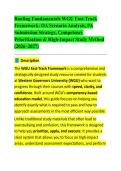
Roofing Fundamentals WGU Fast-Track
Framework: OA Scenario Analysis, PA
Submission Strategy, Competency
Prioritization & High-Impact Study Method
(2026–2027)
Description
The WGU Fast-Track Framework is a comprehensive and
strategically designed study resource created for students
at Western Governors University (WGU) who want to
progress through their courses with speed, clarity, and
confidence. Built around WGU’s competency-based
education model, this guide focuses on helping you
identify exactly what is required to pass and how to
approach assessments in the most efficient way possible.
Unlike traditional study materials that often lead to
overstudying and confusion, this framework is designed
to help you prioritize, apply, and execute. It provides a
clear system that allows you to focus on high-impact
areas, understand assessment expectations, and perform
,effectively in both Objective Assessments (OA) and
Performance Assessments (PA).
1. What is the primary purpose of a roofing system?
A. Decoration
B. Structural support
C. Weather protection
D. Ventilation
2. The topmost layer of a roof is called:
A. Deck
B. Underlayment
C. Covering
D. Flashing
3. Roof decking is also known as:
A. Rafters
B. Sheathing
C. Trusses
D. Fascia
4. Which component supports the roof covering?
A. Flashing
B. Decking
C. Gutter
D. Ridge
5. A sloped roof is designed primarily to:
A. Increase cost
B. Improve aesthetics
C. Shed water efficiently
D. Reduce insulation
6. The intersection of two roof slopes forming an external angle is called:
A. Valley
B. Ridge
, C. Hip
D. Eave
7. The lowest edge of a roof is called:
A. Ridge
B. Valley
C. Eave
D. Hip
8. The horizontal board at the roof edge is:
A. Fascia
B. Soffit
C. Deck
D. Ridge
9. The underside of the eave is known as:
A. Fascia
B. Soffit
C. Flashing
D. Deck
10. What is the peak of a roof called?
A. Hip
B. Ridge
C. Valley
D. Eave
11. A valley is formed where:
A. Two ridges meet
B. Two slopes meet internally
C. Roof meets wall
D. Gutters join
12. Roof pitch is defined as:
A. Height only
B. Width only
C. Rise over run
D. Area
Framework: OA Scenario Analysis, PA
Submission Strategy, Competency
Prioritization & High-Impact Study Method
(2026–2027)
Description
The WGU Fast-Track Framework is a comprehensive and
strategically designed study resource created for students
at Western Governors University (WGU) who want to
progress through their courses with speed, clarity, and
confidence. Built around WGU’s competency-based
education model, this guide focuses on helping you
identify exactly what is required to pass and how to
approach assessments in the most efficient way possible.
Unlike traditional study materials that often lead to
overstudying and confusion, this framework is designed
to help you prioritize, apply, and execute. It provides a
clear system that allows you to focus on high-impact
areas, understand assessment expectations, and perform
,effectively in both Objective Assessments (OA) and
Performance Assessments (PA).
1. What is the primary purpose of a roofing system?
A. Decoration
B. Structural support
C. Weather protection
D. Ventilation
2. The topmost layer of a roof is called:
A. Deck
B. Underlayment
C. Covering
D. Flashing
3. Roof decking is also known as:
A. Rafters
B. Sheathing
C. Trusses
D. Fascia
4. Which component supports the roof covering?
A. Flashing
B. Decking
C. Gutter
D. Ridge
5. A sloped roof is designed primarily to:
A. Increase cost
B. Improve aesthetics
C. Shed water efficiently
D. Reduce insulation
6. The intersection of two roof slopes forming an external angle is called:
A. Valley
B. Ridge
, C. Hip
D. Eave
7. The lowest edge of a roof is called:
A. Ridge
B. Valley
C. Eave
D. Hip
8. The horizontal board at the roof edge is:
A. Fascia
B. Soffit
C. Deck
D. Ridge
9. The underside of the eave is known as:
A. Fascia
B. Soffit
C. Flashing
D. Deck
10. What is the peak of a roof called?
A. Hip
B. Ridge
C. Valley
D. Eave
11. A valley is formed where:
A. Two ridges meet
B. Two slopes meet internally
C. Roof meets wall
D. Gutters join
12. Roof pitch is defined as:
A. Height only
B. Width only
C. Rise over run
D. Area


