

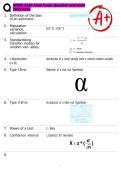
APMA 3120 Final Exam Question and answers 100%correct
2025/2026
1. Definition of the bias
of an estimator
2. Population
variance, E(X^2) - E(X)^2
calculation
3. Standardizing
transfor- mation for
random vari- ables:
4. t distribution distribution of a small sample from a normal random variable
(n<30)
5. Type I Error Rejection of a true null hypothesis
6. Type II Error Acceptance of a false null hypothesis
7. Power of a test 1 - Beta
8. Confidence interval z_(alpha/2) for two-sided
9.
1/
7
, APMA 3120 Final Exam Question and answers 100%correct
2025/2026
Relationship betweenLet's say that you "reject if sample mean is > z". Find the p-value associ-
alpha, acceptance
re- gion, beta, and ated with being greater than or equal to z. That's your alpha.
power
10. Test for population
mean, with known
σ
11. Test for population
mean, σ unknown, n < 40, use test statistic t with n-1 degrees of freedom
small sample:
12. Tests for population
proportion, large
sam- ple: np >= 10, n(1-p) >= 10
13. Tests for population
proportion, small
sam- ple:
Use binomial
14. Tests for
population
variance:
Chi-squared test: use test stat to find a p-value given a null
15. Two-population test hypothesis σ^2 = s^2
for means with normal
pop-
2/
7
2025/2026
1. Definition of the bias
of an estimator
2. Population
variance, E(X^2) - E(X)^2
calculation
3. Standardizing
transfor- mation for
random vari- ables:
4. t distribution distribution of a small sample from a normal random variable
(n<30)
5. Type I Error Rejection of a true null hypothesis
6. Type II Error Acceptance of a false null hypothesis
7. Power of a test 1 - Beta
8. Confidence interval z_(alpha/2) for two-sided
9.
1/
7
, APMA 3120 Final Exam Question and answers 100%correct
2025/2026
Relationship betweenLet's say that you "reject if sample mean is > z". Find the p-value associ-
alpha, acceptance
re- gion, beta, and ated with being greater than or equal to z. That's your alpha.
power
10. Test for population
mean, with known
σ
11. Test for population
mean, σ unknown, n < 40, use test statistic t with n-1 degrees of freedom
small sample:
12. Tests for population
proportion, large
sam- ple: np >= 10, n(1-p) >= 10
13. Tests for population
proportion, small
sam- ple:
Use binomial
14. Tests for
population
variance:
Chi-squared test: use test stat to find a p-value given a null
15. Two-population test hypothesis σ^2 = s^2
for means with normal
pop-
2/
7


