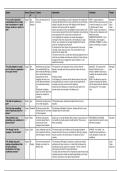
Quotes Source Charact Context Explanation Technique Themes
er
‘’It is a truth universally Chapte Mrs This is the opening line of Austen is satirising Regency society’s obsession with wealth and IRONY - Austen presents a Marriage +
acknowledged, that a single r1 Bennet, the book marriage (Mrs Benett has this view), setting the tone of the book, statement that sounds serious but Love,
man in possession of a good Narrator setting up the plot (the arrival of Mr Bingley and Mrs Bennet’s is meant humorously. its a ‘truth’ Social
fortune, must be in want of a obsession with marrying off her daughters) for families want to amrry Class +
wife” Austen uses satire and irony to highlight how the universal ‘truth’ SATIRE - Austen uses humour to behaviour
can accurately represent the inherent materialism and underlying criticise society’s obesession with
social pressures of her society than an absolute truth wealth and status
It also highlights the importance of socially advantageous OMNISCIENT NARRATOR - this is
marriage for both men and women as the emphasis on ‘good Mrs Bennet’s inner thoughts
fortune’ as a motivation for marriage highlights the financial AUTHORIAL COMMENT - as this is
nature of marriages during that time Austen commenting on society’s
It introduces the main theme of the social world of the novel: values
marriage, money and social class. This would make this very
relevant to the readers then
This sets a tone of wit an social satire (mocking people who try to
climb the social ladder and those who maintain it) that continues
throughout the novel, engages the readers attention + also
wealth and marriage
“You take delight in vexing Chapte Mrs Mrs Bennet has just heard This shows the comic domestic tension and hints that the DIALOGUE - This captures Mrs Marriage +
me. You have no compassion r1 Bennet that netherfield Park has Bennet’s marriage lacks harmony and also reveals the social Bennet’s distinctive voice → Love
on my poor nerves” been rented by Mr Bingley. attitudes emotion, repetitive and anxious,
She is excited and anxious, revealing her personality without
hoping that one of her Historical context: narration
daughters will marry him In the Regency Era, women like Mrs Bennet had very few rights IRONY - Mrs Bennet accuses her
but Mr Bennet pretends to and opportunities so a woman’s future security depended on husband of enjoying her distress
be uninterested, teasing marriage (since they could not inherit property) but the reader knows Mr. Bennet is
her Austen uses their behaviour to critise the social system that only teasing her → this creates
Mrs Bennet complaints pushes women into marriage in the Regency era irony
about her nerves which she
balmes her husband for
upsetting
“Not half so handsome as Chapte Jane Mrs Bennet compares Jane This introduces Jane, showing the readers that she is very
Jane” r1 to her other daughters beautiful
"But Lizzy has something Chapte Elizabeth Mr Bennet counters Mrs This introduces Elizabeth’s character, showing that she is more
more of quickness than her r1 Bennet about her comment intelligent than her other sisters
sisters” of their daughters
"Mary wished to say Chapte Mary Mr Bennet sarcastically Austen uses a contrast between Mary’s desire to sound wise and FREE INDIRECT DISCOURSE - Education
something very sensible, but r2 comments about Mary to her inability to actually express herself sensibly. This sums up Austen blends the narrator’s voice
knew not how” show that she is less Mary’s personality with Mary’s thoughts
intelligent than Elizabeth
“For though I am the Chapte Lydia Lydia confidently syas that This shows Lydia’s self confidence as the youngest daughter HUMOUR - the ‘tallest’ is an
youngest, I’m the tallest” r2 she is suitable for dancing because she thinks she is just as suitable for dancing by arguing insignificant accomplishment →
with Mr Bingley in the ball that she is taller an her other sisters, this shows her lack of comic deception of Lydia’s self
maturity confidence
“Mr. Bingley was good Chapte Mr The narrator describes Mr This introduces Mr Bingley’s character as a polite and cheerful Social
looking and gentleman like; r3 Bingley Bingley as he enters the gentleman with open manners → it shows that he behaves the Class +
he had a pleasant Meryton ball way Meryton society wants him to behave → he fits in with the behaviour
countenance, and easy, social group and meet the social expectations
unaffected manners” This also shows the theme of first impressions (what the book was
originally going to be called) as people judge Bingley by his open
manners, assuming he must also be good-hearted
,“She is the most beautiful Chapte Mr Mr Bingley states his This introduces the relationship between Jane + Bingley and also DIALOGUE - Mr Darcy and Bingley Pride
creature I ever beheld!” - r3 Bingley, admiration for Jane to the potential conflict between Elizabeth and Darcy are having a conversation,
Bingley Mr Darcy Darcy and Darcy insults This also shows their contrast in character as Bingley is Austen’s use of direct speech
“She is tolerable; but not Elizabeth welcoming whereas Darcy is cold and arrogant → shows his pride makes their personalities from
handsome enough to tempt vivid
me” - Darcy
"Their behaviour at the Chapte Miss This shows the Bingley’s This shows that Bingley’s sister’ behaviour is calculated, it is IRONY - the irony lies in the fact Pride
assembly had not been r4 Bingley sisters’ behaviour at the deliberate and performed - they’re trying to act in a socially that their behaviour was meant to
calculated to please in Merton assembly, it shows refined way that befits their class impress (’calculated to please’) but
general” their pride and Ironically, their attempt to appear superior makes them it had the opposite effect. →
condescending behaviour unpleasant to others →this shows Austen’s critique of upper-class Austen mocks social hypocrisy
pretension (those obsessed with manners
’calculated’ suggests something deliberate and artificial rather often fail to display true politeness)
than natural or sincere → highlights the sister’ pretentiousness, THIRD PERSON OMNISCIENT
contrasts with Mr Bingley NARRATOR - this is from the
society’s or Elizabeth’s point of
view
“His character was decided. Chapte Elizabeth Elizabeth overhears Darcy This establishes the tension between Elizabeth and Darcy FREE INDIRECT DISCOURSE - the Prejudice,
He was the proudest, most r3 , Mr say to Bingley that she isn’t This also shows how society quickly judges based on initial narrator conveys society’s Pride
disagreeable man in the Darcy pretty enough for him to encounters, highlighting the theme of first impressions collective opinion, → this allows the
world and everybody hoped ask her to dance, so he’ll readers to see the irony - Darcy is
that he would never come prefer to ask no one. misjudged based on manners,
there again” Elizabeth is making a hinting at Austen’s theme that first
judgement of Mr Darcy’s impressions can be misleading
character here
“All the world are good and Chapte Jane Elizabeth is teasing Jane for This line reflects the contrast between Elizabeth’s critical, witty CONTRAST
agreeable in your eyes. I r4 her gentle, optimistic personality it’s and Jane’s forgiving idealistic disposition (Elizabeth
never heard you speak ill of a nature as she tends to see is quick to judgement whereas Jane isn’t as judgemental)→ there
human being in your life” the good in everyone, even is a degree of foreshowing of her belief in Caroline Bingley being
if it leads her to be her friend + also her belief in Mr Wickham →Austen uses this to
vulnerable explore the dangers of idealism and misjudgment
“He was at the same time Chapte Mr Darcy This was a description of Mr This summaries the contrast between Darcy’s status and his TRICOLON - the list of 3 adjectives Prejudice,
haughty, reserved and r4 Darcy after the Merton manners → despite being ‘well bred’, he lacks warmth and social build a precise image of Darcy’s Pride,
fastidious, his manners, assembly, he is admired for grace. This caused him to be judged harshly by the locals - personality → reinforces his proud Social
though well bred, were not his fortune and looks but showing how first impressions can mislead nature, and the rhythm Class +
inviting” his cold and superior emphasises the weight of these behaviour
behaviour ruins his traits
reputations among the CONTRAST - ‘his manners, though
locals well bred, were not inviting’ → this
contrasts outward refinement with
inner coldness. Highlighting the
difference between appearance
and character
THRID PERSON OMNISCENT
NARRATOR
“I could easily forgive his Chapte Elizabeth Elizabeth is taking to Austen uses this line to expose Elizabeth’s own pride - she mocks IRONY - Elizabeth criticises Darcy’s Prejudice,
pride, if I had not mortified r5 Charlotte Lucas and Darcy for his insults, calling him arrogant and self important, but pride, yet her words reveal her Pride
mine”` reflecting on Mr. Darcy’s it shows her pride too as this shows that she admits her pride too own wounded pride
insult at the Mertyon ball → this moment sets up the central irony of the novel, that both Parallelism, Balance - the structure
Elizabeth and Darcy must overcome their pride and prejudice of the line balances ‘his pride’
before they can understand and love each other against ‘my pride’ → which is a
rhetorical symmetry → emphasises
the mutual flaws in both characters
, WIT - shows Elizabeth’s emotional
vulnerability as Elizabeth uses
humour to disguise hurt feelings →
showing her intelligence. She is
ready to admit that Darcy
wounded her pride with his
comment about her not being
‘handsome enough’ to tempt him
“Happiness in marriage is Chapte Charlotte This exposes Charlotte’s This shows the contrast between Elizabeth’s and Charlotte’s view IRONY - Austen uses irony of Marriage +
entirely a matter of chance” r6 Lucas view on love and marriage on marriage. Charlotte argues that marriage isn’t about love, but Charlotte’s ‘sensible’ view exposes Love,
(and also the society’s about security and practicality, and that happiness depends on how society forces women into Social
view) luck loveless marriages and the Class +
system’s unfairness behaviour
FORESHADOWING - this
foreshadows Charlotte’s marriage
to Mr. Collins, where she gains
financial security but not emotional
fulfilment → this explores the trade
off between comfort and happiness
and women’s choice
“Jane should therefore make Chapte Charlotte Charlotte and Elizabeth are The quote suggests a strategic and calculated approach to IRONY - Austen presents Marriage +
the most of every half hour in r 6 Lucas discussing Jane and marriage, emphasising the importance of making the most of Charlotte’s logic seriously, but the Love
which she can command his Bingley’s relationship. every opportunity to capture a man’s attention idea that love can come after
attention. When she is secure Charlotte believes that Jane ’every half hour’ suggests that women have limited time to marriage is ironic - it reverses the
of him, there will be leisure must secure mr Bingley’s capture a man’s attention → adds a sense of urgency and turns a romantic ideal → the irony exposes
for falling in love as much as attention and subsequently courtship into a tactical opportunity. Charlotte sees Mr Bingley’s the social system’s moral
she chuses” his affection, rather than time and attention as a valuable resources that Jane should use to weakness: women are forced to
being concerned with her her advantage treat marriage as a business deal
own feeling of love ’secure of him’ underlines the importance of marriage to women’s Pragmatic, calculated TONE -
future security as it turns love into a goal of possession (as if phrases like ‘make the most of
Bingley were an achievement or prize to win)→ this reflects the every half hour’ → sounds very
pressure that women were under at that time and how a woman’s calculated and not true to the
success and prosperity were intrinsically connected to her martial heart (which is what romance
choices should ideally be)
Charlotte’s advice highlights the tension between realism and CONTRAST - charlotte values
idealism in the novel → it reflects a pragmatic and practical view practical advantage, while
of marriage whereas Elizabeth represents a more idealistic and Elizabeth values emotional truth →
romantic perspective on marriage Austen uses their dialogue to
explore the tension between
realism and idealism in love and
marriage
“from all that I can collect by Chapte Kitty, This moment occurs after Mr Bennet is sarcastically criticising his younger daughters for IRONY - Mr Bennet is right that his Education,
your manners of talking, you r7 Lydia, Mr Kitty and Lydia spend the being shallow and foolish → highlighting his wit and daughter are ‘silly’ but the irony is Gender
must be two of silliest girl in Bennet day gossiping about the irresponsibility as a father as he didn’t care about his daughter’s that he contributes to their silliness Roles
the country” officers stationed in education after his first 2 by mocking them instead of
Meryton → they are teaching them → this is a subtle
childish, obsessed with men social criticism as his laziness and
and fashion rather than detachment are contributing to his
intelligence or manners, Mr daughter’s foolishness
Bennet makes this
comment mockingly
“All this she must possess … Chapte Elizabeth Elizabeth is staying at Mr Darcy lists qualities that he feels woman must possess, IRONY - Darcy praises intellect and Gender
and to all this she must yet r8 , Mr Netherfield to take care of including specific expectations for an ideal partner: This reflects depth, yet at this point, he still Roles
add something more Darcy her sister, Jane, who has the societal norms of the time, where women were often judged misjudges Elizabeth because of her
, substantial, in the been taken ill. It is the based on a set of prescribed qualities lower class - a subtle irony that
improvement of her mind by evening and she is sitting Mr Darcy emphasises that a woman must possess ‘all this’, highlights his own social prejudice
extensive reading” with Mr Bingley, his family suggesting an emphasis on a woman having skills and abilities CONTRAST - Darcy’s comment
and Mr Darcy beyond appearance → it reflects his desire for depth and shows genuine belief in mental
A conversation begins substance in partner + the societal expectations placed on cultivation, whereas Miss Bingley
about accomplished women women to possess a range of qualities, including physics only imitates refinement → Austen
and Darcy feels that the attractiveness and intellectual strength + implies that a woman’s contrasts real intellect (Darcy and
phrases ‘accomplished’ is worth is measured by ability to meet these expectations Elizabeth) with performative
over used, leading to a → the quote contributes to the novel’s critique of gender roles by intellect (Miss Bingley)
heated debate with highlighting the wide ranging expectations of women at that time
Elizabeth Austen shows Mr Darcy expectations of a partner are high
(including social status), therefore falling in love with Elizabeth
makes him abandon his critera for love
“People themselves alter so Chapte Elizabeth Darcy criticises the Austen shows how Elizabeth’s outlook contrasts with Darcy’s FORESHADOWING - this idea of Social
much, that there is r9 monotony of country life, pessimism change is central to the novel - Class +
something new to observed suggesting it offers little Elizabeth emphatically offers his opinion that people should not Darcy and Elizabeth both undergo behaviour
in them for ever” variety for observation but be harshly judged → the word, ‘alter’, ‘new’ illustrates her significant personal
Elizabeth counters by magnanimous attitude + her tolerance for others conveys transformations
asserting that people Austen’s challenge to pride and prejudice and foreshadows IRONY - Elizabeth’s comment is
themselves are constantly Elizabeth’s later attitudes ironic because Darcy himself will
changing, making them This thoughts sows Elizabeth’s intellectual growth, emotional undergo a change
interesting insight, and moral development DIALOGUE - the quote is part of a
This also connects to the novel’s larger theme of overcoming witty exchange that reveals
pride and prejudice and both Elizabeth and Darcy grow and character dynamics and sets up
change tension between Elizabeth and
Darcy
Reflective + Philosophical TONE -
the tone is thoughtful and
observant, showing Elizabeth’s
wisdom
“It is a pity they are not Chapte Mrs Mrs. Bennet says this while Austen uses this line to satirise Mrs. Bennet’s shallow IRONY - mrs Bennet calls Charlotte Marriage +
handsome, not that I think r9 Bennet discussing the preoccupations and the society that encourages them → she ‘not very plain’ but this is faint Love,
Charlotte so very plain - but attractiveness of potential praises Charlotte only because she is ‘particular friend’, praise - the compliment is Prejudice,
then she is our particular marriage partners and highlighting her self-interest and superficial values secondary to social politeness → Pride
friend” family connections → The society of the Regency era values beauty, connections and Austen uses verbal irony to show
showing her obsession with social propriety over intellect or morality. By highlighting Mrs. how Mrs. Bennet’s values are
marriage prospects → Mrs Bennet’s behaviour, Austen critiques these cultural norms that superficial
Bennet frequently values pressure women to focus on appearance → this is humorous as COMEDY
appearance and social the readers sees both Mrs Bennet’s vanity and foolishness, the
advantage over character satire encourage readers to question societal values particularly
the limited role and expectation of women
“I have been meditating on Chapte Mr Darcy When Darcy is accused of Darcy’s attention to Elizabeth to met with shock as he often takes Formal and awkward TONE - the Gender
the very great pleasure which r 6 being bored, he rejects this, pleasure in challenging Elizabeth - Austen foreshadows their tone is intellectual and distant → it Roles,
a pair of fine eyes in the face saying that he takes relationship by highlighting their similar natures. reflects Darcy’s pride and lack of Marriage +
of a pretty woman can ‘pleasure’ in watching Darcy’s remarks about Elizabeth imply the value placed in a social ease Love
bestow” Elizabeth, who is ‘pretty’ woman’s appearance, this illustrates attitude to gender roles in FORESHADOWING - readers notice
Georgian England that despite his pride, Darcy is
already drawn to Elizabeth, setting
up his eventual emotional growth
“At least, therefore, I did not Chapte Mr Bingley rejects Darcy’s Darcy’s suggestion that he assumed an identify in order flirt is Marriage +
assume the character of r 10 Bingley challenge to his humility strongly rejected → Austen uses this to illustrate Bingley’s distaste Love
needless precipitance merely and integrity, insisting that for falseness with the word ‘merely’ → he is adamant that his
to shew off before the he did not assume the intention was not simply to win over the ‘ladies’
ladies” identity of a quick writer, or Austen illustrates conflicts resulting from her society’s
pretend to be something he preoccupation with marriage
er
‘’It is a truth universally Chapte Mrs This is the opening line of Austen is satirising Regency society’s obsession with wealth and IRONY - Austen presents a Marriage +
acknowledged, that a single r1 Bennet, the book marriage (Mrs Benett has this view), setting the tone of the book, statement that sounds serious but Love,
man in possession of a good Narrator setting up the plot (the arrival of Mr Bingley and Mrs Bennet’s is meant humorously. its a ‘truth’ Social
fortune, must be in want of a obsession with marrying off her daughters) for families want to amrry Class +
wife” Austen uses satire and irony to highlight how the universal ‘truth’ SATIRE - Austen uses humour to behaviour
can accurately represent the inherent materialism and underlying criticise society’s obesession with
social pressures of her society than an absolute truth wealth and status
It also highlights the importance of socially advantageous OMNISCIENT NARRATOR - this is
marriage for both men and women as the emphasis on ‘good Mrs Bennet’s inner thoughts
fortune’ as a motivation for marriage highlights the financial AUTHORIAL COMMENT - as this is
nature of marriages during that time Austen commenting on society’s
It introduces the main theme of the social world of the novel: values
marriage, money and social class. This would make this very
relevant to the readers then
This sets a tone of wit an social satire (mocking people who try to
climb the social ladder and those who maintain it) that continues
throughout the novel, engages the readers attention + also
wealth and marriage
“You take delight in vexing Chapte Mrs Mrs Bennet has just heard This shows the comic domestic tension and hints that the DIALOGUE - This captures Mrs Marriage +
me. You have no compassion r1 Bennet that netherfield Park has Bennet’s marriage lacks harmony and also reveals the social Bennet’s distinctive voice → Love
on my poor nerves” been rented by Mr Bingley. attitudes emotion, repetitive and anxious,
She is excited and anxious, revealing her personality without
hoping that one of her Historical context: narration
daughters will marry him In the Regency Era, women like Mrs Bennet had very few rights IRONY - Mrs Bennet accuses her
but Mr Bennet pretends to and opportunities so a woman’s future security depended on husband of enjoying her distress
be uninterested, teasing marriage (since they could not inherit property) but the reader knows Mr. Bennet is
her Austen uses their behaviour to critise the social system that only teasing her → this creates
Mrs Bennet complaints pushes women into marriage in the Regency era irony
about her nerves which she
balmes her husband for
upsetting
“Not half so handsome as Chapte Jane Mrs Bennet compares Jane This introduces Jane, showing the readers that she is very
Jane” r1 to her other daughters beautiful
"But Lizzy has something Chapte Elizabeth Mr Bennet counters Mrs This introduces Elizabeth’s character, showing that she is more
more of quickness than her r1 Bennet about her comment intelligent than her other sisters
sisters” of their daughters
"Mary wished to say Chapte Mary Mr Bennet sarcastically Austen uses a contrast between Mary’s desire to sound wise and FREE INDIRECT DISCOURSE - Education
something very sensible, but r2 comments about Mary to her inability to actually express herself sensibly. This sums up Austen blends the narrator’s voice
knew not how” show that she is less Mary’s personality with Mary’s thoughts
intelligent than Elizabeth
“For though I am the Chapte Lydia Lydia confidently syas that This shows Lydia’s self confidence as the youngest daughter HUMOUR - the ‘tallest’ is an
youngest, I’m the tallest” r2 she is suitable for dancing because she thinks she is just as suitable for dancing by arguing insignificant accomplishment →
with Mr Bingley in the ball that she is taller an her other sisters, this shows her lack of comic deception of Lydia’s self
maturity confidence
“Mr. Bingley was good Chapte Mr The narrator describes Mr This introduces Mr Bingley’s character as a polite and cheerful Social
looking and gentleman like; r3 Bingley Bingley as he enters the gentleman with open manners → it shows that he behaves the Class +
he had a pleasant Meryton ball way Meryton society wants him to behave → he fits in with the behaviour
countenance, and easy, social group and meet the social expectations
unaffected manners” This also shows the theme of first impressions (what the book was
originally going to be called) as people judge Bingley by his open
manners, assuming he must also be good-hearted
,“She is the most beautiful Chapte Mr Mr Bingley states his This introduces the relationship between Jane + Bingley and also DIALOGUE - Mr Darcy and Bingley Pride
creature I ever beheld!” - r3 Bingley, admiration for Jane to the potential conflict between Elizabeth and Darcy are having a conversation,
Bingley Mr Darcy Darcy and Darcy insults This also shows their contrast in character as Bingley is Austen’s use of direct speech
“She is tolerable; but not Elizabeth welcoming whereas Darcy is cold and arrogant → shows his pride makes their personalities from
handsome enough to tempt vivid
me” - Darcy
"Their behaviour at the Chapte Miss This shows the Bingley’s This shows that Bingley’s sister’ behaviour is calculated, it is IRONY - the irony lies in the fact Pride
assembly had not been r4 Bingley sisters’ behaviour at the deliberate and performed - they’re trying to act in a socially that their behaviour was meant to
calculated to please in Merton assembly, it shows refined way that befits their class impress (’calculated to please’) but
general” their pride and Ironically, their attempt to appear superior makes them it had the opposite effect. →
condescending behaviour unpleasant to others →this shows Austen’s critique of upper-class Austen mocks social hypocrisy
pretension (those obsessed with manners
’calculated’ suggests something deliberate and artificial rather often fail to display true politeness)
than natural or sincere → highlights the sister’ pretentiousness, THIRD PERSON OMNISCIENT
contrasts with Mr Bingley NARRATOR - this is from the
society’s or Elizabeth’s point of
view
“His character was decided. Chapte Elizabeth Elizabeth overhears Darcy This establishes the tension between Elizabeth and Darcy FREE INDIRECT DISCOURSE - the Prejudice,
He was the proudest, most r3 , Mr say to Bingley that she isn’t This also shows how society quickly judges based on initial narrator conveys society’s Pride
disagreeable man in the Darcy pretty enough for him to encounters, highlighting the theme of first impressions collective opinion, → this allows the
world and everybody hoped ask her to dance, so he’ll readers to see the irony - Darcy is
that he would never come prefer to ask no one. misjudged based on manners,
there again” Elizabeth is making a hinting at Austen’s theme that first
judgement of Mr Darcy’s impressions can be misleading
character here
“All the world are good and Chapte Jane Elizabeth is teasing Jane for This line reflects the contrast between Elizabeth’s critical, witty CONTRAST
agreeable in your eyes. I r4 her gentle, optimistic personality it’s and Jane’s forgiving idealistic disposition (Elizabeth
never heard you speak ill of a nature as she tends to see is quick to judgement whereas Jane isn’t as judgemental)→ there
human being in your life” the good in everyone, even is a degree of foreshowing of her belief in Caroline Bingley being
if it leads her to be her friend + also her belief in Mr Wickham →Austen uses this to
vulnerable explore the dangers of idealism and misjudgment
“He was at the same time Chapte Mr Darcy This was a description of Mr This summaries the contrast between Darcy’s status and his TRICOLON - the list of 3 adjectives Prejudice,
haughty, reserved and r4 Darcy after the Merton manners → despite being ‘well bred’, he lacks warmth and social build a precise image of Darcy’s Pride,
fastidious, his manners, assembly, he is admired for grace. This caused him to be judged harshly by the locals - personality → reinforces his proud Social
though well bred, were not his fortune and looks but showing how first impressions can mislead nature, and the rhythm Class +
inviting” his cold and superior emphasises the weight of these behaviour
behaviour ruins his traits
reputations among the CONTRAST - ‘his manners, though
locals well bred, were not inviting’ → this
contrasts outward refinement with
inner coldness. Highlighting the
difference between appearance
and character
THRID PERSON OMNISCENT
NARRATOR
“I could easily forgive his Chapte Elizabeth Elizabeth is taking to Austen uses this line to expose Elizabeth’s own pride - she mocks IRONY - Elizabeth criticises Darcy’s Prejudice,
pride, if I had not mortified r5 Charlotte Lucas and Darcy for his insults, calling him arrogant and self important, but pride, yet her words reveal her Pride
mine”` reflecting on Mr. Darcy’s it shows her pride too as this shows that she admits her pride too own wounded pride
insult at the Mertyon ball → this moment sets up the central irony of the novel, that both Parallelism, Balance - the structure
Elizabeth and Darcy must overcome their pride and prejudice of the line balances ‘his pride’
before they can understand and love each other against ‘my pride’ → which is a
rhetorical symmetry → emphasises
the mutual flaws in both characters
, WIT - shows Elizabeth’s emotional
vulnerability as Elizabeth uses
humour to disguise hurt feelings →
showing her intelligence. She is
ready to admit that Darcy
wounded her pride with his
comment about her not being
‘handsome enough’ to tempt him
“Happiness in marriage is Chapte Charlotte This exposes Charlotte’s This shows the contrast between Elizabeth’s and Charlotte’s view IRONY - Austen uses irony of Marriage +
entirely a matter of chance” r6 Lucas view on love and marriage on marriage. Charlotte argues that marriage isn’t about love, but Charlotte’s ‘sensible’ view exposes Love,
(and also the society’s about security and practicality, and that happiness depends on how society forces women into Social
view) luck loveless marriages and the Class +
system’s unfairness behaviour
FORESHADOWING - this
foreshadows Charlotte’s marriage
to Mr. Collins, where she gains
financial security but not emotional
fulfilment → this explores the trade
off between comfort and happiness
and women’s choice
“Jane should therefore make Chapte Charlotte Charlotte and Elizabeth are The quote suggests a strategic and calculated approach to IRONY - Austen presents Marriage +
the most of every half hour in r 6 Lucas discussing Jane and marriage, emphasising the importance of making the most of Charlotte’s logic seriously, but the Love
which she can command his Bingley’s relationship. every opportunity to capture a man’s attention idea that love can come after
attention. When she is secure Charlotte believes that Jane ’every half hour’ suggests that women have limited time to marriage is ironic - it reverses the
of him, there will be leisure must secure mr Bingley’s capture a man’s attention → adds a sense of urgency and turns a romantic ideal → the irony exposes
for falling in love as much as attention and subsequently courtship into a tactical opportunity. Charlotte sees Mr Bingley’s the social system’s moral
she chuses” his affection, rather than time and attention as a valuable resources that Jane should use to weakness: women are forced to
being concerned with her her advantage treat marriage as a business deal
own feeling of love ’secure of him’ underlines the importance of marriage to women’s Pragmatic, calculated TONE -
future security as it turns love into a goal of possession (as if phrases like ‘make the most of
Bingley were an achievement or prize to win)→ this reflects the every half hour’ → sounds very
pressure that women were under at that time and how a woman’s calculated and not true to the
success and prosperity were intrinsically connected to her martial heart (which is what romance
choices should ideally be)
Charlotte’s advice highlights the tension between realism and CONTRAST - charlotte values
idealism in the novel → it reflects a pragmatic and practical view practical advantage, while
of marriage whereas Elizabeth represents a more idealistic and Elizabeth values emotional truth →
romantic perspective on marriage Austen uses their dialogue to
explore the tension between
realism and idealism in love and
marriage
“from all that I can collect by Chapte Kitty, This moment occurs after Mr Bennet is sarcastically criticising his younger daughters for IRONY - Mr Bennet is right that his Education,
your manners of talking, you r7 Lydia, Mr Kitty and Lydia spend the being shallow and foolish → highlighting his wit and daughter are ‘silly’ but the irony is Gender
must be two of silliest girl in Bennet day gossiping about the irresponsibility as a father as he didn’t care about his daughter’s that he contributes to their silliness Roles
the country” officers stationed in education after his first 2 by mocking them instead of
Meryton → they are teaching them → this is a subtle
childish, obsessed with men social criticism as his laziness and
and fashion rather than detachment are contributing to his
intelligence or manners, Mr daughter’s foolishness
Bennet makes this
comment mockingly
“All this she must possess … Chapte Elizabeth Elizabeth is staying at Mr Darcy lists qualities that he feels woman must possess, IRONY - Darcy praises intellect and Gender
and to all this she must yet r8 , Mr Netherfield to take care of including specific expectations for an ideal partner: This reflects depth, yet at this point, he still Roles
add something more Darcy her sister, Jane, who has the societal norms of the time, where women were often judged misjudges Elizabeth because of her
, substantial, in the been taken ill. It is the based on a set of prescribed qualities lower class - a subtle irony that
improvement of her mind by evening and she is sitting Mr Darcy emphasises that a woman must possess ‘all this’, highlights his own social prejudice
extensive reading” with Mr Bingley, his family suggesting an emphasis on a woman having skills and abilities CONTRAST - Darcy’s comment
and Mr Darcy beyond appearance → it reflects his desire for depth and shows genuine belief in mental
A conversation begins substance in partner + the societal expectations placed on cultivation, whereas Miss Bingley
about accomplished women women to possess a range of qualities, including physics only imitates refinement → Austen
and Darcy feels that the attractiveness and intellectual strength + implies that a woman’s contrasts real intellect (Darcy and
phrases ‘accomplished’ is worth is measured by ability to meet these expectations Elizabeth) with performative
over used, leading to a → the quote contributes to the novel’s critique of gender roles by intellect (Miss Bingley)
heated debate with highlighting the wide ranging expectations of women at that time
Elizabeth Austen shows Mr Darcy expectations of a partner are high
(including social status), therefore falling in love with Elizabeth
makes him abandon his critera for love
“People themselves alter so Chapte Elizabeth Darcy criticises the Austen shows how Elizabeth’s outlook contrasts with Darcy’s FORESHADOWING - this idea of Social
much, that there is r9 monotony of country life, pessimism change is central to the novel - Class +
something new to observed suggesting it offers little Elizabeth emphatically offers his opinion that people should not Darcy and Elizabeth both undergo behaviour
in them for ever” variety for observation but be harshly judged → the word, ‘alter’, ‘new’ illustrates her significant personal
Elizabeth counters by magnanimous attitude + her tolerance for others conveys transformations
asserting that people Austen’s challenge to pride and prejudice and foreshadows IRONY - Elizabeth’s comment is
themselves are constantly Elizabeth’s later attitudes ironic because Darcy himself will
changing, making them This thoughts sows Elizabeth’s intellectual growth, emotional undergo a change
interesting insight, and moral development DIALOGUE - the quote is part of a
This also connects to the novel’s larger theme of overcoming witty exchange that reveals
pride and prejudice and both Elizabeth and Darcy grow and character dynamics and sets up
change tension between Elizabeth and
Darcy
Reflective + Philosophical TONE -
the tone is thoughtful and
observant, showing Elizabeth’s
wisdom
“It is a pity they are not Chapte Mrs Mrs. Bennet says this while Austen uses this line to satirise Mrs. Bennet’s shallow IRONY - mrs Bennet calls Charlotte Marriage +
handsome, not that I think r9 Bennet discussing the preoccupations and the society that encourages them → she ‘not very plain’ but this is faint Love,
Charlotte so very plain - but attractiveness of potential praises Charlotte only because she is ‘particular friend’, praise - the compliment is Prejudice,
then she is our particular marriage partners and highlighting her self-interest and superficial values secondary to social politeness → Pride
friend” family connections → The society of the Regency era values beauty, connections and Austen uses verbal irony to show
showing her obsession with social propriety over intellect or morality. By highlighting Mrs. how Mrs. Bennet’s values are
marriage prospects → Mrs Bennet’s behaviour, Austen critiques these cultural norms that superficial
Bennet frequently values pressure women to focus on appearance → this is humorous as COMEDY
appearance and social the readers sees both Mrs Bennet’s vanity and foolishness, the
advantage over character satire encourage readers to question societal values particularly
the limited role and expectation of women
“I have been meditating on Chapte Mr Darcy When Darcy is accused of Darcy’s attention to Elizabeth to met with shock as he often takes Formal and awkward TONE - the Gender
the very great pleasure which r 6 being bored, he rejects this, pleasure in challenging Elizabeth - Austen foreshadows their tone is intellectual and distant → it Roles,
a pair of fine eyes in the face saying that he takes relationship by highlighting their similar natures. reflects Darcy’s pride and lack of Marriage +
of a pretty woman can ‘pleasure’ in watching Darcy’s remarks about Elizabeth imply the value placed in a social ease Love
bestow” Elizabeth, who is ‘pretty’ woman’s appearance, this illustrates attitude to gender roles in FORESHADOWING - readers notice
Georgian England that despite his pride, Darcy is
already drawn to Elizabeth, setting
up his eventual emotional growth
“At least, therefore, I did not Chapte Mr Bingley rejects Darcy’s Darcy’s suggestion that he assumed an identify in order flirt is Marriage +
assume the character of r 10 Bingley challenge to his humility strongly rejected → Austen uses this to illustrate Bingley’s distaste Love
needless precipitance merely and integrity, insisting that for falseness with the word ‘merely’ → he is adamant that his
to shew off before the he did not assume the intention was not simply to win over the ‘ladies’
ladies” identity of a quick writer, or Austen illustrates conflicts resulting from her society’s
pretend to be something he preoccupation with marriage