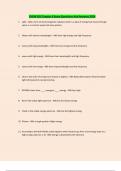
Aggression Short Exam Question
Briefly outline and evaluate findings of one research study into genetic factors in aggression (4
marks).
One study into genetic factors comes from Cases et al. They disabled the MAOA gene in mice which
influenced serotonin levels and males became highly aggressive. Females, on the other hand,
remained unaffected. Furthermore, restoring the function of the gene returned male mice to a
normal state. However, as this research focused on non-human animals, it is unclear whether the
finding can be generalised to human aggression. This is because human social behaviour is more
complex than that of mice.
This achieved 3 marks.
What are innate releasing mechanisms (2 marks)?
They are in-built neural mechanisms that get triggered by a sign stimulus. When innate releasing
mechanisms are stimulated by sign stimulus’, the innate releasing mechanism communicates with
motor control circuits that release a fixed action pattern associated with that stimulus.
This achieved 2 marks.
What are fixed action patterns (2 marks).
Fixed action patterns refer to a repertoire of stereotyped behaviours, or rituals, shared by all
members of the same species, which occur in response to specific ‘triggers’, called ‘sign stimuli’, and
which do not require learning. For example, if a male stickle back sees the red spot on the underbelly
of another male entering their territory, they all instinctively initiate a sequence of highly
stereotyped aggressive behaviours.
This achieved 2 marks.
Briefly explain one limitation of the situational explanation for institutional aggression (2 marks).
One limitation was found by Hensley et al, they found this from analysing two prisons in Mississippi,
America, that allowed conjugal visits. They found that there was no link between involvement in
these visits and reduced aggressive behaviour. This is a problem as it suggests the deprivation of
heterosexual relationships does not affect prison violence.
This achieved 2 marks.
What is the ‘limbic system’ (2 marks).
Outline neural mechanisms in aggression (4 marks).
Outline hormonal mechanisms in aggression (4 marks).
Outline genetic factors in aggression (4 marks).
Briefly outline and evaluate findings of one research study into genetic factors in aggression (4
marks).
One study into genetic factors comes from Cases et al. They disabled the MAOA gene in mice which
influenced serotonin levels and males became highly aggressive. Females, on the other hand,
remained unaffected. Furthermore, restoring the function of the gene returned male mice to a
normal state. However, as this research focused on non-human animals, it is unclear whether the
finding can be generalised to human aggression. This is because human social behaviour is more
complex than that of mice.
This achieved 3 marks.
What are innate releasing mechanisms (2 marks)?
They are in-built neural mechanisms that get triggered by a sign stimulus. When innate releasing
mechanisms are stimulated by sign stimulus’, the innate releasing mechanism communicates with
motor control circuits that release a fixed action pattern associated with that stimulus.
This achieved 2 marks.
What are fixed action patterns (2 marks).
Fixed action patterns refer to a repertoire of stereotyped behaviours, or rituals, shared by all
members of the same species, which occur in response to specific ‘triggers’, called ‘sign stimuli’, and
which do not require learning. For example, if a male stickle back sees the red spot on the underbelly
of another male entering their territory, they all instinctively initiate a sequence of highly
stereotyped aggressive behaviours.
This achieved 2 marks.
Briefly explain one limitation of the situational explanation for institutional aggression (2 marks).
One limitation was found by Hensley et al, they found this from analysing two prisons in Mississippi,
America, that allowed conjugal visits. They found that there was no link between involvement in
these visits and reduced aggressive behaviour. This is a problem as it suggests the deprivation of
heterosexual relationships does not affect prison violence.
This achieved 2 marks.
What is the ‘limbic system’ (2 marks).
Outline neural mechanisms in aggression (4 marks).
Outline hormonal mechanisms in aggression (4 marks).
Outline genetic factors in aggression (4 marks).