Sociologist Theory Key findings
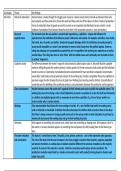
Karl Marx Historical materialism Human history is made through the struggle over resources. Human society starts to break up between those who
own property and those who don’t; those who work and those who live off the labour of others. Mode of production =
forces of production (how the goods we need to survive on are organised and distributed across society) + social
relations of production (how humans related to each other in the production process i.e. boss and worker).
Base and The economic base the way society is economically organised e.g. capitalism – shapes and influence the
superstructure superstructure the institutions that influence people’s behaviour and outlook. For example, education, mass media,
the family, law, the police and politics. Dominant bourgeois ideology within the institutions persuades people to
accept social inequalities as ‘natural’ and attempts to remove social change from the political agenda. However,
ruling class ideology isn’t automatically accepted they are in competition with working class experiences as well as
socialist ideas. The ruling class have to from ‘blocs’ with the middle classes and continually win the battle of ideas
to achieve ‘hegemony’.
Capitalist society The difference between the worker’s wage the value created is called surplus value i.e. the profit that the capitalist
makes by selling the goods the workers produce. Surplus product is the extra resources that society and the individual
needs to survive on. Ownership of production becomes concentrated in fewer and fewer companies (concentrated
ownership). Small traders end up bankrupt and part of the working class. Greater competition forces the capitalists to
pay lower wages in order to keep the prices of goods low. Working class become poverty stricken. Concentration of
ownership and the deskilling of the proletariat produces class polarisation (between the proletariat and bourgeoisie).
Class consciousness Worker becomes aware that society isn’t organised in their interests and want to abolish the capitalist system. The
working class move from being a class in itself (objectively economic occupation) to a class for itself (see themselves
as a distinct and exploited group) with an awareness to over throw capitalism. E.g. from a factory worker to a
factory worker who is a trade unionist.
Ideology False representation that distorts the true workings of society. It’s a set of beliefs that justify the existing social
order as desirable or inevitable. In families the father dominates the children which accustoms them to the ideas
that there is always someone in charge (usually men) and so they accept orders at work. Education is portrayed as
meritocratic but ensures the working class end up in thein working class jobs.
Alienation Work appears as something that controls man, rather than man controlling or shaping work. Work appears ‘alien’ to
the worker. In school, education appears as something that overpowers the child, leading them to find learning as
alien.
The state revolution The state is a ‘armed body of men’: the police, army, prisons, courts etc. - part of the repressive state apparatus.
and communism The role of the state is the be used a weapon in the class struggle, to protect their property, suppress opposition
and prevent revolution. A working class revolution would be different from previous revolutions as the majority
would be in control of the minority in society. Collective ownership would replace private (socialism). The
proletarian revolution would lead to a classless communist society with production being based on human need
rather than profit.
Karl Marx Historical materialism Human history is made through the struggle over resources. Human society starts to break up between those who
own property and those who don’t; those who work and those who live off the labour of others. Mode of production =
forces of production (how the goods we need to survive on are organised and distributed across society) + social
relations of production (how humans related to each other in the production process i.e. boss and worker).
Base and The economic base the way society is economically organised e.g. capitalism – shapes and influence the
superstructure superstructure the institutions that influence people’s behaviour and outlook. For example, education, mass media,
the family, law, the police and politics. Dominant bourgeois ideology within the institutions persuades people to
accept social inequalities as ‘natural’ and attempts to remove social change from the political agenda. However,
ruling class ideology isn’t automatically accepted they are in competition with working class experiences as well as
socialist ideas. The ruling class have to from ‘blocs’ with the middle classes and continually win the battle of ideas
to achieve ‘hegemony’.
Capitalist society The difference between the worker’s wage the value created is called surplus value i.e. the profit that the capitalist
makes by selling the goods the workers produce. Surplus product is the extra resources that society and the individual
needs to survive on. Ownership of production becomes concentrated in fewer and fewer companies (concentrated
ownership). Small traders end up bankrupt and part of the working class. Greater competition forces the capitalists to
pay lower wages in order to keep the prices of goods low. Working class become poverty stricken. Concentration of
ownership and the deskilling of the proletariat produces class polarisation (between the proletariat and bourgeoisie).
Class consciousness Worker becomes aware that society isn’t organised in their interests and want to abolish the capitalist system. The
working class move from being a class in itself (objectively economic occupation) to a class for itself (see themselves
as a distinct and exploited group) with an awareness to over throw capitalism. E.g. from a factory worker to a
factory worker who is a trade unionist.
Ideology False representation that distorts the true workings of society. It’s a set of beliefs that justify the existing social
order as desirable or inevitable. In families the father dominates the children which accustoms them to the ideas
that there is always someone in charge (usually men) and so they accept orders at work. Education is portrayed as
meritocratic but ensures the working class end up in thein working class jobs.
Alienation Work appears as something that controls man, rather than man controlling or shaping work. Work appears ‘alien’ to
the worker. In school, education appears as something that overpowers the child, leading them to find learning as
alien.
The state revolution The state is a ‘armed body of men’: the police, army, prisons, courts etc. - part of the repressive state apparatus.
and communism The role of the state is the be used a weapon in the class struggle, to protect their property, suppress opposition
and prevent revolution. A working class revolution would be different from previous revolutions as the majority
would be in control of the minority in society. Collective ownership would replace private (socialism). The
proletarian revolution would lead to a classless communist society with production being based on human need
rather than profit.