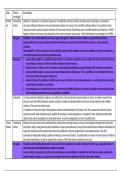
Topic Theory/ Key findings
sociologist
Positivi Theoretical Linked to a ‘top down’ or ‘structural’ approach = Functionalist, Marxist, Feminist. Societies norms and values, its economic
sm factors structures influence behaviour and create behaviour patterns in society. Uses scientific methods. Believe it is possible to make
‘discoveries’ about society using the methods of the natural sciences. Discovering cause and effect patterns of behaviour = WHAT
happens. Believe that reason and rationality can be used to improve mass society – led to development of sociology in the 1890s.
Key goals Reliability: the use that methods can be used again and again to achieve the same results e.g. standardised questions.
Representativeness: large scale data collection will make more accurate and truthful about society e.g. large scale data
collection.
Generalisability: the data collected can help establish cause and effect patterns that can be applied to the whole of society e.g.
pre-coded responses that produce quantitative data.
Reasoning 1. Assume that society has an objective factual reality i.e. the world outside of our sense exists, the world is factually real and
not an illusion. It exists ‘out there’ just like the physical world of nature.
2. Society exerts an influence over its members, systematically (methodical approach) shaping their behaviour and patterns.
3. Uses quantitative data to uncover and measure these patterns of behaviour. This is scientific as it is information that is put
into factual rather than opinion based form.
4. Seeks to discover the objective scientific laws of cause and effect that determine behaviour i.e. social laws that consistently
cause behaviour patterns or outcomes.
5. Use questionnaires, structured interviews, experiments and official statistics, that produce reliable and representative data.
When beginning research they use a hypothesis or prediction.
Evaluation (+) data produced is detached, objective and without bias. Data produced is representative of society. It enables researchers to
discover cause and effect behaviour patterns overtime. Enables social policymakers to discover social problems and establish
solutions. There are few ethical issues.
(-) problems of researcher bias in the questions written and interpretation of the data. Free will- comparisons with the natural
world are invalid. Data collected may be superficial focusing on surface appearance, a snapshot in time. Objective truthful data
claim can be used to clampdown on alternative views - it can be manipulated as a form of political rule.
Interpr Theoretical Believes the social world can be understood by studying the meanings humans construct and negotiate through their interaction
etivism factors with others. Reject using natural science methods to study human behaviour. Accept that external factors influence individuals but
argue that individuals will interpret these factors/act differently. Structural approaches are too deterministic. Free will=
autonomous independent beings capable of making our own moral choices. To understand our actions we need research methods
that allow individuals to be able to explain their actions or WHY they believe something to be true.
Key goals Meanings: understanding how people make sense of their experience and what is important to them e.g. using observation to
understand the relationship between teachers and pupils.
Greater validity: interpretivists sacrifice representativeness and reliability for methods that will focus on smaller participants
and gain deeper insights e.g. using long unstructured interviews to understand victims of domestic violence.
sociologist
Positivi Theoretical Linked to a ‘top down’ or ‘structural’ approach = Functionalist, Marxist, Feminist. Societies norms and values, its economic
sm factors structures influence behaviour and create behaviour patterns in society. Uses scientific methods. Believe it is possible to make
‘discoveries’ about society using the methods of the natural sciences. Discovering cause and effect patterns of behaviour = WHAT
happens. Believe that reason and rationality can be used to improve mass society – led to development of sociology in the 1890s.
Key goals Reliability: the use that methods can be used again and again to achieve the same results e.g. standardised questions.
Representativeness: large scale data collection will make more accurate and truthful about society e.g. large scale data
collection.
Generalisability: the data collected can help establish cause and effect patterns that can be applied to the whole of society e.g.
pre-coded responses that produce quantitative data.
Reasoning 1. Assume that society has an objective factual reality i.e. the world outside of our sense exists, the world is factually real and
not an illusion. It exists ‘out there’ just like the physical world of nature.
2. Society exerts an influence over its members, systematically (methodical approach) shaping their behaviour and patterns.
3. Uses quantitative data to uncover and measure these patterns of behaviour. This is scientific as it is information that is put
into factual rather than opinion based form.
4. Seeks to discover the objective scientific laws of cause and effect that determine behaviour i.e. social laws that consistently
cause behaviour patterns or outcomes.
5. Use questionnaires, structured interviews, experiments and official statistics, that produce reliable and representative data.
When beginning research they use a hypothesis or prediction.
Evaluation (+) data produced is detached, objective and without bias. Data produced is representative of society. It enables researchers to
discover cause and effect behaviour patterns overtime. Enables social policymakers to discover social problems and establish
solutions. There are few ethical issues.
(-) problems of researcher bias in the questions written and interpretation of the data. Free will- comparisons with the natural
world are invalid. Data collected may be superficial focusing on surface appearance, a snapshot in time. Objective truthful data
claim can be used to clampdown on alternative views - it can be manipulated as a form of political rule.
Interpr Theoretical Believes the social world can be understood by studying the meanings humans construct and negotiate through their interaction
etivism factors with others. Reject using natural science methods to study human behaviour. Accept that external factors influence individuals but
argue that individuals will interpret these factors/act differently. Structural approaches are too deterministic. Free will=
autonomous independent beings capable of making our own moral choices. To understand our actions we need research methods
that allow individuals to be able to explain their actions or WHY they believe something to be true.
Key goals Meanings: understanding how people make sense of their experience and what is important to them e.g. using observation to
understand the relationship between teachers and pupils.
Greater validity: interpretivists sacrifice representativeness and reliability for methods that will focus on smaller participants
and gain deeper insights e.g. using long unstructured interviews to understand victims of domestic violence.