Pediatric Brain Tumor Case Study
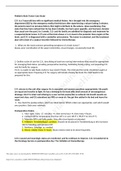
Pediatric Brain Tumor Case Study- 1 Pediatric Brain Tumor Case StudyZ.O. is a 3-year-old boy with no significant medical history. He is brought into the emergency department (ED) by the emergency medical technicians after experiencing a seizure lasting 3 minutes. His parents report no previous history that might contribute to the seizure. Upon questioning, they state that they have noticed that he has been irritable, has had a poor appetite, and has been clumsierthan usual over the past 2 to 3 weeks. Z.O. and his family are admitted for diagnosis and treatment fora suspected brain tumor. A CT scan of the brain shows a 1-cm mass in the posterior fossa region of the brain, and Z.O. is diagnosed with a cerebellar astrocytoma. The tumor is contained, and the treatment plan will consist of a surgical resection followed by chemotherapy. 1. What are the most common presenting symptoms of a brain tumor?Ataxia, poor coordination of the upper extremities, visual changes, occasionally head tilt. 2. Outline a plan of care for Z.O., describing at least two nursing interventions that would be appropriate for managing fluid status, providing preoperative teaching, facilitating family coping, and preparing Z.O. and his family for surgery.If Z.O. is unable to take fluids orally he may need IV fluids. The child and the family should be taught at an appropriate level. Preparing Z.O. for surgery will include shaving his head; the child needs to be prepared for this. Z.O. returns to the unit after surgery. He is arousable and answers questions appropriately. His pupils are equal and reactive to light. He has a dressing to his head with small amount of serosanguinous drainage. His IV is intact and infusing to a new central venous line as ordered. His breath sounds are equal and clear, and O2 saturations are 98% on room air. You get him settled in his bed and leave the room. 3. You check the postop orders, which are listed below. Which orders are appropriate, and which would you question. State your rationale. Postoperative Orders 1. Vital signs every 15 minutes ×4, then every hour ×4, then every 4 hours. 2. Contact MD for temperature less than 36° C or over 38.5° C (96.8° F to 101.3° F). 3. Maintain NPO until fully awake. May offer clear liquids as tolerated. 4. Maintain Trendelenburg's position. Should not be placed in Trendelenburg as this increases risk for bleeding and increases ICP. 5. Reinforce bandage as needed. 6. Neuro checks every 8 hours. Neuro checks need to be done frequently. Z.O.'s wound and neurologic status are monitored, and he continues to improve. Z.O. is transferred to the Oncology Service on postoperative day 7 for initiation of chemotherapy.
École, étude et sujet
Infos sur le Document
- Publié le
- 13 mai 2021
- Nombre de pages
- 3
- Écrit en
- 2020/2021
- Type
- Cas
- Professeur(s)
- Pediatric brain tumor case study
- Qualité
- A+
Sujets
-
pediatric brain tumor case study 1 pediatric brain tumor case studyzo is a 3 year old boy with no significant medical history he is brought into the emergency department ed by the emergency medic

Document également disponible en groupe