HCD 303 Final Exam Study Guide
Study online at https://quizlet.com/_76y95z
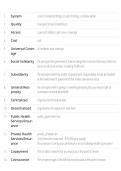
1. System a set of connected things or parts forming a complex whole
2. Quality how good or bad something is
3. Access a person's ability to get care or coverage
4. Cost cost
5. Universal Cover- all residents have coverage
age
6. Social Solidarity the principle that governments have an obligation to ensure that every citizen has
access to all social services including healthcare
7. Subsidiarity the principle belief that matter of government responsibility should be handled
at the lowest level of government that makes operational sense
8. General Reci- the principle belief in giving to something knowing that you may not get an
procity immediate returned benefititifif
9. Centralized Organized at the federal level
10. Decentralized Organized at the regional or state level
11. Public Health public, government run
Services/Insur-
ance
12. Private Health private, privately run
Services/Insur- Only those who make over ~$70,000/year qualify
ance The premium is set by your performance on an individual health assessment
13. Copayment The set dollar amount that you must pay at the point of service
14. Coinsurance The set percentage of the bill that must be paid at the point of service
, HCD 303 Final Exam Study Guide
Study online at https://quizlet.com/_76y95z
15. Deductible The amount that must be paid out-of-pocket annually, before insurance coverage
kicks in
16. Sickness Funds ~130 sickness funds today (although this number is continually dropping)
Covers ~ 86% of the country's population
Membership is mandatory
Must pay a legally mandated premium of 14.6% of their income (through payroll
deduction)
Split between employer and employee
Percent of premium is determined by income
~11% of the population opts out of the SHI and opts for Private Health Insurance
(PHI)
Percent of premium is determined by health assessment and is risk-adjusted
17. Safety Net Children under 18 years of age exempt from all cost-sharing
Adults:
Annual cap equal to 2% of household income
Annual cap lowered to 1% of household income for qualifying chronically ill
people
Unemployed contribute to SHI in proportion to their unemployment entitlements;
For long term unemployed government contributes on their behalf
18. Cost Sharing Cost Sharing (all USD):
Outpatient Prescriptions: $6.40 - $12.70
Inpatient Stay: $10.00/day (first 28 days/yr)
Rehabilitation Stay: $10.00/day (first 28 days/yr)
Deductibles: vary by sickness fund plan
Preventative services do not count towards deductible
19. Subsidy government assistance
, HCD 303 Final Exam Study Guide
Study online at https://quizlet.com/_76y95z
20. Health Financing it is the function of a system concerned with the mobilization, accumulation, and
allocation of money to cover the health needs of the people, individually and
collectively, in the health system
21. Health Spending The percent of money spent on healthcare every year, in relation to the total
as % of GDP amount spent throughout all industries in the same year
22. Fee-for-service A payment model where all healthcare services, products, and prescription med-
(FFS) ications are unbundled and paid for separately.
incentive: Overtreatment, Provide more services, testing, and treatments that are
billable through an ICD-code.
23. Per Diem payment model that reimburses organizations and/or providers based upon the
number of days treatment was given
24. Pay-for-perfor- A payment model that reimburses healthcare organizations and physicians who
mance achieve, improve, or exceed their performance on specified quality and cost
measures, as well as other benchmarks.
incentive: Measure of performance metrics, Incentives can be financial or non-fi-
nancial, Adherence to process
25. Salary Physicians are paid a predetermined salary based upon their level of expertise
and experience.
incentive: No incentive for overtreatment, Provide the best treatment, regardless
of ICD-code to the patient, There is also no direct incentive to work hard.
26. Bundled pay- DRG - A prospective payment model in which hospitals are reimbursed with a fixed
ments (DRG, fee regardless of the actual costs. Includes hospital expenses only. ACA required
EDGR, Reference 30-day readmission penalty
Pricing) DRG Incentive - Reduce length of stay, Discharge appropriately, Keep costs to a
minimum
, HCD 303 Final Exam Study Guide
Study online at https://quizlet.com/_76y95z
EDRG - An EDRG is another form of a bundled payment.
The bundled payment = hospital + all physician payments + longer period of time
(e.g. 6 - 12 months after hospitalization).
The EDRG acts as a forcing function - encouraging physician and hospital collab-
oration on improving both patient outcomes and cost.
Reference Pricing - Reference Price = the payment amount now going to medical
centers with high quality and low cost
Medical centers can charge more than reference price
Patients told which medical centers charge more than reference price
If patient chooses higher cost medical centers, patient pays the difference be-
tween reference price and medical center price
27. Capitation A prospective payment model where the hospital or provider is paid a contracted
rate per-member-per-month, regardless of the number of services provided.
Rates are typically (but not always) risk-adjusted
Incentive: Keep the patient healthy and living their daily lives in their own home,
keep patient out of the hospital/clinic, freedom to provide non-traditional health-
care services
28. Components of people, parts, inter-relationships, and culture
a healthcare sys-
tem
29. US rankings in: 1. 37th
1. WHO report 2. 54th
2. Bloomberg 3. 11th
Business report
3. Common-
wealth Fund re-
port
Study online at https://quizlet.com/_76y95z
1. System a set of connected things or parts forming a complex whole
2. Quality how good or bad something is
3. Access a person's ability to get care or coverage
4. Cost cost
5. Universal Cover- all residents have coverage
age
6. Social Solidarity the principle that governments have an obligation to ensure that every citizen has
access to all social services including healthcare
7. Subsidiarity the principle belief that matter of government responsibility should be handled
at the lowest level of government that makes operational sense
8. General Reci- the principle belief in giving to something knowing that you may not get an
procity immediate returned benefititifif
9. Centralized Organized at the federal level
10. Decentralized Organized at the regional or state level
11. Public Health public, government run
Services/Insur-
ance
12. Private Health private, privately run
Services/Insur- Only those who make over ~$70,000/year qualify
ance The premium is set by your performance on an individual health assessment
13. Copayment The set dollar amount that you must pay at the point of service
14. Coinsurance The set percentage of the bill that must be paid at the point of service
, HCD 303 Final Exam Study Guide
Study online at https://quizlet.com/_76y95z
15. Deductible The amount that must be paid out-of-pocket annually, before insurance coverage
kicks in
16. Sickness Funds ~130 sickness funds today (although this number is continually dropping)
Covers ~ 86% of the country's population
Membership is mandatory
Must pay a legally mandated premium of 14.6% of their income (through payroll
deduction)
Split between employer and employee
Percent of premium is determined by income
~11% of the population opts out of the SHI and opts for Private Health Insurance
(PHI)
Percent of premium is determined by health assessment and is risk-adjusted
17. Safety Net Children under 18 years of age exempt from all cost-sharing
Adults:
Annual cap equal to 2% of household income
Annual cap lowered to 1% of household income for qualifying chronically ill
people
Unemployed contribute to SHI in proportion to their unemployment entitlements;
For long term unemployed government contributes on their behalf
18. Cost Sharing Cost Sharing (all USD):
Outpatient Prescriptions: $6.40 - $12.70
Inpatient Stay: $10.00/day (first 28 days/yr)
Rehabilitation Stay: $10.00/day (first 28 days/yr)
Deductibles: vary by sickness fund plan
Preventative services do not count towards deductible
19. Subsidy government assistance
, HCD 303 Final Exam Study Guide
Study online at https://quizlet.com/_76y95z
20. Health Financing it is the function of a system concerned with the mobilization, accumulation, and
allocation of money to cover the health needs of the people, individually and
collectively, in the health system
21. Health Spending The percent of money spent on healthcare every year, in relation to the total
as % of GDP amount spent throughout all industries in the same year
22. Fee-for-service A payment model where all healthcare services, products, and prescription med-
(FFS) ications are unbundled and paid for separately.
incentive: Overtreatment, Provide more services, testing, and treatments that are
billable through an ICD-code.
23. Per Diem payment model that reimburses organizations and/or providers based upon the
number of days treatment was given
24. Pay-for-perfor- A payment model that reimburses healthcare organizations and physicians who
mance achieve, improve, or exceed their performance on specified quality and cost
measures, as well as other benchmarks.
incentive: Measure of performance metrics, Incentives can be financial or non-fi-
nancial, Adherence to process
25. Salary Physicians are paid a predetermined salary based upon their level of expertise
and experience.
incentive: No incentive for overtreatment, Provide the best treatment, regardless
of ICD-code to the patient, There is also no direct incentive to work hard.
26. Bundled pay- DRG - A prospective payment model in which hospitals are reimbursed with a fixed
ments (DRG, fee regardless of the actual costs. Includes hospital expenses only. ACA required
EDGR, Reference 30-day readmission penalty
Pricing) DRG Incentive - Reduce length of stay, Discharge appropriately, Keep costs to a
minimum
, HCD 303 Final Exam Study Guide
Study online at https://quizlet.com/_76y95z
EDRG - An EDRG is another form of a bundled payment.
The bundled payment = hospital + all physician payments + longer period of time
(e.g. 6 - 12 months after hospitalization).
The EDRG acts as a forcing function - encouraging physician and hospital collab-
oration on improving both patient outcomes and cost.
Reference Pricing - Reference Price = the payment amount now going to medical
centers with high quality and low cost
Medical centers can charge more than reference price
Patients told which medical centers charge more than reference price
If patient chooses higher cost medical centers, patient pays the difference be-
tween reference price and medical center price
27. Capitation A prospective payment model where the hospital or provider is paid a contracted
rate per-member-per-month, regardless of the number of services provided.
Rates are typically (but not always) risk-adjusted
Incentive: Keep the patient healthy and living their daily lives in their own home,
keep patient out of the hospital/clinic, freedom to provide non-traditional health-
care services
28. Components of people, parts, inter-relationships, and culture
a healthcare sys-
tem
29. US rankings in: 1. 37th
1. WHO report 2. 54th
2. Bloomberg 3. 11th
Business report
3. Common-
wealth Fund re-
port