8A - Musculoskeletal System
1 STRUCTURE OF THE SKELETAL SYSTEM
1.1 MY LABELLED DIAGRAM
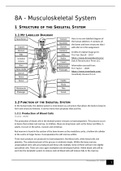
Here is my own labelled diagram of
the human skeleton. It contains all
the bones and bone structures that I
will refer to in this assignment.
Credits of original image go to:
Tim Van Devall - 2014
https://www.timvandevall.com/
Dutch Renaissance Press LLC.
Information sourced from:
Tim Taylor – 2020
https://www.innerbody.com/
InnerBody Research LLC.
1.2 FUNCTION OF THE SKELETAL SYSTEM
In the human body, the skeletal system is most known as a structure that allows the body to keep its
form and structure however, it serves many more purposes than just this.
1.2.1 Production of Blood Cells
(Taylor, 2020)
The production of blood cells in the skeletal system is known as haematopoiesis. This process occurs
in bones that contain red marrow. In children, these are long bones such as the femur and tibia, in
adults, it occurs in the pelvis, cranium and vertebrae.
Red marrow is found in the section of the bone known as the medullary cavity, a hollow-ish cylinder
at the centre of larger bones. It encapsulates the soft marrow within.
Three main products are produced via haematopoiesis. Red blood cells, white blood cells and
platelets. The understood part of the process is relatively simple. Within the bone marrow,
unspecialised stem cells are produced and these cells multiply. Some of them will turn into slightly
specialised cells. These are once again multiplied and developed further. White blood cells will be
sent into the lymphatic system to mature and red blood cells will mature fully in the marrow.
November 25, 2020
1
, This entire process is not fully understood, so this is a very basic explanation of one of skeleton’s
functions.
1.2.2 Storage of Minerals
Bones act as stores for 99% of the body’s calcium and 85% of the body’s phosphorus. It is vital that
the blood’s calcium levels are kept within a narrow range. In times of need, for example, during
pregnancy, calcium can be removed from the bones. This process is carefully regulated by
hormones. Bone cells also release osteocalcin, a hormone that helps regulate blood sugar and fat
deposition. The yellow bone marrow inside of our hollow long bones is used to store energy in the
form of lipids. Finally, red bone marrow stores some iron in the form of the molecule ferritin and
uses this iron to form haemoglobin in red blood cells.
1.2.3 Support
Bones are hard, relatively rigid structures that offer support from compression and tension, shearing
and gravitational forces that would otherwise cause major damage to internal organs.
1.2.4 Protection
Various sections of the skeleton are specialised to protect certain organs and organ systems from
harm. Examples of this include the cranium for the brain, vertebral column protects the spinal cord,
and the rib cage protects any organs in the chest cavity such as the heart of lungs.
1.2.5 Movement
Bones themselves are connected to one-another via various types of joints. These joints control the
range of movement and type of movement that is possible in that area. The moving its self,
however, is done by the expansion and contraction of skeletal muscle.
The muscles are attached to the bones via tendons. These tendons mean that when the muscles
contract, it causes the join the move in a specific Figure 1
direction that is determined by the muscle and
type of joint.
In figure 1 we can see an elbow joint. When the
bicep muscle contracts, it pulls the radius and
ulna upwards, causing the arm to flex. It is also
important to not that if the bicep is contracting,
the triceps becomes loser to allow the arm to
move freely.
1.3 MAIN TYPES OF JOINTS
There are three overall types of joints.
1.3.1 Cartilaginous:
Bones are connected by cartilage.
Little to no movement
No joint cavity
E.g. intervertebral discs
1.3.2 Fibrous:
Bones are connected by a fibrous tissue made mostly from collagen.
No muscular movement but are slightly flexible.
November 25, 2020
2
1 STRUCTURE OF THE SKELETAL SYSTEM
1.1 MY LABELLED DIAGRAM
Here is my own labelled diagram of
the human skeleton. It contains all
the bones and bone structures that I
will refer to in this assignment.
Credits of original image go to:
Tim Van Devall - 2014
https://www.timvandevall.com/
Dutch Renaissance Press LLC.
Information sourced from:
Tim Taylor – 2020
https://www.innerbody.com/
InnerBody Research LLC.
1.2 FUNCTION OF THE SKELETAL SYSTEM
In the human body, the skeletal system is most known as a structure that allows the body to keep its
form and structure however, it serves many more purposes than just this.
1.2.1 Production of Blood Cells
(Taylor, 2020)
The production of blood cells in the skeletal system is known as haematopoiesis. This process occurs
in bones that contain red marrow. In children, these are long bones such as the femur and tibia, in
adults, it occurs in the pelvis, cranium and vertebrae.
Red marrow is found in the section of the bone known as the medullary cavity, a hollow-ish cylinder
at the centre of larger bones. It encapsulates the soft marrow within.
Three main products are produced via haematopoiesis. Red blood cells, white blood cells and
platelets. The understood part of the process is relatively simple. Within the bone marrow,
unspecialised stem cells are produced and these cells multiply. Some of them will turn into slightly
specialised cells. These are once again multiplied and developed further. White blood cells will be
sent into the lymphatic system to mature and red blood cells will mature fully in the marrow.
November 25, 2020
1
, This entire process is not fully understood, so this is a very basic explanation of one of skeleton’s
functions.
1.2.2 Storage of Minerals
Bones act as stores for 99% of the body’s calcium and 85% of the body’s phosphorus. It is vital that
the blood’s calcium levels are kept within a narrow range. In times of need, for example, during
pregnancy, calcium can be removed from the bones. This process is carefully regulated by
hormones. Bone cells also release osteocalcin, a hormone that helps regulate blood sugar and fat
deposition. The yellow bone marrow inside of our hollow long bones is used to store energy in the
form of lipids. Finally, red bone marrow stores some iron in the form of the molecule ferritin and
uses this iron to form haemoglobin in red blood cells.
1.2.3 Support
Bones are hard, relatively rigid structures that offer support from compression and tension, shearing
and gravitational forces that would otherwise cause major damage to internal organs.
1.2.4 Protection
Various sections of the skeleton are specialised to protect certain organs and organ systems from
harm. Examples of this include the cranium for the brain, vertebral column protects the spinal cord,
and the rib cage protects any organs in the chest cavity such as the heart of lungs.
1.2.5 Movement
Bones themselves are connected to one-another via various types of joints. These joints control the
range of movement and type of movement that is possible in that area. The moving its self,
however, is done by the expansion and contraction of skeletal muscle.
The muscles are attached to the bones via tendons. These tendons mean that when the muscles
contract, it causes the join the move in a specific Figure 1
direction that is determined by the muscle and
type of joint.
In figure 1 we can see an elbow joint. When the
bicep muscle contracts, it pulls the radius and
ulna upwards, causing the arm to flex. It is also
important to not that if the bicep is contracting,
the triceps becomes loser to allow the arm to
move freely.
1.3 MAIN TYPES OF JOINTS
There are three overall types of joints.
1.3.1 Cartilaginous:
Bones are connected by cartilage.
Little to no movement
No joint cavity
E.g. intervertebral discs
1.3.2 Fibrous:
Bones are connected by a fibrous tissue made mostly from collagen.
No muscular movement but are slightly flexible.
November 25, 2020
2