

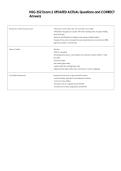
NSG 352 Exam 2 UPDATED ACTUAL Questions and CORRECT
Answers
Medication orders should include -Medication name (take care with look alike, sound alike)
-Medication dosage (use caution with zeros, leading zeros are good, trailing
zeros are bad)
-Route of administration (multiple routes require multiple orders)
-Purpose (*may not be included for every medication but commonly for PRN)
-Signature (written or electronic)
Types of orders -Routine
-PRN (as needed)
-Standing protocols (ex: when patient has chest pain obtain an EKG + notify
provider)
-one time orders
-stat orders (give asap)
-verbal orders (for emergencies only)
-telephone/fax orders (write down, read back, must be cosigned)
Controlled Substances Medications that have a high potential for abuse
-must be locked, typically in auto dispense machine
-counts must be verified
-all waste must be cosigned by another RN
-any returns must bee cosigned by another RN
, Safe Medication Administration -store medication properly (refrigerator, light-sensitive, etc)
-never leave medications unattended (all meds should be locked until use)
-check allergies
-is the dose safe and appropriate?
-does this medication interact with food or is it best taken with food?
-assess your patients (auscultating breathe sounds before bronchodilators)
-know your lab values (potassium for furosemide)
-know limitations for your route (can the patient swallow, what sites have the right
amount of muscle for an IM, do they have adequate IV site)
6 rights of medication administration The right patient
>check arm band, chart, and patient
>two identifiers include name, mrn, dob
The right medication
>look alike, sound alike
>incorrect dispensing from pharmacy
>don't give a medication you have not prepared
-patient questions it (although sometimes they look different)
The right dose
>watch the zeros
>patient questions it
The right time
> daily, BID, TID achs
>within 30-60 min depending on organizations policies
The right documentation
>time, route, dosage, site, nurses's initials and signature
The 3 checks Medication name, dose, route should be checked at least 3 times
-at the point of removing it from its storage location
-comparing to the MAR before preparing (hold it up to the computer)
-scanning
-when administering a medication that requires calculation, on more time after
preparing and prior to administration
Medication Errors are preventable -1.5 million errors/year
-thousands of deaths/year
-don't bypass safety measures that are in place (if scanning tech is in place then
use it, always identify patient)
-don't get distracted
-monitor patient appropriately (ex: first dose of antibiotic)
-if an error occurs:
>manage patient's needs as indicated
>don't chart it was given if it wasn't
>report to your charge nurse and complete required incident documentation
>notify provider
high alert medications -medications identified as contributing to harmful errors
-often require double checks are extra precautions prior to administering
Ex: concentrated electrolyte solutions (potassium chloride), heparin, insulin,
morphine, neuromuscular drugs, chemotherapy drugs
Answers
Medication orders should include -Medication name (take care with look alike, sound alike)
-Medication dosage (use caution with zeros, leading zeros are good, trailing
zeros are bad)
-Route of administration (multiple routes require multiple orders)
-Purpose (*may not be included for every medication but commonly for PRN)
-Signature (written or electronic)
Types of orders -Routine
-PRN (as needed)
-Standing protocols (ex: when patient has chest pain obtain an EKG + notify
provider)
-one time orders
-stat orders (give asap)
-verbal orders (for emergencies only)
-telephone/fax orders (write down, read back, must be cosigned)
Controlled Substances Medications that have a high potential for abuse
-must be locked, typically in auto dispense machine
-counts must be verified
-all waste must be cosigned by another RN
-any returns must bee cosigned by another RN
, Safe Medication Administration -store medication properly (refrigerator, light-sensitive, etc)
-never leave medications unattended (all meds should be locked until use)
-check allergies
-is the dose safe and appropriate?
-does this medication interact with food or is it best taken with food?
-assess your patients (auscultating breathe sounds before bronchodilators)
-know your lab values (potassium for furosemide)
-know limitations for your route (can the patient swallow, what sites have the right
amount of muscle for an IM, do they have adequate IV site)
6 rights of medication administration The right patient
>check arm band, chart, and patient
>two identifiers include name, mrn, dob
The right medication
>look alike, sound alike
>incorrect dispensing from pharmacy
>don't give a medication you have not prepared
-patient questions it (although sometimes they look different)
The right dose
>watch the zeros
>patient questions it
The right time
> daily, BID, TID achs
>within 30-60 min depending on organizations policies
The right documentation
>time, route, dosage, site, nurses's initials and signature
The 3 checks Medication name, dose, route should be checked at least 3 times
-at the point of removing it from its storage location
-comparing to the MAR before preparing (hold it up to the computer)
-scanning
-when administering a medication that requires calculation, on more time after
preparing and prior to administration
Medication Errors are preventable -1.5 million errors/year
-thousands of deaths/year
-don't bypass safety measures that are in place (if scanning tech is in place then
use it, always identify patient)
-don't get distracted
-monitor patient appropriately (ex: first dose of antibiotic)
-if an error occurs:
>manage patient's needs as indicated
>don't chart it was given if it wasn't
>report to your charge nurse and complete required incident documentation
>notify provider
high alert medications -medications identified as contributing to harmful errors
-often require double checks are extra precautions prior to administering
Ex: concentrated electrolyte solutions (potassium chloride), heparin, insulin,
morphine, neuromuscular drugs, chemotherapy drugs


