

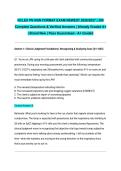
NCLEX PN NGN FORMAT EXAM NEWEST 2026/2027 | 300
Complete Questions & Verified Answers | Already Graded A+
| Brand New | Pass Guaranteed - A+ Graded
Section 1: Clinical Judgment Foundations: Recognizing & Analyzing Cues (Q1–Q45)
Q1: You're an LPN caring for a 68-year-old client admitted with community-acquired
pneumonia. During your morning assessment, you note the following: temperature
38.9°C (102°F), respiratory rate 28 breaths/min, oxygen saturation 91% on room air, and
the client reports feeling "more short of breath than yesterday." Which cue requires the
most immediate follow-up by the LPN?
A. The elevated temperature indicating infection
B. The increased respiratory rate and dropping oxygen saturation [CORRECT]
C. The client's subjective report of worsening dyspnea
D. The need for antibiotic administration timing
Correct Answer: B
Rationale: What you're looking for here is the cue cluster that signals actual respiratory
compromise. The temp is expected with pneumonia, but the respiratory rate climbing to
28 with an SpO2 dipping to 91% tells you the client is heading toward hypoxemia. The
clinical judgment move is recognizing that objective vital sign trends trump subjective
complaints when we're talking about airway and breathing. I tell my students all the
time—when the numbers are moving in the wrong direction on the respiratory front,
that's your priority cue to act on.
,Q2: The nurse is reviewing the laboratory results for a client with chronic kidney disease
stage 4. Which finding should the LPN recognize as the most significant indicator of
worsening renal function?
A. Hemoglobin 10.2 g/dL
B. Serum potassium 5.8 mEq/L [CORRECT]
C. Blood urea nitrogen 45 mg/dL
D. Serum creatinine 2.8 mg/dL
Correct Answer: B
Rationale: Here's why this is the best choice—while all these values are off in CKD, a
potassium of 5.8 is knocking on the door of hyperkalemia that can trigger lethal cardiac
arrhythmias. The BUN and creatinine tell you the kidneys are struggling, and the anemia
is expected, but that potassium level is the cue that can kill your client today. Remember
what the NGN is testing here: recognizing which abnormal value presents the most
immediate threat to life.
Q3: Select all that apply. The LPN is caring for a client with heart failure who has the
following assessment findings. Which findings should the LPN report to the RN
immediately? (Select all that apply.)
A. Weight gain of 2 pounds over 2 days
B. Jugular venous distension at 45 degrees [CORRECT]
C. Crackles audible at the lung bases bilaterally [CORRECT]
D. 2+ pitting edema in bilateral lower extremities
E. Report of waking up short of breath twice last night [CORRECT]
F. Blood pressure 148/92 mmHg
Correct Answers: B, C, E
Rationale: Think about it this way—these three findings together paint a picture of
decompensated heart failure that needs RN notification and likely provider intervention
,now. JVD at 45 degrees tells you volume overload is significant, new bilateral crackles
suggest pulmonary edema developing, and nocturnal dyspnea (orthopnea) means the
client's compensatory mechanisms are failing even at rest. The weight gain and edema
are concerning but expected chronic findings, and that BP, while elevated, isn't the acute
crisis signal here.
Q4: You're an LPN in a long-term care facility. During rounds, you notice an 82-year-old
resident with diabetes has cool, clammy skin and is slightly confused. The resident's
breakfast tray is untouched. Which action best demonstrates the LPN recognizing and
analyzing cues using clinical judgment?
A. Documenting the findings and continuing with the medication pass
B. Checking the resident's blood glucose immediately [CORRECT]
C. Offering the resident juice and crackers
D. Notifying the family of the behavior change
Correct Answer: B
Rationale: The clinical judgment move is connecting cool, clammy skin + confusion +
missed meal in a diabetic resident and recognizing this screams hypoglycemia until
proven otherwise. What you're looking for here is the LPN who doesn't just see isolated
symptoms but analyzes the cue cluster and takes the fastest action to confirm the
hypothesis. Offering food without checking glucose first is dangerous if the resident is
actually hyperglycemic, and documenting without acting misses the window for
intervention.
Q5: A client post-op day 2 after total knee replacement has the following vital signs: BP
138/84, HR 96, RR 18, Temp 37.2°C (99.0°F), SpO2 94% on room air. The client is using
the incentive spirometer 10 times per hour as instructed. Which cue should prompt the
LPN to analyze further?
, A. The slightly elevated temperature
B. The heart rate of 96 beats/min [CORRECT]
C. The oxygen saturation of 94%
D. The blood pressure reading
Correct Answer: B
Rationale: I tell my students all the time—after orthopedic surgery, a resting heart rate in
the mid-90s is your subtle cue that something else might be going on. It could be pain,
but it could also be early bleeding, developing DVT, or even a pulmonary embolism
brewing. The temp is barely elevated post-op day 2, 94% SpO2 isn't alarming if baseline,
but that tachycardia without obvious cause needs your clinical eye to dig deeper.
Q6: The LPN is reviewing a client's medication administration record and notes the
following: furosemide 40 mg PO daily, potassium chloride 20 mEq PO daily, digoxin 0.25
mg PO daily. Which laboratory value should the LPN prioritize checking before
administering the morning medications?
A. Complete blood count
B. Serum potassium level [CORRECT]
C. Liver function panel
D. Blood glucose level
Correct Answer: B
Rationale: Remember what the NGN is testing here—recognizing the dangerous
intersection of a potassium-wasting diuretic, potassium supplementation, and a drug
whose toxicity is directly linked to potassium balance. Digoxin and furosemide create a
perfect storm where potassium can swing low, and low potassium sets your client up
for digoxin toxicity. The clinical judgment move is knowing which lab value can make or
break medication safety for this specific combination.
Complete Questions & Verified Answers | Already Graded A+
| Brand New | Pass Guaranteed - A+ Graded
Section 1: Clinical Judgment Foundations: Recognizing & Analyzing Cues (Q1–Q45)
Q1: You're an LPN caring for a 68-year-old client admitted with community-acquired
pneumonia. During your morning assessment, you note the following: temperature
38.9°C (102°F), respiratory rate 28 breaths/min, oxygen saturation 91% on room air, and
the client reports feeling "more short of breath than yesterday." Which cue requires the
most immediate follow-up by the LPN?
A. The elevated temperature indicating infection
B. The increased respiratory rate and dropping oxygen saturation [CORRECT]
C. The client's subjective report of worsening dyspnea
D. The need for antibiotic administration timing
Correct Answer: B
Rationale: What you're looking for here is the cue cluster that signals actual respiratory
compromise. The temp is expected with pneumonia, but the respiratory rate climbing to
28 with an SpO2 dipping to 91% tells you the client is heading toward hypoxemia. The
clinical judgment move is recognizing that objective vital sign trends trump subjective
complaints when we're talking about airway and breathing. I tell my students all the
time—when the numbers are moving in the wrong direction on the respiratory front,
that's your priority cue to act on.
,Q2: The nurse is reviewing the laboratory results for a client with chronic kidney disease
stage 4. Which finding should the LPN recognize as the most significant indicator of
worsening renal function?
A. Hemoglobin 10.2 g/dL
B. Serum potassium 5.8 mEq/L [CORRECT]
C. Blood urea nitrogen 45 mg/dL
D. Serum creatinine 2.8 mg/dL
Correct Answer: B
Rationale: Here's why this is the best choice—while all these values are off in CKD, a
potassium of 5.8 is knocking on the door of hyperkalemia that can trigger lethal cardiac
arrhythmias. The BUN and creatinine tell you the kidneys are struggling, and the anemia
is expected, but that potassium level is the cue that can kill your client today. Remember
what the NGN is testing here: recognizing which abnormal value presents the most
immediate threat to life.
Q3: Select all that apply. The LPN is caring for a client with heart failure who has the
following assessment findings. Which findings should the LPN report to the RN
immediately? (Select all that apply.)
A. Weight gain of 2 pounds over 2 days
B. Jugular venous distension at 45 degrees [CORRECT]
C. Crackles audible at the lung bases bilaterally [CORRECT]
D. 2+ pitting edema in bilateral lower extremities
E. Report of waking up short of breath twice last night [CORRECT]
F. Blood pressure 148/92 mmHg
Correct Answers: B, C, E
Rationale: Think about it this way—these three findings together paint a picture of
decompensated heart failure that needs RN notification and likely provider intervention
,now. JVD at 45 degrees tells you volume overload is significant, new bilateral crackles
suggest pulmonary edema developing, and nocturnal dyspnea (orthopnea) means the
client's compensatory mechanisms are failing even at rest. The weight gain and edema
are concerning but expected chronic findings, and that BP, while elevated, isn't the acute
crisis signal here.
Q4: You're an LPN in a long-term care facility. During rounds, you notice an 82-year-old
resident with diabetes has cool, clammy skin and is slightly confused. The resident's
breakfast tray is untouched. Which action best demonstrates the LPN recognizing and
analyzing cues using clinical judgment?
A. Documenting the findings and continuing with the medication pass
B. Checking the resident's blood glucose immediately [CORRECT]
C. Offering the resident juice and crackers
D. Notifying the family of the behavior change
Correct Answer: B
Rationale: The clinical judgment move is connecting cool, clammy skin + confusion +
missed meal in a diabetic resident and recognizing this screams hypoglycemia until
proven otherwise. What you're looking for here is the LPN who doesn't just see isolated
symptoms but analyzes the cue cluster and takes the fastest action to confirm the
hypothesis. Offering food without checking glucose first is dangerous if the resident is
actually hyperglycemic, and documenting without acting misses the window for
intervention.
Q5: A client post-op day 2 after total knee replacement has the following vital signs: BP
138/84, HR 96, RR 18, Temp 37.2°C (99.0°F), SpO2 94% on room air. The client is using
the incentive spirometer 10 times per hour as instructed. Which cue should prompt the
LPN to analyze further?
, A. The slightly elevated temperature
B. The heart rate of 96 beats/min [CORRECT]
C. The oxygen saturation of 94%
D. The blood pressure reading
Correct Answer: B
Rationale: I tell my students all the time—after orthopedic surgery, a resting heart rate in
the mid-90s is your subtle cue that something else might be going on. It could be pain,
but it could also be early bleeding, developing DVT, or even a pulmonary embolism
brewing. The temp is barely elevated post-op day 2, 94% SpO2 isn't alarming if baseline,
but that tachycardia without obvious cause needs your clinical eye to dig deeper.
Q6: The LPN is reviewing a client's medication administration record and notes the
following: furosemide 40 mg PO daily, potassium chloride 20 mEq PO daily, digoxin 0.25
mg PO daily. Which laboratory value should the LPN prioritize checking before
administering the morning medications?
A. Complete blood count
B. Serum potassium level [CORRECT]
C. Liver function panel
D. Blood glucose level
Correct Answer: B
Rationale: Remember what the NGN is testing here—recognizing the dangerous
intersection of a potassium-wasting diuretic, potassium supplementation, and a drug
whose toxicity is directly linked to potassium balance. Digoxin and furosemide create a
perfect storm where potassium can swing low, and low potassium sets your client up
for digoxin toxicity. The clinical judgment move is knowing which lab value can make or
break medication safety for this specific combination.


