

Chapter 5
DNA
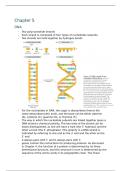
- Two polynucleotide strands
- Each strand is composed of four types of nucleotides subunits
- Two strands are held together by hydrogen bonds
- For the nucleotides in DNA, the sugar is deoxyribose (hence the
name deoxyribonucleic acid), and the base can be either adenine
(A), cytosine (C), guanine (G), or thymine (T).
- The way in which the nucleotide subunits are linked together gives a
DNA strand a chemical polarity. The two ends of the strand can be
easily distinguished, as one will have a hole (the 3’ hydroxyl) and the
other a knob (the 5’ phosphate). This polarity in a DNA strand is
indicated by referring to one end as the 3’ end and the other as the
5’ end.
- A always pairs with T, and G always pairs with C
- genes contain the instructions for producing proteins. As discussed
in Chapter 4, the function of a protein is determined by its three-
dimensional structure, and this structure in turn is determined by the
sequence of the amino acids in its polypeptide chain. The linear
DNA
- Two polynucleotide strands
- Each strand is composed of four types of nucleotides subunits
- Two strands are held together by hydrogen bonds
- For the nucleotides in DNA, the sugar is deoxyribose (hence the
name deoxyribonucleic acid), and the base can be either adenine
(A), cytosine (C), guanine (G), or thymine (T).
- The way in which the nucleotide subunits are linked together gives a
DNA strand a chemical polarity. The two ends of the strand can be
easily distinguished, as one will have a hole (the 3’ hydroxyl) and the
other a knob (the 5’ phosphate). This polarity in a DNA strand is
indicated by referring to one end as the 3’ end and the other as the
5’ end.
- A always pairs with T, and G always pairs with C
- genes contain the instructions for producing proteins. As discussed
in Chapter 4, the function of a protein is determined by its three-
dimensional structure, and this structure in turn is determined by the
sequence of the amino acids in its polypeptide chain. The linear


