Circular motion & Gravitation- A summary.
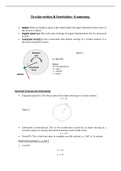
• Radian: When arc length is equal to the radial length, the angel subtended at the centre of
the circle is a radian.
• Angular speed (ω): This is the rate of change of angular displacement (θ). It is measured
in rads-1.
• Centripetal force(Fc): Force associated with objects moving in a circular motion; it is
directed towards the centre.
Figure 1
Important formulae and relationships
• Tangential speed(v): The linear speed of an object moving in a circular motion.
𝑣 = 𝜔𝑟
Figure 2
• Centripetal acceleration(a): This is the acceleration caused by an object moving in a
circular motion, it is always directed towards the centre of the circle.
𝑎 = 𝜔2 𝑟
• Period(T): This is the time taken to complete one full rotation, i.e., 360ᵒ or 2π radians
Relationship between vt, ω, and T.
1. v,ω and r
𝑣 = 𝜔𝑟
𝜔 = 𝑣𝑟
, 𝑎 = 𝜔2 𝑟
𝑣2
𝑎= ⋅𝛾
𝑟2
𝑣2
𝑎=
𝑟
2. Fc, a, ω and v
𝐹𝑐 = 𝑚𝑎
𝑎 = 𝜔2 𝑟 𝑜𝑟 𝑎 = 𝜔2 𝑟
𝑚𝑣 2
𝐹𝑐 = 𝑚𝜔2 𝑟 𝑜𝑟 𝐹𝐶 =
𝑟
3. T and ω
2𝜋
𝑇=
𝜔
Gravitation
The universal law of gravitation:
“In the universe, every object attracts every other object with a force that is directly proportional
to the product of the masses of the objects, and indirectly proportional to the square of the
distance between them.”
Figure 3
From the law:
𝐹 ∝ m1 m2
1
𝐹∝
𝑟2
𝑚1 𝑚2
𝐹∝
𝑟2
𝐺𝑚1 𝑚2
𝐹=
𝑟2
Where G is the universal gravitational constant. It has the value: 𝐺 = 6.67 × 10⁻¹¹ 𝑁𝑚2 𝑘𝑔−2 .
• Radian: When arc length is equal to the radial length, the angel subtended at the centre of
the circle is a radian.
• Angular speed (ω): This is the rate of change of angular displacement (θ). It is measured
in rads-1.
• Centripetal force(Fc): Force associated with objects moving in a circular motion; it is
directed towards the centre.
Figure 1
Important formulae and relationships
• Tangential speed(v): The linear speed of an object moving in a circular motion.
𝑣 = 𝜔𝑟
Figure 2
• Centripetal acceleration(a): This is the acceleration caused by an object moving in a
circular motion, it is always directed towards the centre of the circle.
𝑎 = 𝜔2 𝑟
• Period(T): This is the time taken to complete one full rotation, i.e., 360ᵒ or 2π radians
Relationship between vt, ω, and T.
1. v,ω and r
𝑣 = 𝜔𝑟
𝜔 = 𝑣𝑟
, 𝑎 = 𝜔2 𝑟
𝑣2
𝑎= ⋅𝛾
𝑟2
𝑣2
𝑎=
𝑟
2. Fc, a, ω and v
𝐹𝑐 = 𝑚𝑎
𝑎 = 𝜔2 𝑟 𝑜𝑟 𝑎 = 𝜔2 𝑟
𝑚𝑣 2
𝐹𝑐 = 𝑚𝜔2 𝑟 𝑜𝑟 𝐹𝐶 =
𝑟
3. T and ω
2𝜋
𝑇=
𝜔
Gravitation
The universal law of gravitation:
“In the universe, every object attracts every other object with a force that is directly proportional
to the product of the masses of the objects, and indirectly proportional to the square of the
distance between them.”
Figure 3
From the law:
𝐹 ∝ m1 m2
1
𝐹∝
𝑟2
𝑚1 𝑚2
𝐹∝
𝑟2
𝐺𝑚1 𝑚2
𝐹=
𝑟2
Where G is the universal gravitational constant. It has the value: 𝐺 = 6.67 × 10⁻¹¹ 𝑁𝑚2 𝑘𝑔−2 .