

Written by students who passed Immediately available after payment Read online or as PDF Wrong document? Swap it for free 4.6 TrustPilot
logo-home
Exam (elaborations)

NASM Senior Fitness Specialist SFS Exam | Verified Questions and Answers with Rationales | Multiple Choice, Fill-in-the-Blank & Direct Answers | NASM SFS Certification Prep | Grade A Guaranteed

Rating
-
Sold
-
Pages
23
Grade
A+
Uploaded on
13-04-2026
Written in
2025/2026

INSTANT PDF DOWNLOAD — This is the comprehensive exam preparation guide for the NASM Senior Fitness Specialist (SFS) Exam through the National Academy of Sports Medicine, featuring verified questions and answers with detailed rationales including multiple choice, fill-in-the-blank, and direct answer question formats. Designed for personal trainers, fitness professionals, health coaches, physical therapy assistants, and individuals seeking NASM SFS Certification, this resource consolidates the critical senior fitness and older adult training concepts required to achieve a Grade A score on the certification examination. The NASM Senior Fitness Specialist credential is a specialty certification that empowers fitness professionals to help older adults stave off age-related decline, regain strength, stamina, and flexibility to maintain independence, while understanding the physiological and psychological changes that occur with aging . The guide is meticulously aligned with the current NASM SFS examination blueprint, the NASM Optimum Performance Training (OPT™) Model application for older adults, evidence-based exercise science standards for aging populations, and industry best practices for senior fitness programming . This verified resource provides comprehensive coverage of key NASM Senior Fitness Specialist (SFS) Exam topics, including: scope of practice for senior fitness specialists (role in the healthcare continuum, knowing when to refer older adults to qualified healthcare practitioners, understanding limitations and fitness obstacles of older adults, providing advice about healthy lifestyle choices while staying within professional boundaries, legal requirements when working as a personal trainer, NASM's Code of Professional Conduct, scope of practice limitations for clients with chronic health conditions or physical limitations) , physical and physiological considerations of aging (physiological changes in the nervous system as people age, cardiorespiratory system changes with aging, musculoskeletal system changes (decreased lean body mass, reduced bone density, joint changes, sarcopenia), safety concerns for older adult clients, age-related influences on quality of life, emotional well-being, and self-perception, the psychosocial effects that exercise can have on older adults, understanding age-related changes in metabolism, thermoregulation, immune function, and hormonal regulation) , assessment strategies for older adults (components of an integrated assessment to be used with older adults, screening process to identify health risks and contraindications for exercise, interpreting assessment data to reveal health risks, functional fitness assessments specific to senior populations (chair stand test for lower body strength, arm curl test for upper body strength, 2-minute step test for aerobic endurance, chair sit-and-reach test for lower body flexibility, back scratch test for upper body flexibility, 8-foot up-and-go test for agility and dynamic balance), risk factor screening (cardiovascular disease risk factors, fall risk assessment tools (Timed Up and Go (TUG), Berg Balance Scale, Functional Reach Test), frailty screening, cognitive screening (Mini-Cog, Montreal Cognitive Assessment (MoCA) basics), understanding when to refer to healthcare providers based on assessment findings) , program components for older adults (flexibility guidelines for active older adults (rationale for flexibility training, safely progressing older adults through flexibility training, acute variables for flexibility training with older adults, appropriate stretching techniques (static stretching, dynamic stretching, active stretching, self-myofascial release (SMR)), contraindicated stretches for seniors (avoid ballistic stretching, extreme joint ranges, cervical spine loading, supine positions for clients with GERD or respiratory issues, prone positions for clients with spinal stenosis or breathing difficulties)) , cardiorespiratory training guidelines for active older adults (applying FITTE principles (Frequency, Intensity, Time, Type, Enjoyment) for senior populations, appropriate intensity monitoring methods (rating of perceived exertion (RPE) (Borg 6-20 scale or modified 0-10 scale), talk test, heart rate monitoring with consideration for medications that affect heart rate (beta-blockers), starting zones for deconditioned seniors (Zone 1 training, 65-75% maximum heart rate or RPE 3-4/10), progression strategies for cardiorespiratory endurance, duration recommendations (accumulating 150 minutes per week of moderate-intensity aerobic activity, starting with 10-minute bouts for beginners), types of cardiorespiratory exercise appropriate for seniors (walking, stationary cycling, swimming, water aerobics, elliptical training, recumbent biking), safety considerations (avoid Valsalva maneuver, monitor for dizziness, shortness of breath, angina, excessive fatigue), environmental considerations (temperature regulation (older adults have reduced thermoregulatory capacity), hydration needs, appropriate footwear and clothing)) , core, balance, and plyometric training guidelines for active older adults (epidemiology of falls and importance of fall prevention programming in older adults (1 in 4 adults aged 65+ falls annually, falls are leading cause of injury-related death in older adults, fall-related injuries (hip fractures, head injuries, lacerations, fractures, fear of falling leading to activity restriction and further deconditioning)), core training for seniors (stabilization exercises (prone iso-abs, floor prone cobra, bird-dog, dead bug, plank variations (knee plank, incline plank)), balance training progressions (two-leg stable, single-leg stable, two-leg unstable (foam pad, BOSU ball (dome side up)), single-leg unstable, dynamic balance drills (tandem walk, heel-to-toe walk, single-leg stance with eyes open/closed, reaching activities, weight shifts, Tai Chi movements), balance training frequency (minimum 2-3 times per week, daily preferred), plyometric and reactive training for seniors (low-intensity options (balance and stabilization exercises (balance and reactive exercises without jumping), controlled landing drills (step-offs, small hops), appropriate for Phase 1 and 2 of OPT model, contraindications for plyometric training in seniors (osteoporosis, joint replacements, uncontrolled hypertension, significant balance deficits, history of falls)) , resistance training guidelines for active older adults (adaptations that occur during each phase of the OPT™ Model for senior clients (stabilization-endurance (Phase 1) (improve muscular endurance, stability, posture, balance, corrective exercise), strength-endurance (Phase 2) (supersets combining strength and stabilization), hypertrophy (Phase 3) (higher volume, 8-12 reps, appropriate for experienced seniors), maximal strength (Phase 4) (heavy load, low reps (1-5), requires adequate strength base, bone density, joint health, not appropriate for all seniors), power (Phase 5) (explosive movements, for active, fit seniors without contraindications (osteoporosis, joint issues, balance deficits)), appropriate resistance training exercises for seniors based on OPT model levels, acute variables for senior clients (sets (1-3 sets for beginners, 2-4 sets for intermediate/advanced), repetitions (10-15 reps for stabilization and endurance, 8-12 reps for hypertrophy, 6-10 reps for strength, 1-5 reps for power (advanced only)), intensity (50-70% 1RM for stabilization, 70-85% 1RM for strength/hypertrophy, 85-100% 1RM for maximal strength (advanced)), rest periods (30-60 seconds for stabilization, 60-90 seconds for hypertrophy, 90-120+ seconds for strength/power), tempo (4-2-1 for stabilization (4 seconds eccentric, 2 seconds isometric, 1 second concentric)

Show more Read less
Institution
NASM Senior Fitness Specialist
Course
NASM Senior Fitness Specialist

Content preview

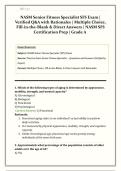
1|Page


NASM Senior Fitness Specialist SFS Exam |
Verified Q&A with Rationales | Multiple Choice,
Fill-in-the-Blank & Direct Answers | NASM SFS
Certification Prep | Grade A


Exam Structure:

Subject: NASM Senior Fitness Specialist (SFS) Exam

Source: Practice Exam Senior Fitness Specialist – Questions and Answers (Verified by

Expert)

Format: Multiple Choice, Fill-in-the-Blank, & Direct Answer with Rationales


1. Which of the following types of aging is determined by appearance,
mobility, strength, and mental capacity?
A) Chronological
B) Biological
C) Functional
D) Psychological
Correct Answer: C) Functional
Rationale:
1. Functional aging refers to an individual’s actual ability to perform
daily activities.
2. It is measured by physical appearance, mobility, strength, and cognitive
capacity.
3. Unlike chronological age, functional age varies greatly among
individuals of the same birth year.

2. Approximately what percentage of the population consists of older
adults over the age of 65?
A) 5%

, 2|Page


B) 8%
C) 12.5%
D) 20%
Correct Answer: C) 12.5%
Rationale:
1. At the time of the exam data, older adults (65+) made up about
12.5% of the U.S. population.
2. This percentage has been increasing due to aging baby boomers.
3. Understanding population demographics helps fitness professionals
plan services.

3. By the year 2050, approximately what percentage of the total
population is projected to be older than the age of 65?
A) 15%
B) 20%
C) 25%
D) 30%
Correct Answer: C) 25%
Rationale:
1. Projections indicate that by 2050, one in four Americans will be 65 or
older.
2. This demographic shift increases demand for senior fitness specialists.
3. Preparing for this trend is essential for long-term career planning.

4. In 2005, health care expenditures for every older adult was
approximately:
A) $5,000
B) $8,000
C) $12,000
D) $15,000
Correct Answer: C) $12,000
Rationale:
1. Older adults have higher healthcare costs due to chronic conditions.
2. In 2005, per capita spending for those 65+ was about $12,000
annually.
3. Regular exercise can reduce healthcare expenditures by preventing
disease.

, 3|Page


5. Which of the following was the most prevalent cause of morbidity in
older adults for the year 2000?
A) Cancer
B) Diabetes
C) Heart disease
D) Arthritis
Correct Answer: C) Heart disease
Rationale:
1. Heart disease remains the leading cause of morbidity and mortality in
older adults.
2. Modifiable risk factors include hypertension, sedentary lifestyle, and
poor diet.
3. Exercise programming should prioritize cardiovascular health.

6. What age-related nervous system change will cause nerve signals to
travel at a slower rate in the central and peripheral nervous system?
A) Loss of myelin
B) Thinning of the dendrites
C) Reduction in brain weight
D) Decreased neurotransmitter production
Correct Answer: B) Thinning of the dendrites
Rationale:
1. Dendrites receive signals from other neurons; thinning reduces
connectivity.
2. This slows nerve conduction velocity and reaction time.
3. Balance and coordination training can partially compensate.

7. What type of training best reverses proprioception loss?
A) Strength training
B) Balance training
C) Cardiorespiratory training
D) Flexibility training
Correct Answer: B) Balance training
Rationale:
1. Proprioception is the body’s ability to sense joint position and
movement.

Written for

Institution
NASM Senior Fitness Specialist
Course
NASM Senior Fitness Specialist

Document information

Uploaded on
April 13, 2026
Number of pages
23
Written in
2025/2026
Type
Exam (elaborations)
Contains
Questions & answers

Subjects

  • nas
$12.49
Get access to the full document:

Wrong document? Swap it for free Within 14 days of purchase and before downloading, you can choose a different document. You can simply spend the amount again.
Written by students who passed
Immediately available after payment
Read online or as PDF


Also available in package deal

Thumbnail
Package deal
NASM Senior Fitness | Group Personal Training |NASM Nutrition Exam | NASM Physique and Bodybuilding | PACKAGE DEAL
-
5 2026
$ 26.97 More info

Get to know the seller

Seller avatar
Reputation scores are based on the amount of documents a seller has sold for a fee and the reviews they have received for those documents. There are three levels: Bronze, Silver and Gold. The better the reputation, the more your can rely on the quality of the sellers work.
Honours Howard Community College
View profile
Follow You need to be logged in order to follow users or courses
Sold
31
Member since
3 months
Number of followers
1
Documents
395
Last sold
9 hours ago

5.0

20 reviews

5
19
4
1
3
0
2
0
1
0

Why students choose Stuvia

Created by fellow students, verified by reviews

Quality you can trust: written by students who passed their tests and reviewed by others who've used these notes.

Didn't get what you expected? Choose another document

No worries! You can instantly pick a different document that better fits what you're looking for.

Pay as you like, start learning right away

No subscription, no commitments. Pay the way you're used to via credit card and download your PDF document instantly.

Student with book image

“Bought, downloaded, and aced it. It really can be that simple.”

Alisha Student

Working on your references?

Create accurate citations in APA, MLA and Harvard with our free citation generator.

Working on your references?

Frequently asked questions

