

Written by students who passed Immediately available after payment Read online or as PDF Wrong document? Swap it for free 4.6 TrustPilot
logo-home
Exam (elaborations)

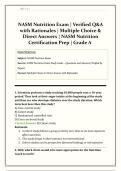
NASM Nutrition Exam | Verified Q&A with Rationales | Multiple Choice & Direct Answers | NASM Nutrition Certification Prep | Grade A

Rating
-
Sold
-
Pages
13
Grade
A+
Uploaded on
13-04-2026
Written in
2025/2026

INSTANT PDF DOWNLOAD — This is the comprehensive exam preparation guide for the NASM Physique and Bodybuilding Coach (PBC) Certification Exam, featuring verified questions and answers with detailed rationales. Designed for personal trainers, bodybuilding coaches, physique competitors, fitness professionals, and nutrition coaches seeking NASM PBC Certification, this resource consolidates the critical physique and bodybuilding training concepts required to achieve a Grade A score on the certification examination. The guide is meticulously aligned with the current NASM PBC curriculum, OPT model application for physique athletes, evidence-based sports nutrition standards, periodization principles, and bodybuilding competition preparation protocols. This verified resource provides comprehensive coverage of key NASM Physique and Bodybuilding Coach Certification Exam topics, including: introduction to physique and bodybuilding coaching (scope of practice for physique coach (training program design for hypertrophy, strength, and conditioning, nutrition coaching for fat loss and muscle gain, contest preparation (peak week, water manipulation, carbohydrate loading, sodium manipulation, tanning, posing, stage presentation), supplementation guidance (legal, NSF-certified, evidence-based), referral to healthcare providers (medical conditions, injury rehabilitation, eating disorders, hormone imbalances), difference between general personal training and physique coaching (goal specificity (muscle hypertrophy, low body fat percentage, symmetrical development, stage presentation vs general health, weight loss, athletic performance), timeline orientation (contest prep with specific show date, off-season vs in-season periodization vs general fitness with flexible timeline), assessment methods (body composition (DEXA, hydrostatic weighing, Bod Pod, skin folds, bioelectrical impedance), circumference measurements (symmetry analysis, stage presentation evaluation, posing assessment), physique photography (front, back, side, mandatory poses), performance metrics (strength standards relative to bodyweight (bench press, squat, deadlift, overhead press, pull-ups), volume load tracking, rep max progression), aesthetic assessment (muscle balance, proportion (adonis index, waist-to-shoulder ratio, shoulder-to-waist-to-hip ratio), visual assessment for lagging body parts, posing improvement)), client populations for physique coaching (recreational bodybuilding (fitness enthusiasts seeking muscle growth and improved body composition, no competition goal, flexible timeline), amateur competitor (first-time or local/regional level bodybuilding, figure, bikini, physique, classic physique, wellness competitor, typically 12-20 week prep), natural bodybuilder (tested federation (OCB, INBA, NANBF, WNBF, USADA-tested shows), no anabolic steroid, SARMs, diuretics, growth hormone use, specific nutrition and supplement protocols to maximize natural testosterone, cortisol management, recovery optimization, longer off-seasons (12-24 months between shows), slower prep (16-24 weeks)), enhanced bodybuilder (non-tested federation (NPC, IFBB Pro League, some regional shows), requires understanding of side effect management (gynecomastia, acne, hair loss, cardiovascular strain, hepatotoxicity, nephrotoxicity, endocrine disruption, mood disorders), not coaching on administration (illegal without prescription, outside scope of practice), may need to coordinate with medical supervision, focus on training and nutrition around supraphysiological androgen levels), lifestyle physique client (general population seeking visible muscle definition, "beach body", not competing, less extreme nutrition protocols, flexible dieting, adherence-focused, realistic timelines, body positivity considerations), special populations (older adults (sarcopenia prevention, joint protection, longer recovery, volume management, testosterone decline, mobility focus), women (hormonal cycle considerations (follicular vs luteal phase performance differences, strength fluctuation, fatigue, hunger, water retention), pregnancy and postpartum (return to training, diastasis recti, pelvic floor, breast surgery recovery (augmentation, reduction, lift, mastectomy, reconstruction)), hormonal contraception effects, menopause (estrogen decline, fat redistribution to abdomen, muscle loss, bone density, sleep disruption, hot flashes), transgender athletes (testosterone use for female-to-male (monitoring per medical provider, performance considerations), estrogen/testosterone blockers for male-to-female (muscle retention, fat redistribution, bone health, federation rules for competition))), exercise physiology for hypertrophy (muscle hypertrophy mechanisms (mechanical tension (primary driver of hypertrophy, force production during eccentric (lengthening) and concentric (shortening) contractions, high threshold motor unit recruitment, tension per motor unit, muscle fiber damage, time under tension (TUT) (30-60 seconds per set optimal for hypertrophy), metabolic stress (accumulation of metabolites (lactate, hydrogen ions, inorganic phosphate, creatine, reactive oxygen species, adenosine phosphate), cellular swelling (pump), anabolic signaling (mTOR activation, satellite cell proliferation, growth factor release), muscle damage (eccentric-induced damage, Z-line streaming, sarcomere disruption, inflammatory response, satellite cell activation, muscle protein synthesis upregulation, DOMS (delayed onset muscle soreness) (peaks 24-72 hours post-exercise), not required for hypertrophy (can be minimized with training familiarization, volume management, recovery strategies))), muscle fiber types (type I (slow-twitch, oxidative, fatigue-resistant, smaller cross-sectional area, recruited during low-intensity, high-repetition training, endurance activities, aerobic metabolism), type IIa (fast-twitch oxidative-glycolytic, intermediate fatigue resistance

Show more Read less
Institution
NASM Nutrition
Course
NASM Nutrition

Content preview

1|Page


NASM Nutrition Exam | Verified Q&A
with Rationales | Multiple Choice &
Direct Answers | NASM Nutrition
Certification Prep | Grade A
Exam Structure:

Subject: NASM Nutrition Exam

Source: NASM Nutrition Exam Study Guide – Questions and Answers (Verified by

Expert)

Format: Multiple Choice & Direct Answer with Rationales


1. Scientists perform a study tracking 10,000 people over a 10-year
period. They look at their sugar intake at the beginning of the study
and then see who develops diabetes over the study duration. Which
term best describes this study?
A) Case-control study
B) Cohort study
C) Randomized controlled trial
D) Cross-sectional study
Correct Answer: B) Cohort study
Rationale:
1. A cohort study follows a group (cohort) over time to see how exposures
affect outcomes.
2. This study design is observational, not interventional.
3. Cohort studies can be prospective (forward-looking) or retrospective.

2. With which client would it be most appropriate for the Nutrition
Coach to work?

, 2|Page


A) Client with eating disorder diagnosis
B) Client with kidney failure on dialysis
C) Client with issues with consistent weight loss
D) Client requiring tube feeding
Correct Answer: C) Client with issues with consistent weight loss
Rationale:
1. Nutrition coaches work with generally healthy individuals on lifestyle
and behavior change.
2. Medical conditions (eating disorders, kidney failure, tube feeding)
require registered dietitians.
3. Weight loss plateaus or inconsistency is within coach scope.

3. Which term describes the phenomenon when a group does not
represent the population a scientist is intending to study?
A) Sampling error
B) Confounding bias
C) Selection bias
D) Measurement bias
Correct Answer: C) Selection bias
Rationale:
1. Selection bias occurs when study participants are not representative of
the target population.
2. Leads to invalid conclusions.
3. Can be reduced by random sampling.

4. What foods tend to have a higher thermic response than others?
A) High-fat foods
B) High-carbohydrate foods
C) High-protein foods
D) High-fiber foods
Correct Answer: C) High-protein foods
Rationale:
1. Thermic effect of food (TEF) is energy used for digestion and
absorption.
2. Protein has the highest TEF (20-30% of calories consumed).
3. Carbohydrate TEF ~5-10%, fat TEF ~0-3%.

Written for

Institution
NASM Nutrition
Course
NASM Nutrition

Document information

Uploaded on
April 13, 2026
Number of pages
13
Written in
2025/2026
Type
Exam (elaborations)
Contains
Questions & answers

Subjects

  • supplement strategies
$12.49
Get access to the full document:

Wrong document? Swap it for free Within 14 days of purchase and before downloading, you can choose a different document. You can simply spend the amount again.
Written by students who passed
Immediately available after payment
Read online or as PDF


Also available in package deal

Thumbnail
Package deal
NASM Senior Fitness | Group Personal Training |NASM Nutrition Exam | NASM Physique and Bodybuilding | PACKAGE DEAL
-
5 2026
$ 26.97 More info

Get to know the seller

Seller avatar
Reputation scores are based on the amount of documents a seller has sold for a fee and the reviews they have received for those documents. There are three levels: Bronze, Silver and Gold. The better the reputation, the more your can rely on the quality of the sellers work.
Honours Howard Community College
View profile
Follow You need to be logged in order to follow users or courses
Sold
31
Member since
3 months
Number of followers
1
Documents
395
Last sold
9 hours ago

5.0

20 reviews

5
19
4
1
3
0
2
0
1
0

Why students choose Stuvia

Created by fellow students, verified by reviews

Quality you can trust: written by students who passed their tests and reviewed by others who've used these notes.

Didn't get what you expected? Choose another document

No worries! You can instantly pick a different document that better fits what you're looking for.

Pay as you like, start learning right away

No subscription, no commitments. Pay the way you're used to via credit card and download your PDF document instantly.

Student with book image

“Bought, downloaded, and aced it. It really can be that simple.”

Alisha Student

Working on your references?

Create accurate citations in APA, MLA and Harvard with our free citation generator.

Working on your references?

Frequently asked questions

