
Respiratory System
I. General structure of the Respiratory System.
It is functionally divided into a conductive region and an exchange
region. The main function of the conductive region is to conduct, moisten,
warm, and filter incoming air. To do this it employs nasal hair, mucus lined
epithelia, sinuses, ciliated epithelia, and blood flow. The conductive
surface is supplied by the systemic circulation.
The exchange surface is denoted by the presence of alveoli and is
supplied by the pulmonary circulation. Alveoli are tiny air sacs where
gases are exchanged between pulmonary capillaries and alveoli (this is
called external respiration). Below is a list of respiratory system structures.
1. Nose: conductive
2. Pharynx: conductive
3. Larynx: conductive
4. Trachea: conductive
5. Bronchi: conductive
6. Bronchioles: conductive unless they contain alveoli
7. Alveoli: exchange
II. Pharynx and Larynx
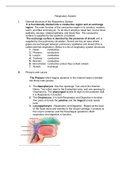
The Pharynx which begins posterior to the internal nares is divided
into three main groups.
1. The Nasopharynx. Has five openings. Two are to the Internal
Nares, Two which lead to the Eustachian tube, and one opening to
Oropharyrnx. The pharyngeal tonsils lie high on the posterior wall.
It is Respiratory in function.
2. The Oropharynx. It is both Respiratory and Digestive in function.
Two pairs of tonsils the palatine and the lingual tonsils reside
here.
3. Laryngopharynx . Respiratory and Digestive. Begins at the level
of the hyoid bone and extends to the cricoid cartilage. Connects to
the Larynx (anterior) and the Esophagus (posterior). Both
respiratory and digestive in function.
, The Larynx (Respiratory only in function)
4. Larynx. Consists of nine pieces of cartilage. Three single and three
paired. Connects the laryngophyarnx with the trachea. Lies
between the C3 and C6 vertebra
5.
1. Summary of cartilages in the larynx
a. One Thyroid ( “ the Adams Apple”)
b. Two Arytenoids
c. One Cricoid
d. Two corniculates
e. Two Cuneiform
III. Trachea
Is a tubular passage way for air. The length is 12 cm (5inches),
diameter 2.5 cm. It is anterior to the Esophagus. It extends from the
Trachea to where it divides into right and left primary bronchi. Is layered,
moving deep to superficial the layers are: Mucosa - a layer of Pseudo
stratified ciliated epithelia interspersed with mucus producing Goblet cells
I. General structure of the Respiratory System.
It is functionally divided into a conductive region and an exchange
region. The main function of the conductive region is to conduct, moisten,
warm, and filter incoming air. To do this it employs nasal hair, mucus lined
epithelia, sinuses, ciliated epithelia, and blood flow. The conductive
surface is supplied by the systemic circulation.
The exchange surface is denoted by the presence of alveoli and is
supplied by the pulmonary circulation. Alveoli are tiny air sacs where
gases are exchanged between pulmonary capillaries and alveoli (this is
called external respiration). Below is a list of respiratory system structures.
1. Nose: conductive
2. Pharynx: conductive
3. Larynx: conductive
4. Trachea: conductive
5. Bronchi: conductive
6. Bronchioles: conductive unless they contain alveoli
7. Alveoli: exchange
II. Pharynx and Larynx
The Pharynx which begins posterior to the internal nares is divided
into three main groups.
1. The Nasopharynx. Has five openings. Two are to the Internal
Nares, Two which lead to the Eustachian tube, and one opening to
Oropharyrnx. The pharyngeal tonsils lie high on the posterior wall.
It is Respiratory in function.
2. The Oropharynx. It is both Respiratory and Digestive in function.
Two pairs of tonsils the palatine and the lingual tonsils reside
here.
3. Laryngopharynx . Respiratory and Digestive. Begins at the level
of the hyoid bone and extends to the cricoid cartilage. Connects to
the Larynx (anterior) and the Esophagus (posterior). Both
respiratory and digestive in function.
, The Larynx (Respiratory only in function)
4. Larynx. Consists of nine pieces of cartilage. Three single and three
paired. Connects the laryngophyarnx with the trachea. Lies
between the C3 and C6 vertebra
5.
1. Summary of cartilages in the larynx
a. One Thyroid ( “ the Adams Apple”)
b. Two Arytenoids
c. One Cricoid
d. Two corniculates
e. Two Cuneiform
III. Trachea
Is a tubular passage way for air. The length is 12 cm (5inches),
diameter 2.5 cm. It is anterior to the Esophagus. It extends from the
Trachea to where it divides into right and left primary bronchi. Is layered,
moving deep to superficial the layers are: Mucosa - a layer of Pseudo
stratified ciliated epithelia interspersed with mucus producing Goblet cells


