

Page 1 of 130
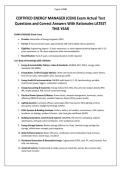
CERTIFIED ENERGY MANAGER (CEM) Exam Actual Test
Questions and Correct Answers With Rationales LATEST
THIS YEAR
EXAM COVERAGE (Point Form)
• Provider: Association of Energy Engineers (AEE)
• Format: 4-hour proctored exam, approximately 100–120 multiple-choice questions
• Eligibility: Engineering degree + 3 years experience, or other degree/technical degree with 5–10
years experience, or 10+ years experience with recommendations
• Recertification: Every 3 years; continuing education credits required
Core Body of Knowledge (AEE CEM BoK)
1. Energy & Sustainability Policies, Codes & Standards: ASHRAE, IECC, EPAct, energy codes,
standards (ISO 50001)
2. Energy Rates, Tariffs & Supply Options: Utility rate structures (demand, energy, power factor),
time-of-use rates, interruptible rates, natural gas tariffs
3. Energy Audits & Instrumentation: ASHRAE audit levels (I, II, III), benchmarking, portable
instruments (power loggers, combustion analyzers)
4. Energy Accounting & Economics: Energy indices (EUI, SEC), life cycle cost analysis (LCCA), NPV,
IRR, simple payback, ROI, cost of conserved energy
5. Electrical Power Systems & Motors: Power factor, demand management, harmonics, motor
efficiency (NEMA Premium), variable frequency drives (VFDs), power quality
6. Lighting Systems: Luminous efficacy, lamp types (LED, fluorescent, HID), lighting controls
(occupancy sensors, daylight harvesting), ballasts
7. HVAC Systems & Building Envelope: Chillers, boilers, air handlers, economizers, VAV systems,
insulation, air leakage, window U-factors, solar heat gain coefficient (SHGC)
8. Building Automation, Controls & AI Systems: BAS/EMS, PID control, scheduling, setpoint
optimization, demand control ventilation, AI for predictive control
9. Energy Storage Systems: Battery storage (lithium-ion, flow), thermal energy storage (ice
storage, chilled water storage), grid integration
10. Boiler & Steam Systems: Boiler efficiency, combustion control, blowdown heat recovery,
condensate return, steam traps, insulation
11. Distributed Generation & Renewable Energy: Cogeneration (CHP), solar PV, wind, biomass, fuel
cells, net metering
12. Industrial Systems: Compressed air (leaks, pressure reduction), pumps, fans, process heat,
waste heat recovery
, Page 2 of 130
13. Operations, Maintenance & Commissioning: M&V (IPMVP), retro-commissioning,
preventive/predictive maintenance
14. Energy Performance Contracts & M&V: ESPC, guaranteed savings, measurement & verification
(Option A, B, C, D)
15. Decarbonization & Climate Action: Greenhouse gas accounting (Scope 1, 2, 3), carbon reduction
strategies, renewable energy credits (RECs), net-zero planning
1. What is the primary role of a Certified Energy Manager (CEM)?
A) To design electrical systems for new buildings
B) To optimize energy performance of facilities, buildings, or industrial plants
C) To install solar panels on residential rooftops
D) To audit financial statements for energy companies
Answer: B) To optimize energy performance of facilities, buildings, or industrial plants
Rationale: The CEM optimizes energy performance across facilities, integrating electrical, mechanical,
and building systems to reduce consumption cost-effectively .
2. The Certified Energy Manager (CEM) certification is offered by which organization?
A) ASHRAE
B) U.S. Department of Energy (DOE)
C) Association of Energy Engineers (AEE)
, Page 3 of 130
D) IEEE
Answer: C) Association of Energy Engineers (AEE)
Rationale: AEE is the global non-profit organization that administers the CEM certification, which is
recognized as the gold standard in energy management .
3. A CEM certification must be renewed every:
A) 1 year
B) 2 years
C) 3 years
D) 5 years
Answer: C) 3 years
Rationale: CEM certification requires renewal every three years, with continuing education credits
needed to stay current with industry practices .
4. In 2024, AEE updated the CEM Body of Knowledge to include which new critical topic area?
A) Nuclear power plant design
B) Decarbonization and climate action
C) Coal-fired boiler maintenance
, Page 4 of 130
D) Manual data entry techniques
Answer: B) Decarbonization and climate action
Rationale: AEE’s 2024 update added decarbonization and climate change topics to ensure CEMs can
drive global decarbonization through advanced energy strategies .
5. The three scopes of greenhouse gas (GHG) emissions are defined by:
A) The Kyoto Protocol
B) The Greenhouse Gas (GHG) Protocol
C) ASHRAE Standard 90.1
D) ISO 50001
Answer: B) The Greenhouse Gas (GHG) Protocol
Rationale: The GHG Protocol defines Scope 1 (direct), Scope 2 (indirect from purchased energy), and
Scope 3 (other indirect emissions) for corporate accounting .
6. Which of the following is an example of a Scope 2 GHG emission for a manufacturing facility?
A) Natural gas burned in a boiler on site
B) Electricity purchased from the utility grid
C) Employee business travel in personal vehicles
CERTIFIED ENERGY MANAGER (CEM) Exam Actual Test
Questions and Correct Answers With Rationales LATEST
THIS YEAR
EXAM COVERAGE (Point Form)
• Provider: Association of Energy Engineers (AEE)
• Format: 4-hour proctored exam, approximately 100–120 multiple-choice questions
• Eligibility: Engineering degree + 3 years experience, or other degree/technical degree with 5–10
years experience, or 10+ years experience with recommendations
• Recertification: Every 3 years; continuing education credits required
Core Body of Knowledge (AEE CEM BoK)
1. Energy & Sustainability Policies, Codes & Standards: ASHRAE, IECC, EPAct, energy codes,
standards (ISO 50001)
2. Energy Rates, Tariffs & Supply Options: Utility rate structures (demand, energy, power factor),
time-of-use rates, interruptible rates, natural gas tariffs
3. Energy Audits & Instrumentation: ASHRAE audit levels (I, II, III), benchmarking, portable
instruments (power loggers, combustion analyzers)
4. Energy Accounting & Economics: Energy indices (EUI, SEC), life cycle cost analysis (LCCA), NPV,
IRR, simple payback, ROI, cost of conserved energy
5. Electrical Power Systems & Motors: Power factor, demand management, harmonics, motor
efficiency (NEMA Premium), variable frequency drives (VFDs), power quality
6. Lighting Systems: Luminous efficacy, lamp types (LED, fluorescent, HID), lighting controls
(occupancy sensors, daylight harvesting), ballasts
7. HVAC Systems & Building Envelope: Chillers, boilers, air handlers, economizers, VAV systems,
insulation, air leakage, window U-factors, solar heat gain coefficient (SHGC)
8. Building Automation, Controls & AI Systems: BAS/EMS, PID control, scheduling, setpoint
optimization, demand control ventilation, AI for predictive control
9. Energy Storage Systems: Battery storage (lithium-ion, flow), thermal energy storage (ice
storage, chilled water storage), grid integration
10. Boiler & Steam Systems: Boiler efficiency, combustion control, blowdown heat recovery,
condensate return, steam traps, insulation
11. Distributed Generation & Renewable Energy: Cogeneration (CHP), solar PV, wind, biomass, fuel
cells, net metering
12. Industrial Systems: Compressed air (leaks, pressure reduction), pumps, fans, process heat,
waste heat recovery
, Page 2 of 130
13. Operations, Maintenance & Commissioning: M&V (IPMVP), retro-commissioning,
preventive/predictive maintenance
14. Energy Performance Contracts & M&V: ESPC, guaranteed savings, measurement & verification
(Option A, B, C, D)
15. Decarbonization & Climate Action: Greenhouse gas accounting (Scope 1, 2, 3), carbon reduction
strategies, renewable energy credits (RECs), net-zero planning
1. What is the primary role of a Certified Energy Manager (CEM)?
A) To design electrical systems for new buildings
B) To optimize energy performance of facilities, buildings, or industrial plants
C) To install solar panels on residential rooftops
D) To audit financial statements for energy companies
Answer: B) To optimize energy performance of facilities, buildings, or industrial plants
Rationale: The CEM optimizes energy performance across facilities, integrating electrical, mechanical,
and building systems to reduce consumption cost-effectively .
2. The Certified Energy Manager (CEM) certification is offered by which organization?
A) ASHRAE
B) U.S. Department of Energy (DOE)
C) Association of Energy Engineers (AEE)
, Page 3 of 130
D) IEEE
Answer: C) Association of Energy Engineers (AEE)
Rationale: AEE is the global non-profit organization that administers the CEM certification, which is
recognized as the gold standard in energy management .
3. A CEM certification must be renewed every:
A) 1 year
B) 2 years
C) 3 years
D) 5 years
Answer: C) 3 years
Rationale: CEM certification requires renewal every three years, with continuing education credits
needed to stay current with industry practices .
4. In 2024, AEE updated the CEM Body of Knowledge to include which new critical topic area?
A) Nuclear power plant design
B) Decarbonization and climate action
C) Coal-fired boiler maintenance
, Page 4 of 130
D) Manual data entry techniques
Answer: B) Decarbonization and climate action
Rationale: AEE’s 2024 update added decarbonization and climate change topics to ensure CEMs can
drive global decarbonization through advanced energy strategies .
5. The three scopes of greenhouse gas (GHG) emissions are defined by:
A) The Kyoto Protocol
B) The Greenhouse Gas (GHG) Protocol
C) ASHRAE Standard 90.1
D) ISO 50001
Answer: B) The Greenhouse Gas (GHG) Protocol
Rationale: The GHG Protocol defines Scope 1 (direct), Scope 2 (indirect from purchased energy), and
Scope 3 (other indirect emissions) for corporate accounting .
6. Which of the following is an example of a Scope 2 GHG emission for a manufacturing facility?
A) Natural gas burned in a boiler on site
B) Electricity purchased from the utility grid
C) Employee business travel in personal vehicles


