

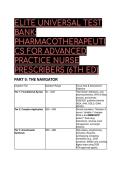
ELITE UNIVERSAL TEST
BANK:
PHARMACOTHERAPEUTI
CS FOR ADVANCED
PRACTICE NURSE
PRESCRIBERS (6TH ED)
PART 0: THE NAVIGATOR
Cognitive Tier Question Range Focus Area & Assessment
Objective
Tier 1: Foundational Syntax Q1 – Q28 "Hard Deck" definitions, core
pharmacokinetics, WHO 6-Step
process, and primary
2026/2027 guideline theories
(ADA, AHA, GOLD, GINA,
KDIGO).
Tier 2: Complex Application Q29 – Q58 Clinical simulation: "Situation X
occurs. Variable Y changes.
What is the IMMEDIATE
action?" Tests drug
interactions, adverse event
management, and target
titrations.
Tier 3: Grandmaster Q59 – Q88 High-stakes, polypharmacy
Synthesis scenarios. Requires
synthesizing competing
morbidities (e.g., CKM
syndrome, MASH) and avoiding
legacy traps using 2026
FDA-approved agents.
,PART I: THE PRIMER
Mastery of this test bank translates directly to elite clinical decision-making, forging practitioners
capable of navigating the complex intersections of the 2026/2027 global pharmacological
guidelines. By deconstructing these advanced scenarios, you transition from rote generalist to
precision prescriber.
The "Critical Axioms" Cheat Sheet
2026/2027 Clinical Framework The "Hard Deck" Rule Clinical Translation for APRNs
(Non-Negotiable)
AHA PREVENT Calculator Replaces Pooled Cohort When calculating 10-year
Equations; removes race; ASCVD risk, biological markers
integrates CKM factors (eGFR,of renal and metabolic damage
UACR, HbA1c). supersede demographic
proxies.
ADA MASH/MASLD Mandate GLP-1 receptor agonists are Incretin therapy is now a
unequivocally first-line for type dual-diagnosis tool, targeting
2 diabetes with biopsy-proven both glycemic control and
steatohepatitis. aggressive hepatic fat
clearance.
GINA MART Standard SABA monotherapy is obsolete. Every asthmatic breath requires
Maintenance and Reliever an anti-inflammatory blanket.
Therapy (MART) using Rescue bronchodilation without
ICS-formoterol is the global an ICS fuels exacerbations.
standard.
GOLD Exacerbation Shift A single moderate exacerbation One exacerbation represents a
classifies the patient as pharmacological system failure;
high-risk, demanding escalation escalate therapy immediately to
to achieve "low disease protect lung parenchyma.
activity".
KDIGO Anemia Ceiling Withhold routine intravenous Respect the ferritin ceiling to
iron in CKD if ferritin >700 prevent massive multi-organ
ng/mL or TSAT ≥40%. iron deposition and oxidative
stress.
PART II: THE ELITE TEST BANK
TIER 1: FOUNDATIONAL SYNTAX & APPLICATION (Q1–Q28)
Q1: According to the WHO 6-step process for rational prescribing, an APRN assesses a patient
and diagnoses acute otitis media. What is the IMMEDIATE next step required before selecting a
drug? A) Select the P-drug B) Specify the therapeutic objective C) Initiate antimicrobial therapy
D) Verify the suitability of the standard treatment
● The Answer: B (Specify the therapeutic objective)
● Distractor Analysis:
○ A is incorrect: Selecting the P-drug is Step 3 and requires an objective to guide it.
, ○ C is incorrect: Initiating therapy is Step 4.
○ D is incorrect: Verifying suitability is Step 3b.
The Mentor's Analysis: Step 2 defines the clinical target (e.g., eradicate infection, alleviate pain)
to anchor drug selection and monitoring. Professional/Academic Intuition: Always establish the
clinical destination before selecting the pharmacological vehicle.
Q2: An APRN utilizes the AHA 2026 PREVENT calculator for a 45-year-old male. Which
variable, historically relied upon in the legacy Pooled Cohort Equations, is EXCLUDED from this
contemporary algorithm? A) Systolic blood pressure B) Patient race C) Estimated glomerular
filtration rate (eGFR) D) Hemoglobin A1c
● The Answer: B (Patient race)
● Distractor Analysis:
○ A is incorrect: Blood pressure remains a core metric.
○ C is incorrect: eGFR is a newly integrated variable in the PREVENT model.
○ D is incorrect: HbA1c is a newly integrated metabolic variable.
The Mentor's Analysis: The PREVENT calculator removes race to eliminate biological fallacies
and introduces cardiovascular-kidney-metabolic (CKM) factors for precise, equitable risk
assessment. Professional/Academic Intuition: Modern risk stratification relies on
biomarkers, not demographic proxies.
Q3: Under the ADA 2026 Standards of Care, a 28-year-old patient with Type 1 Diabetes and a
BMI of 31 kg/m² seeks weight management. Which pharmacologic intervention is newly
endorsed FIRST line alongside insulin? A) Metformin B) A GLP-1 receptor agonist C) A
sulfonylurea D) Orlistat
● The Answer: B (A GLP-1 receptor agonist)
● Distractor Analysis:
○ A is incorrect: Metformin may reduce insulin requirements but lacks potent weight
loss efficacy.
○ C is incorrect: Sulfonylureas cause weight gain and are contraindicated in T1D.
○ D is incorrect: Orlistat is an older agent with poor adherence and minimal efficacy.
The Mentor's Analysis: The 2026 ADA guidelines formally endorse GLP-1 therapies for T1D
patients with obesity to manage weight and reduce cardiovascular risk, provided insulin is
adjusted. Professional/Academic Intuition: Incretin therapy is now a dual-diagnosis tool,
spanning both T2D and T1D with obesity.
Q4: A pediatric patient (6 years old) is diagnosed with Lyme disease. According to 2026
antimicrobial standards, which agent is the drug of choice DESPITE legacy pediatric warnings?
A) Amoxicillin B) Azithromycin C) Doxycycline D) Ceftriaxone
● The Answer: C (Doxycycline)
● Distractor Analysis:
○ A is incorrect: Amoxicillin is an alternative but not superior for tick-borne pathogens.
○ B is incorrect: Macrolides have high failure rates in Lyme.
○ D is incorrect: IV Ceftriaxone is reserved for severe neurological/cardiac Lyme.
The Mentor's Analysis: Short courses of doxycycline (under 21 days) do not cause visible dental
staining in children under 8. It is the gold standard for tick-borne illness across all ages.
Professional/Academic Intuition: For vector-borne disease, the tetracycline class outweighs
legacy dental fears.
Q5: According to KDIGO 2026, an APRN is managing a patient with CKD stage 4 and anemia.
The patient's ferritin is 750 ng/mL and TSAT is 42%. Which action is MOST APPROPRIATE? A)
Initiate a trial of oral iron B) Administer intravenous iron dextran C) Withhold routine iron therapy
D) Initiate a blood transfusion
BANK:
PHARMACOTHERAPEUTI
CS FOR ADVANCED
PRACTICE NURSE
PRESCRIBERS (6TH ED)
PART 0: THE NAVIGATOR
Cognitive Tier Question Range Focus Area & Assessment
Objective
Tier 1: Foundational Syntax Q1 – Q28 "Hard Deck" definitions, core
pharmacokinetics, WHO 6-Step
process, and primary
2026/2027 guideline theories
(ADA, AHA, GOLD, GINA,
KDIGO).
Tier 2: Complex Application Q29 – Q58 Clinical simulation: "Situation X
occurs. Variable Y changes.
What is the IMMEDIATE
action?" Tests drug
interactions, adverse event
management, and target
titrations.
Tier 3: Grandmaster Q59 – Q88 High-stakes, polypharmacy
Synthesis scenarios. Requires
synthesizing competing
morbidities (e.g., CKM
syndrome, MASH) and avoiding
legacy traps using 2026
FDA-approved agents.
,PART I: THE PRIMER
Mastery of this test bank translates directly to elite clinical decision-making, forging practitioners
capable of navigating the complex intersections of the 2026/2027 global pharmacological
guidelines. By deconstructing these advanced scenarios, you transition from rote generalist to
precision prescriber.
The "Critical Axioms" Cheat Sheet
2026/2027 Clinical Framework The "Hard Deck" Rule Clinical Translation for APRNs
(Non-Negotiable)
AHA PREVENT Calculator Replaces Pooled Cohort When calculating 10-year
Equations; removes race; ASCVD risk, biological markers
integrates CKM factors (eGFR,of renal and metabolic damage
UACR, HbA1c). supersede demographic
proxies.
ADA MASH/MASLD Mandate GLP-1 receptor agonists are Incretin therapy is now a
unequivocally first-line for type dual-diagnosis tool, targeting
2 diabetes with biopsy-proven both glycemic control and
steatohepatitis. aggressive hepatic fat
clearance.
GINA MART Standard SABA monotherapy is obsolete. Every asthmatic breath requires
Maintenance and Reliever an anti-inflammatory blanket.
Therapy (MART) using Rescue bronchodilation without
ICS-formoterol is the global an ICS fuels exacerbations.
standard.
GOLD Exacerbation Shift A single moderate exacerbation One exacerbation represents a
classifies the patient as pharmacological system failure;
high-risk, demanding escalation escalate therapy immediately to
to achieve "low disease protect lung parenchyma.
activity".
KDIGO Anemia Ceiling Withhold routine intravenous Respect the ferritin ceiling to
iron in CKD if ferritin >700 prevent massive multi-organ
ng/mL or TSAT ≥40%. iron deposition and oxidative
stress.
PART II: THE ELITE TEST BANK
TIER 1: FOUNDATIONAL SYNTAX & APPLICATION (Q1–Q28)
Q1: According to the WHO 6-step process for rational prescribing, an APRN assesses a patient
and diagnoses acute otitis media. What is the IMMEDIATE next step required before selecting a
drug? A) Select the P-drug B) Specify the therapeutic objective C) Initiate antimicrobial therapy
D) Verify the suitability of the standard treatment
● The Answer: B (Specify the therapeutic objective)
● Distractor Analysis:
○ A is incorrect: Selecting the P-drug is Step 3 and requires an objective to guide it.
, ○ C is incorrect: Initiating therapy is Step 4.
○ D is incorrect: Verifying suitability is Step 3b.
The Mentor's Analysis: Step 2 defines the clinical target (e.g., eradicate infection, alleviate pain)
to anchor drug selection and monitoring. Professional/Academic Intuition: Always establish the
clinical destination before selecting the pharmacological vehicle.
Q2: An APRN utilizes the AHA 2026 PREVENT calculator for a 45-year-old male. Which
variable, historically relied upon in the legacy Pooled Cohort Equations, is EXCLUDED from this
contemporary algorithm? A) Systolic blood pressure B) Patient race C) Estimated glomerular
filtration rate (eGFR) D) Hemoglobin A1c
● The Answer: B (Patient race)
● Distractor Analysis:
○ A is incorrect: Blood pressure remains a core metric.
○ C is incorrect: eGFR is a newly integrated variable in the PREVENT model.
○ D is incorrect: HbA1c is a newly integrated metabolic variable.
The Mentor's Analysis: The PREVENT calculator removes race to eliminate biological fallacies
and introduces cardiovascular-kidney-metabolic (CKM) factors for precise, equitable risk
assessment. Professional/Academic Intuition: Modern risk stratification relies on
biomarkers, not demographic proxies.
Q3: Under the ADA 2026 Standards of Care, a 28-year-old patient with Type 1 Diabetes and a
BMI of 31 kg/m² seeks weight management. Which pharmacologic intervention is newly
endorsed FIRST line alongside insulin? A) Metformin B) A GLP-1 receptor agonist C) A
sulfonylurea D) Orlistat
● The Answer: B (A GLP-1 receptor agonist)
● Distractor Analysis:
○ A is incorrect: Metformin may reduce insulin requirements but lacks potent weight
loss efficacy.
○ C is incorrect: Sulfonylureas cause weight gain and are contraindicated in T1D.
○ D is incorrect: Orlistat is an older agent with poor adherence and minimal efficacy.
The Mentor's Analysis: The 2026 ADA guidelines formally endorse GLP-1 therapies for T1D
patients with obesity to manage weight and reduce cardiovascular risk, provided insulin is
adjusted. Professional/Academic Intuition: Incretin therapy is now a dual-diagnosis tool,
spanning both T2D and T1D with obesity.
Q4: A pediatric patient (6 years old) is diagnosed with Lyme disease. According to 2026
antimicrobial standards, which agent is the drug of choice DESPITE legacy pediatric warnings?
A) Amoxicillin B) Azithromycin C) Doxycycline D) Ceftriaxone
● The Answer: C (Doxycycline)
● Distractor Analysis:
○ A is incorrect: Amoxicillin is an alternative but not superior for tick-borne pathogens.
○ B is incorrect: Macrolides have high failure rates in Lyme.
○ D is incorrect: IV Ceftriaxone is reserved for severe neurological/cardiac Lyme.
The Mentor's Analysis: Short courses of doxycycline (under 21 days) do not cause visible dental
staining in children under 8. It is the gold standard for tick-borne illness across all ages.
Professional/Academic Intuition: For vector-borne disease, the tetracycline class outweighs
legacy dental fears.
Q5: According to KDIGO 2026, an APRN is managing a patient with CKD stage 4 and anemia.
The patient's ferritin is 750 ng/mL and TSAT is 42%. Which action is MOST APPROPRIATE? A)
Initiate a trial of oral iron B) Administer intravenous iron dextran C) Withhold routine iron therapy
D) Initiate a blood transfusion


