

PPG1: Public policy: an introduction to the field
Objectives:
Why do we need public policy anyhow?
Two different perspectives on public policy.
- Positivist perspective: assuming that policies are designed and implemented under
conditions of bounded rationality, and that policy-making is mainly a technocratic
process.
- Constructivist perspective: assuming that policies are largely made of language. As
such policy-making is always open to multiple interpretations and hence open to
political claims-making.
Literature:
● Knill & Tosun chapter 1 (Introduction), pp. 1-13.
● Stone: Introduction & Chapter 1 (The market and the polis), pp. 1-36.
I. Why public policy?
- There are a lot of things to deal with in public ways, in order to do that we need
policies.
- Policy happens in a context of the state and is subjected to political interests and
processes.
=> Policies do not always play out, policy making is usually a slow process bc you have to
observe during long periods of time and sometimes you do not have all the information.
Examples: public policy in action:
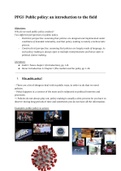
,=> We can conclude that public policy can be found everywhere. All problems in the
society can be solved by changing/making public policy. Police are very important and
are required to do everything and change the status quo.
Much policy is needed to move around your city or town
Without policy?:
Policy helps us to:
1) Set goals and invent solutions: if you as a government you don't have a goal you don't
need policy.
,2) Allocate means to achieve solutions: The mean is called a policy instrument. There are
three basic policy instruments: a. Money; raise taxes for example, reallocated in order to
be able to implement policies. b. Rules and regulations c. Communication meant to
convince us that, for example, we should change our behavior.
3) Coordinate efforts to work on solutions: ethre is the need of an actor, the government
to coordinate efforts ex: global warming, covid…
4) Divide tasks gov and non-gov
5) Make gov predictable: live under the rule of law, we need policy and rules to predict
government, otherwise it is an authoritarian system (+corruption -predictable). It is
important that the government is predictable, because it should clarify what the limits
of the governments are. This way, a dictatorship is prevented.
6) Influence behavioral change: taxes, fines… among the population to make them do
something, this is very complex because there are a lot of different actors with
different ideas and interests.
II) Two perspectives on public policy
Ex: FOOD POLICY
+ importing food from different countries
+ there is a big and complex mechanism with different actors and steps, and
processes (production, transportation, preparation, sell…)
Steam meals I: meat Steam meals II: fish
, Steam meals III: veggie => Long production chains
Less obvious aspects food safety:
List of ingredients EFSA
Date Inspections
II. Positivist take: Knill and Tosum (rationalist)
● Focus on facts and proof: We need to be able to rely on scientific
knowledge/evidence (ex: food policy → temperature, health,
conditions, dates…). There is no way of making policy if there are no
facts.
● Bounded rationality: Human beings have limited capacity to process
information, we do not process everything. The rationality of human’s
is limited. We are not able to take all the available information into
account. Not all possible solutions and dimensions can be overseen.
Policy is not purely rational.
● Behave according to interest: Actors behave according to their
self-interest. If you are a rational human being, you will try to
maximize your self-interest.
Objectives:
Why do we need public policy anyhow?
Two different perspectives on public policy.
- Positivist perspective: assuming that policies are designed and implemented under
conditions of bounded rationality, and that policy-making is mainly a technocratic
process.
- Constructivist perspective: assuming that policies are largely made of language. As
such policy-making is always open to multiple interpretations and hence open to
political claims-making.
Literature:
● Knill & Tosun chapter 1 (Introduction), pp. 1-13.
● Stone: Introduction & Chapter 1 (The market and the polis), pp. 1-36.
I. Why public policy?
- There are a lot of things to deal with in public ways, in order to do that we need
policies.
- Policy happens in a context of the state and is subjected to political interests and
processes.
=> Policies do not always play out, policy making is usually a slow process bc you have to
observe during long periods of time and sometimes you do not have all the information.
Examples: public policy in action:
,=> We can conclude that public policy can be found everywhere. All problems in the
society can be solved by changing/making public policy. Police are very important and
are required to do everything and change the status quo.
Much policy is needed to move around your city or town
Without policy?:
Policy helps us to:
1) Set goals and invent solutions: if you as a government you don't have a goal you don't
need policy.
,2) Allocate means to achieve solutions: The mean is called a policy instrument. There are
three basic policy instruments: a. Money; raise taxes for example, reallocated in order to
be able to implement policies. b. Rules and regulations c. Communication meant to
convince us that, for example, we should change our behavior.
3) Coordinate efforts to work on solutions: ethre is the need of an actor, the government
to coordinate efforts ex: global warming, covid…
4) Divide tasks gov and non-gov
5) Make gov predictable: live under the rule of law, we need policy and rules to predict
government, otherwise it is an authoritarian system (+corruption -predictable). It is
important that the government is predictable, because it should clarify what the limits
of the governments are. This way, a dictatorship is prevented.
6) Influence behavioral change: taxes, fines… among the population to make them do
something, this is very complex because there are a lot of different actors with
different ideas and interests.
II) Two perspectives on public policy
Ex: FOOD POLICY
+ importing food from different countries
+ there is a big and complex mechanism with different actors and steps, and
processes (production, transportation, preparation, sell…)
Steam meals I: meat Steam meals II: fish
, Steam meals III: veggie => Long production chains
Less obvious aspects food safety:
List of ingredients EFSA
Date Inspections
II. Positivist take: Knill and Tosum (rationalist)
● Focus on facts and proof: We need to be able to rely on scientific
knowledge/evidence (ex: food policy → temperature, health,
conditions, dates…). There is no way of making policy if there are no
facts.
● Bounded rationality: Human beings have limited capacity to process
information, we do not process everything. The rationality of human’s
is limited. We are not able to take all the available information into
account. Not all possible solutions and dimensions can be overseen.
Policy is not purely rational.
● Behave according to interest: Actors behave according to their
self-interest. If you are a rational human being, you will try to
maximize your self-interest.


