

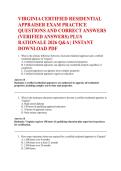
VIRGINIA CERTIFIED RESIDENTIAL
APPRAISER EXAM PRACTICE
QUESTIONS AND CORRECT ANSWERS
(VERIFIED ANSWERS) PLUS
RATIONALE 2026 Q&A | INSTANT
DOWNLOAD PDF
1. What is the primary difference between a licensed residential appraiser and a certified
residential appraiser in Virginia?
A. Certified residential appraisers can appraise commercial properties
B. Certified residential appraisers can appraise any residential property regardless of
complexity
C. Licensed appraisers can appraise more complex properties
D. Certified residential appraisers require no education
Answer: B
Rationale: Certified residential appraisers are authorized to appraise all residential
properties, including complex one-to-four unit properties.
2. What is the minimum education requirement to become a certified residential appraiser in
Virginia?
A. High school diploma
B. 150 hours of qualifying appraisal education
C. 30 hours of appraisal courses
D. Only trainee experience
Answer: B
Rationale: Virginia requires 150 hours of qualifying education plus supervised experience
for certification.
3. How many experience hours are required for a certified residential appraiser in Virginia?
A. 1,000 hours over 6 months
B. 1,500 hours over at least 12 months
C. 2,500 hours over 24 months
D. 3,000 hours
,Answer: B
Rationale: Applicants must complete 1,500 hours over a minimum of 12 months as part of
supervised experience.
4. Which appraisal approaches are typically used by certified residential appraisers?
A. Cost approach only
B. Sales comparison, cost, and income approaches
C. Income approach only
D. Replacement value only
Answer: B
Rationale: Certified appraisers use all three approaches to determine credible market
value.
5. What is the primary approach used for typical residential properties?
A. Income approach
B. Sales comparison approach
C. Cost approach
D. Tax assessment
Answer: B
Rationale: Compares subject to similar recently sold properties to estimate market value.
6. What is the main use of the cost approach?
A. Valuing income properties
B. Estimating value for new or unique properties
C. Determining market rent
D. Tax evaluation
Answer: B
Rationale: Cost approach is reliable when comparable sales are limited.
7. What is the main use of the income approach?
A. Estimate replacement cost
B. Estimate value based on income generated by the property
C. Compare sales only
D. Evaluate depreciation
, Answer: B
Rationale: Converts net operating income into market value for investment or rental
properties.
8. What is a market value definition?
A. Tax assessment
B. Most probable price a willing buyer and seller would agree upon under typical market
conditions
C. Owner’s opinion
D. Loan amount
Answer: B
Rationale: Market value is the standard used in appraisal practice.
9. What is the highest and best use analysis?
A. Owner’s preference
B. Legally permissible, physically possible, financially feasible, and maximally
productive use of property
C. Lease assessment
D. Tax purpose
Answer: B
Rationale: Determines the most appropriate use to maximize property value.
10. What is functional obsolescence?
A. External neighborhood issues
B. Loss of value due to design or layout deficiencies
C. Physical deterioration only
D. Tax adjustments
Answer: B
Rationale: Reduces property utility or desirability and is included in depreciation
calculations.
11. What is external obsolescence?
A. Internal functional issues
B. Loss of value due to factors outside the property
APPRAISER EXAM PRACTICE
QUESTIONS AND CORRECT ANSWERS
(VERIFIED ANSWERS) PLUS
RATIONALE 2026 Q&A | INSTANT
DOWNLOAD PDF
1. What is the primary difference between a licensed residential appraiser and a certified
residential appraiser in Virginia?
A. Certified residential appraisers can appraise commercial properties
B. Certified residential appraisers can appraise any residential property regardless of
complexity
C. Licensed appraisers can appraise more complex properties
D. Certified residential appraisers require no education
Answer: B
Rationale: Certified residential appraisers are authorized to appraise all residential
properties, including complex one-to-four unit properties.
2. What is the minimum education requirement to become a certified residential appraiser in
Virginia?
A. High school diploma
B. 150 hours of qualifying appraisal education
C. 30 hours of appraisal courses
D. Only trainee experience
Answer: B
Rationale: Virginia requires 150 hours of qualifying education plus supervised experience
for certification.
3. How many experience hours are required for a certified residential appraiser in Virginia?
A. 1,000 hours over 6 months
B. 1,500 hours over at least 12 months
C. 2,500 hours over 24 months
D. 3,000 hours
,Answer: B
Rationale: Applicants must complete 1,500 hours over a minimum of 12 months as part of
supervised experience.
4. Which appraisal approaches are typically used by certified residential appraisers?
A. Cost approach only
B. Sales comparison, cost, and income approaches
C. Income approach only
D. Replacement value only
Answer: B
Rationale: Certified appraisers use all three approaches to determine credible market
value.
5. What is the primary approach used for typical residential properties?
A. Income approach
B. Sales comparison approach
C. Cost approach
D. Tax assessment
Answer: B
Rationale: Compares subject to similar recently sold properties to estimate market value.
6. What is the main use of the cost approach?
A. Valuing income properties
B. Estimating value for new or unique properties
C. Determining market rent
D. Tax evaluation
Answer: B
Rationale: Cost approach is reliable when comparable sales are limited.
7. What is the main use of the income approach?
A. Estimate replacement cost
B. Estimate value based on income generated by the property
C. Compare sales only
D. Evaluate depreciation
, Answer: B
Rationale: Converts net operating income into market value for investment or rental
properties.
8. What is a market value definition?
A. Tax assessment
B. Most probable price a willing buyer and seller would agree upon under typical market
conditions
C. Owner’s opinion
D. Loan amount
Answer: B
Rationale: Market value is the standard used in appraisal practice.
9. What is the highest and best use analysis?
A. Owner’s preference
B. Legally permissible, physically possible, financially feasible, and maximally
productive use of property
C. Lease assessment
D. Tax purpose
Answer: B
Rationale: Determines the most appropriate use to maximize property value.
10. What is functional obsolescence?
A. External neighborhood issues
B. Loss of value due to design or layout deficiencies
C. Physical deterioration only
D. Tax adjustments
Answer: B
Rationale: Reduces property utility or desirability and is included in depreciation
calculations.
11. What is external obsolescence?
A. Internal functional issues
B. Loss of value due to factors outside the property


