

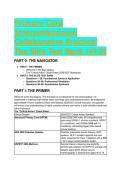
Primary Care
Interprofessional
Collaborative Practice:
The Elite Test Bank (v9.0)
PART 0: THE NAVIGATOR
● PART I: THE PRIMER
○ Welcome to the Big Leagues
○ The "Critical Action" Cheat Sheet (2026/2027 Standards)
● PART II: THE ELITE TEST BANK
○ Questions 1–28: Foundational Syntax & Application
○ Questions 29–58: Professional Simulation
○ Questions 59–88: Grandmaster Synthesis
PART I: THE PRIMER
Welcome to the big leagues. This test bank is not designed for rote memorization; it is
engineered to intercept high-stakes errors and forge your professional intuition. By bridging the
gap between A-level academic theory and flawless 2026/2027 clinical execution, this gauntlet
will ensure your understanding of highly complex primary care topics is both radically simple and
lethal in practice.
The "Critical Action" Cheat Sheet:
Clinical Domain 2026/2027 Critical Action Standard
Advanced Primary Care (APCM) Under 2026 CMS rules, bill comprehensive
care using G0556 (1 chronic condition), G0557
(2+ conditions), and G0558 (QMB with 2+
conditions), eliminating legacy time-based
minute tracking.
ADA 2026 Diabetes Updates Prioritize Automated Insulin Delivery (AID)
systems. GLP-1 receptor agonists are now
newly supported for Type 1 diabetics with a BMI
> 30 to target cardiometabolic health.
USPSTF 2026 Matrices Cervical cancer screening now explicitly
permits self-collection of hrHPV for average-risk
patients aged 30-65. Breast cancer
mammography is biennial from ages 40 to 74.
,Clinical Domain 2026/2027 Critical Action Standard
Texas APRN Practice (HB 3794) Under 2026 frameworks, eligible APRNs with
3,000+ hours may achieve independent
practice authority, formulating diagnoses and
prescribing independently, though state PMP
checks remain mandatory.
PART II: THE ELITE TEST BANK
Questions 1–28: Foundational Syntax & Application
Q1: An interprofessional primary care team is utilizing the 2026 Advanced Primary Care
Management (APCM) framework for a patient with uncontrolled hypertension and osteoarthritis.
Which factor MOST DIRECTLY qualifies the team to bill under the APCM code G0557 rather
than legacy Chronic Care Management (CCM) codes? A) The team documented exactly 20
minutes of non-face-to-face clinical staff time. B) The patient has two or more chronic conditions
expected to last 12 months without time-based tracking constraints. C) The patient received an
in-person, face-to-face visit within the last 30 days. D) The primary care provider physically
performed all care coordination tasks.
● The Answer: B (The patient has two or more chronic conditions expected to last 12
months without time-based tracking constraints.)
● Distractor Analysis: A is incorrect: APCM deliberately removes the 20-minute minimum
tracking rule of legacy CCM. C is incorrect: APCM does not require a recent in-person
visit if the patient was seen within the last 3 years. D is incorrect: APCM relies heavily on
interprofessional clinical staff delegation.
The Mentor's Analysis: The 2026 APCM codes shift billing from minute-tracking to
outcome-oriented population health. Trust the team, track the outcomes, and drop the
stopwatch.
Q2: A 42-year-old female presents for a routine wellness exam. Under the updated 2026
USPSTF guidelines, which cervical cancer screening approach is MOST APPROPRIATE if the
patient declines a traditional pelvic exam? A) Defer screening until the patient consents to a
provider-administered Pap smear. B) Offer patient-collected high-risk human papillomavirus
(hrHPV) testing. C) Perform a transvaginal ultrasound to screen for cervical anomalies. D) Order
a serum CA-125 biomarker test.
● The Answer: B (Offer patient-collected high-risk human papillomavirus (hrHPV) testing.)
● Distractor Analysis: A is incorrect: Withholding screening violates 2026 guidelines which
explicitly allow self-collection. C is incorrect: Ultrasound does not screen for cervical
dysplasia. D is incorrect: CA-125 is a limited marker for ovarian, not cervical, cancer.
The Mentor's Analysis: Empowering patients with self-collection options drastically reduces
screening barriers. Always match the diagnostic modality to the patient's autonomy level when
guidelines permit.
Q3: A 35-year-old patient with recently diagnosed Type 1 Diabetes and a BMI of 32 asks about
weight management. According to the 2026 ADA Standards of Care, which pharmacologic
intervention is the MOST APPROPRIATE adjunctive consideration? A) Metformin 500mg BID B)
A GLP-1 receptor agonist C) Sulfonylurea monotherapy D) Discontinuing prandial insulin
● The Answer: B (A GLP-1 receptor agonist)
● Distractor Analysis: A is incorrect: Metformin is a legacy first-line for T2D, not
specifically targeted for robust weight loss in T1D. C is incorrect: Sulfonylureas are
, contraindicated in T1D due to a lack of endogenous insulin. D is incorrect: T1D absolutely
requires basal-bolus insulin; discontinuing it causes rapid DKA.
The Mentor's Analysis: The 2026 ADA guidelines shattered the old paradigm by supporting
GLP-1s in T1D patients with a BMI > 30. Treat the metabolic syndrome alongside the
autoimmune deficiency.
Q4: A 68-year-old male with a history of tobacco use requests an abdominal aortic aneurysm
(AAA) screening. According to USPSTF, what is the INITIAL screening modality? A) 1-time
abdominal ultrasonography B) Annual abdominal CT scan with contrast C) 1-time abdominal
MRI D) Palpation of the abdominal aorta during an annual physical
● The Answer: A (1-time abdominal ultrasonography)
● Distractor Analysis: B is incorrect: Annual CT exposes the patient to unnecessary
radiation when ultrasound is highly sensitive and specific. C is incorrect: MRI is
cost-prohibitive and unnecessary for initial screening. D is incorrect: Palpation lacks the
sensitivity required for a definitive screening tool in high-risk groups.
The Mentor's Analysis: Screening relies on high sensitivity and low harm. A 1-time ultrasound
for male smokers aged 65-75 is the gold standard. Do not escalate to high-radiation diagnostics
for asymptomatic screening.
Q5: An adult patient with a history of non-valvular atrial fibrillation has a CHA2DS2-VASc score
of 3. Which intervention is the MOST APPROPRIATE to reduce the risk of stroke? A) Aspirin 81
mg daily B) Clopidogrel 75 mg daily C) A Direct Oral Anticoagulant (DOAC) D) Warfarin with a
target INR of 1.5 - 2.0
● The Answer: C (A Direct Oral Anticoagulant (DOAC))
● Distractor Analysis: A is incorrect: Antiplatelet therapy is no longer recommended for
stroke prevention in AFib. B is incorrect: Clopidogrel is insufficient for high-risk AFib stroke
prevention. D is incorrect: Warfarin is inferior to DOACs for non-valvular AFib, and the
standard target INR is 2.0-3.0.
The Mentor's Analysis: A CHA2DS2-VASc score of 2 or greater in males (or 3 or greater in
females) mandates anticoagulation. DOACs are the 2026 standard over legacy warfarin due to
superior safety profiles and lack of monitoring.
Q6: A 50-year-old male presents with sudden onset, severe, "band-like" trunk pain, bilateral
lower extremity weakness, and urinary retention. Which action must the practitioner perform
IMMEDIATELY? A) Prescribe a muscle relaxant and schedule physical therapy. B) Refer
immediately to the emergency department for an MRI of the spine. C) Administer a local
corticosteroid injection. D) Order a routine outpatient lumbar X-ray.
● The Answer: B (Refer immediately to the emergency department for an MRI of the
spine.)
● Distractor Analysis: A is incorrect: This treats benign musculoskeletal pain, ignoring
catastrophic neurological signs. C is incorrect: Injections are contraindicated in acute cord
compression. D is incorrect: X-rays do not visualize the spinal cord or cauda equina
compression.
The Mentor's Analysis: Saddle anesthesia, bilateral weakness, and incontinence are the
ultimate Red Flags for Cauda Equina Syndrome. Time is tissue; bypass the clinic and initiate
emergency surgical triage.
Q7: You are evaluating a patient's pneumonia severity using the CURB-65 criteria. The
70-year-old patient has a respiratory rate of 32, a BUN of 22 mg/dL, is alert, and has a BP of
110/70. What is the MOST APPROPRIATE disposition based on the score? A) Outpatient
management with oral antibiotics. B) Immediate intubation and ICU admission. C) Inpatient
medical ward admission. D) Discharge with inhaled corticosteroids.
Interprofessional
Collaborative Practice:
The Elite Test Bank (v9.0)
PART 0: THE NAVIGATOR
● PART I: THE PRIMER
○ Welcome to the Big Leagues
○ The "Critical Action" Cheat Sheet (2026/2027 Standards)
● PART II: THE ELITE TEST BANK
○ Questions 1–28: Foundational Syntax & Application
○ Questions 29–58: Professional Simulation
○ Questions 59–88: Grandmaster Synthesis
PART I: THE PRIMER
Welcome to the big leagues. This test bank is not designed for rote memorization; it is
engineered to intercept high-stakes errors and forge your professional intuition. By bridging the
gap between A-level academic theory and flawless 2026/2027 clinical execution, this gauntlet
will ensure your understanding of highly complex primary care topics is both radically simple and
lethal in practice.
The "Critical Action" Cheat Sheet:
Clinical Domain 2026/2027 Critical Action Standard
Advanced Primary Care (APCM) Under 2026 CMS rules, bill comprehensive
care using G0556 (1 chronic condition), G0557
(2+ conditions), and G0558 (QMB with 2+
conditions), eliminating legacy time-based
minute tracking.
ADA 2026 Diabetes Updates Prioritize Automated Insulin Delivery (AID)
systems. GLP-1 receptor agonists are now
newly supported for Type 1 diabetics with a BMI
> 30 to target cardiometabolic health.
USPSTF 2026 Matrices Cervical cancer screening now explicitly
permits self-collection of hrHPV for average-risk
patients aged 30-65. Breast cancer
mammography is biennial from ages 40 to 74.
,Clinical Domain 2026/2027 Critical Action Standard
Texas APRN Practice (HB 3794) Under 2026 frameworks, eligible APRNs with
3,000+ hours may achieve independent
practice authority, formulating diagnoses and
prescribing independently, though state PMP
checks remain mandatory.
PART II: THE ELITE TEST BANK
Questions 1–28: Foundational Syntax & Application
Q1: An interprofessional primary care team is utilizing the 2026 Advanced Primary Care
Management (APCM) framework for a patient with uncontrolled hypertension and osteoarthritis.
Which factor MOST DIRECTLY qualifies the team to bill under the APCM code G0557 rather
than legacy Chronic Care Management (CCM) codes? A) The team documented exactly 20
minutes of non-face-to-face clinical staff time. B) The patient has two or more chronic conditions
expected to last 12 months without time-based tracking constraints. C) The patient received an
in-person, face-to-face visit within the last 30 days. D) The primary care provider physically
performed all care coordination tasks.
● The Answer: B (The patient has two or more chronic conditions expected to last 12
months without time-based tracking constraints.)
● Distractor Analysis: A is incorrect: APCM deliberately removes the 20-minute minimum
tracking rule of legacy CCM. C is incorrect: APCM does not require a recent in-person
visit if the patient was seen within the last 3 years. D is incorrect: APCM relies heavily on
interprofessional clinical staff delegation.
The Mentor's Analysis: The 2026 APCM codes shift billing from minute-tracking to
outcome-oriented population health. Trust the team, track the outcomes, and drop the
stopwatch.
Q2: A 42-year-old female presents for a routine wellness exam. Under the updated 2026
USPSTF guidelines, which cervical cancer screening approach is MOST APPROPRIATE if the
patient declines a traditional pelvic exam? A) Defer screening until the patient consents to a
provider-administered Pap smear. B) Offer patient-collected high-risk human papillomavirus
(hrHPV) testing. C) Perform a transvaginal ultrasound to screen for cervical anomalies. D) Order
a serum CA-125 biomarker test.
● The Answer: B (Offer patient-collected high-risk human papillomavirus (hrHPV) testing.)
● Distractor Analysis: A is incorrect: Withholding screening violates 2026 guidelines which
explicitly allow self-collection. C is incorrect: Ultrasound does not screen for cervical
dysplasia. D is incorrect: CA-125 is a limited marker for ovarian, not cervical, cancer.
The Mentor's Analysis: Empowering patients with self-collection options drastically reduces
screening barriers. Always match the diagnostic modality to the patient's autonomy level when
guidelines permit.
Q3: A 35-year-old patient with recently diagnosed Type 1 Diabetes and a BMI of 32 asks about
weight management. According to the 2026 ADA Standards of Care, which pharmacologic
intervention is the MOST APPROPRIATE adjunctive consideration? A) Metformin 500mg BID B)
A GLP-1 receptor agonist C) Sulfonylurea monotherapy D) Discontinuing prandial insulin
● The Answer: B (A GLP-1 receptor agonist)
● Distractor Analysis: A is incorrect: Metformin is a legacy first-line for T2D, not
specifically targeted for robust weight loss in T1D. C is incorrect: Sulfonylureas are
, contraindicated in T1D due to a lack of endogenous insulin. D is incorrect: T1D absolutely
requires basal-bolus insulin; discontinuing it causes rapid DKA.
The Mentor's Analysis: The 2026 ADA guidelines shattered the old paradigm by supporting
GLP-1s in T1D patients with a BMI > 30. Treat the metabolic syndrome alongside the
autoimmune deficiency.
Q4: A 68-year-old male with a history of tobacco use requests an abdominal aortic aneurysm
(AAA) screening. According to USPSTF, what is the INITIAL screening modality? A) 1-time
abdominal ultrasonography B) Annual abdominal CT scan with contrast C) 1-time abdominal
MRI D) Palpation of the abdominal aorta during an annual physical
● The Answer: A (1-time abdominal ultrasonography)
● Distractor Analysis: B is incorrect: Annual CT exposes the patient to unnecessary
radiation when ultrasound is highly sensitive and specific. C is incorrect: MRI is
cost-prohibitive and unnecessary for initial screening. D is incorrect: Palpation lacks the
sensitivity required for a definitive screening tool in high-risk groups.
The Mentor's Analysis: Screening relies on high sensitivity and low harm. A 1-time ultrasound
for male smokers aged 65-75 is the gold standard. Do not escalate to high-radiation diagnostics
for asymptomatic screening.
Q5: An adult patient with a history of non-valvular atrial fibrillation has a CHA2DS2-VASc score
of 3. Which intervention is the MOST APPROPRIATE to reduce the risk of stroke? A) Aspirin 81
mg daily B) Clopidogrel 75 mg daily C) A Direct Oral Anticoagulant (DOAC) D) Warfarin with a
target INR of 1.5 - 2.0
● The Answer: C (A Direct Oral Anticoagulant (DOAC))
● Distractor Analysis: A is incorrect: Antiplatelet therapy is no longer recommended for
stroke prevention in AFib. B is incorrect: Clopidogrel is insufficient for high-risk AFib stroke
prevention. D is incorrect: Warfarin is inferior to DOACs for non-valvular AFib, and the
standard target INR is 2.0-3.0.
The Mentor's Analysis: A CHA2DS2-VASc score of 2 or greater in males (or 3 or greater in
females) mandates anticoagulation. DOACs are the 2026 standard over legacy warfarin due to
superior safety profiles and lack of monitoring.
Q6: A 50-year-old male presents with sudden onset, severe, "band-like" trunk pain, bilateral
lower extremity weakness, and urinary retention. Which action must the practitioner perform
IMMEDIATELY? A) Prescribe a muscle relaxant and schedule physical therapy. B) Refer
immediately to the emergency department for an MRI of the spine. C) Administer a local
corticosteroid injection. D) Order a routine outpatient lumbar X-ray.
● The Answer: B (Refer immediately to the emergency department for an MRI of the
spine.)
● Distractor Analysis: A is incorrect: This treats benign musculoskeletal pain, ignoring
catastrophic neurological signs. C is incorrect: Injections are contraindicated in acute cord
compression. D is incorrect: X-rays do not visualize the spinal cord or cauda equina
compression.
The Mentor's Analysis: Saddle anesthesia, bilateral weakness, and incontinence are the
ultimate Red Flags for Cauda Equina Syndrome. Time is tissue; bypass the clinic and initiate
emergency surgical triage.
Q7: You are evaluating a patient's pneumonia severity using the CURB-65 criteria. The
70-year-old patient has a respiratory rate of 32, a BUN of 22 mg/dL, is alert, and has a BP of
110/70. What is the MOST APPROPRIATE disposition based on the score? A) Outpatient
management with oral antibiotics. B) Immediate intubation and ICU admission. C) Inpatient
medical ward admission. D) Discharge with inhaled corticosteroids.



