

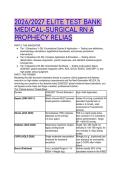
2026/2027 ELITE TEST BANK:
MEDICAL-SURGICAL RN A
PROPHECY RELIAS
PART 0: THE NAVIGATOR
● Tier 1 (Questions 1–28): Foundational Syntax & Application — Testing core definitions,
pharmacology calculations, legal/ethical boundaries, and primary procedural
interventions.
● Tier 2 (Questions 29–58): Complex Application & Simulation — Testing clinical
deterioration, disease progression, priority responses, and standard medical-surgical
emergencies.
● Tier 3 (Questions 59–88): Grandmaster Synthesis — Testing multi-system failure,
2026/2027 global standards integration (AHA, ADA, GOLD, KDIGO, CMS SEP-1), and
high-stakes clinical judgment.
PART I: THE PRIMER
Mastering this elite test bank translates directly to superior clinical judgment and flawless
execution on high-stakes competency assessments and the Next-Generation NCLEX. By
anchoring your practice in the absolute latest 2026/2027 global evidence-based standards, you
will bypass novice traps and forge a resilient, professional intuition.
The "Critical Axioms" Cheat Sheet
Domain 2026/2027 Clinical Standard / High-Yield Application
Axiom
Sepsis (CMS SEP-1) Blood cultures MUST precede Initiate 30 mL/kg crystalloids for
broad-spectrum antibiotics. persistent hypotension or
lactate ≥ 4 mmol/L; start
vasopressors if hypotension
persists.
Stroke (AHA 2026) Tenecteplase (TNK) replaces TNK is a rapid single-bolus.
alteplase as the primary Non-contrast CT is mandatory
4.5-hour agent. before administration. Target
BP <180/105 mmHg.
Diabetes (ADA 2026) Basal-bolus regimens replace Target 140–180 mg/dL for
legacy sliding-scale critically ill; 100–180 mg/dL for
monotherapy. non-critically ill. Stop sliding
scales.
COPD (GOLD 2026) Single moderate exacerbation Biologics (e.g., dupilumab) are
threshold for treatment now standard for eosinophilic
escalation. type-2 COPD after inhaler
failure.
Burns (Parkland) 4 mL Lactated Ringer’s × % Deliver exactly 50% of the
TBSA × Weight (kg). calculated volume in the FIRST
,Domain 2026/2027 Clinical Standard / High-Yield Application
Axiom
8 hours to avert fatal
hypovolemic shock.
CV Risk (PREVENT) The AHA PREVENT equation Integrates the Social
replaces the Pooled Cohort Deprivation Index (SDI) and
Equation. removes race-based biological
assumptions.
PART II: THE ELITE TEST BANK
Q1: The provider orders 1.2 milligrams of a medication. The pharmacy dispenses the drug in
micrograms. How many micrograms will the nurse MOST ACCURATELY administer? A) 120
mcg B) 12,000 mcg C) 1200 mcg D) 1,200,000 mcg
● The Answer: C (1200 mcg)
● Distractor Analysis:
○ A is incorrect: This calculation incorrectly moves the decimal only two places to the
right, underdosing the client.
○ B is incorrect: This calculation incorrectly moves the decimal four places to the
right, causing a massive overdose.
○ D is incorrect: This mathematically represents a conversion to nanograms, a
dangerous calculation error.
The Mentor's Analysis: Safe medication administration requires flawless basic metric
conversions. Moving the decimal exactly three places to the right converts milligrams to
micrograms. Professional/Academic Intuition: Always verify zero placements in metric
conversions to prevent tenfold dosing errors.
Q2: A postoperative client has a Jackson-Pratt (JP) drain in place. To ensure effective drain
function, which action MUST the nurse perform IMMEDIATELY after emptying the device? A)
Flush the tubing with sterile normal saline to prevent blockages. B) Leave the bulb
uncompressed to allow continuous gravity drainage. C) Compress the drain bulb, then plug it to
establish suction. D) Connect the tubing directly to continuous high wall suction.
● The Answer: C (Compress the drain bulb, then plug it to establish suction)
● Distractor Analysis:
○ A is incorrect: Flushing a closed-suction drain introduces severe infection risk and
retrograde fluid flow.
○ B is incorrect: Leaving the bulb uncompressed entirely eliminates the negative
pressure required for fluid removal.
○ D is incorrect: JP drains are specifically designed for gentle, localized negative
pressure, not high-intensity wall suction.
The Mentor's Analysis: Closed-suction drains rely entirely on the manual creation of a vacuum
space. By physically squeezing the bulb before sealing it, the nurse engages the therapeutic
mechanism. Professional/Academic Intuition: A fully expanded JP bulb indicates a total loss
of therapeutic suction.
Q3: While inflating the balloon of an indwelling urinary catheter, the male client reports sudden,
sharp discomfort. Which action is the MOST APPROPRIATE? A) Instruct the client to take deep
breaths and continue inflating. B) Deflate the balloon, advance the catheter further, then
reinflate the balloon. C) Withdraw the catheter slightly and attempt to reinflate the balloon. D)
Administer a prescribed analgesic and reassess in 15 minutes.
● The Answer: B (Deflate the balloon, advance the catheter further, then reinflate the
, balloon)
● Distractor Analysis:
○ A is incorrect: Continuing inflation inside the highly vascular urethra causes severe
trauma, hemorrhage, and potential rupture.
○ C is incorrect: Withdrawing the catheter guarantees the balloon remains improperly
seated in the urethral canal.
○ D is incorrect: Analgesia dangerously masks the mechanical injury occurring from
improper anatomical placement.
The Mentor's Analysis: Pain during balloon inflation strictly signifies the balloon is expanding
within the urethra, not the bladder cavity. Advancing the catheter to the bifurcation ensures
bladder placement before inflation. Professional/Academic Intuition: Never ignore sharp pain
during catheter balloon inflation; it is the cardinal sign of urethral trauma.
Q4: A client with symptomatic anemia secondary to acute hemorrhage refuses a prescribed
blood transfusion due to religious reasons. Based on ethical frameworks, which action is the
MOST APPROPRIATE? A) Administer the transfusion once the client’s level of consciousness
declines. B) Explain that refusing the transfusion is considered leaving against medical advice.
C) Respect his wishes and notify the provider. D) Consult the hospital ethics committee to
legally override the refusal.
● The Answer: C (Respect his wishes and notify the provider)
● Distractor Analysis:
○ A is incorrect: Administering blood to an unconscious client who previously explicitly
refused it violates battery laws and basic autonomy.
○ B is incorrect: Refusing a single, specific treatment does not equate to refusing all
medical care (AMA).
○ D is incorrect: Ethics committees possess no legal authority to override a
competent adult's right to refuse physical treatment.
The Mentor's Analysis: The principle of Autonomy supersedes the provider's desire for
Beneficence. The nurse's role is to ensure informed refusal and rapidly facilitate alternative
non-blood therapies. Professional/Academic Intuition: A competent adult's documented
refusal of blood products is an absolute legal and ethical boundary.
Q5: A client is admitted with acute diverticulitis. During the initial inflammatory phase, which diet
does the nurse MOST EXPECT to be ordered for the patient? A) High-fiber diet with whole
grains and legumes. B) Broth, jello, soft fruit no skin. C) Soft fruit with skins and seeds intact. D)
High-protein, high-fat enteral tube nutrition.
● The Answer: B (Broth, jello, soft fruit no skin)
● Distractor Analysis:
○ A is incorrect: High fiber is indicated for diverticulosis maintenance, but strictly
contraindicated during acute diverticulitis inflammation.
○ C is incorrect: Skins and seeds increase mechanical irritation, trapping particles in
the inflamed diverticula.
○ D is incorrect: Complex digestion stimulates intense bowel motility, worsening the
acute inflammatory and ischemic process.
The Mentor's Analysis: Acute bowel inflammation demands profound physiological rest. A clear
liquid to low-residue diet minimizes bowel workload and halts peristaltic friction.
Professional/Academic Intuition: In acute abdominal inflammatory states, bowel rest takes
absolute precedence over nutritional optimization.
Q6: An experienced medical unit nurse arrives for their shift, and the charge nurse has assigned
them to the post-surgical unit since they are understaffed. Which is the MOST APPROPRIATE
, action? A) Refuse the assignment based on a lack of recent dedicated surgical experience. B)
Report to the post-surgical unit. C) Demand to take only observational telemetry clients on the
surgical unit. D) Leave the facility and contact the nursing supervisor from home.
● The Answer: B (Report to the post-surgical unit)
● Distractor Analysis:
○ A is incorrect: Refusing a float assignment to a unit with overlapping core
competencies constitutes patient abandonment.
○ C is incorrect: While task negotiation is acceptable, demanding a specific
assignment outright constitutes unprofessional insubordination.
○ D is incorrect: Leaving the facility is definitive job abandonment and grounds for
immediate board discipline.
The Mentor's Analysis: Medical-surgical competencies are broadly universal. A nurse must
accept the mandated float assignment but advocate for a safe patient load that matches their
specific skill set. Professional/Academic Intuition: Float assignments are mandatory;
however, advocating for a modified, competency-aligned patient load is a professional
right.
Q7: A client is prescribed intravenous pantoprazole (Protonix). Based on pharmacodynamic
principles, what is this proton pump inhibitor used for? A) Neutralizing existing gastric acid. B)
Promoting gastric motility and emptying. C) Acid Reduction. D) Coating the stomach lining to
prevent ulceration.
● The Answer: C (Acid Reduction)
● Distractor Analysis:
○ A is incorrect: Antacids (e.g., calcium carbonate) physically neutralize existing acid;
pantoprazole prevents its initial formation.
○ B is incorrect: Prokinetics (e.g., metoclopramide) promote physiological motility, not
proton pump inhibitors.
○ D is incorrect: Mucosal protectants (e.g., sucralfate) coat the lining; they do not alter
the chemical acid secretion.
The Mentor's Analysis: Pantoprazole is a PPI that irreversibly binds to the H+/K+ ATPase
enzyme, halting the final step of acid secretion in the parietal cells. Professional/Academic
Intuition: PPIs stop acid at the biological source; they do not alter the acid that is already
pooling in the stomach.
Q8: A severely contracted client is entirely unable to bear weight. Which adaptive equipment
would be MOST APPROPRIATE to use when transferring from the bed to the chair? A) A
standard wooden sliding board. B) A gait belt with a two-person physical assist. C) Patient lift
(e.g., Hoyer). D) A motorized sit-to-stand mechanical lift.
● The Answer: C (Patient lift (e.g., Hoyer))
● Distractor Analysis:
○ A is incorrect: Sliding boards require the client to possess intact upper body
strength and core sitting balance.
○ B is incorrect: Manual lifting of a non-weight-bearing, contracted client severely
risks staff injury and catastrophic client skin sheer.
○ D is incorrect: Sit-to-stand lifts require the client to bear at least some weight on
their lower extremities.
The Mentor's Analysis: Safe patient handling protocols mandate zero-lift techniques for clients
completely devoid of weight-bearing capacity to prevent occupational injury.
Professional/Academic Intuition: If a client cannot bear any weight, a full-body mechanical
sling is the only acceptable transfer method.
MEDICAL-SURGICAL RN A
PROPHECY RELIAS
PART 0: THE NAVIGATOR
● Tier 1 (Questions 1–28): Foundational Syntax & Application — Testing core definitions,
pharmacology calculations, legal/ethical boundaries, and primary procedural
interventions.
● Tier 2 (Questions 29–58): Complex Application & Simulation — Testing clinical
deterioration, disease progression, priority responses, and standard medical-surgical
emergencies.
● Tier 3 (Questions 59–88): Grandmaster Synthesis — Testing multi-system failure,
2026/2027 global standards integration (AHA, ADA, GOLD, KDIGO, CMS SEP-1), and
high-stakes clinical judgment.
PART I: THE PRIMER
Mastering this elite test bank translates directly to superior clinical judgment and flawless
execution on high-stakes competency assessments and the Next-Generation NCLEX. By
anchoring your practice in the absolute latest 2026/2027 global evidence-based standards, you
will bypass novice traps and forge a resilient, professional intuition.
The "Critical Axioms" Cheat Sheet
Domain 2026/2027 Clinical Standard / High-Yield Application
Axiom
Sepsis (CMS SEP-1) Blood cultures MUST precede Initiate 30 mL/kg crystalloids for
broad-spectrum antibiotics. persistent hypotension or
lactate ≥ 4 mmol/L; start
vasopressors if hypotension
persists.
Stroke (AHA 2026) Tenecteplase (TNK) replaces TNK is a rapid single-bolus.
alteplase as the primary Non-contrast CT is mandatory
4.5-hour agent. before administration. Target
BP <180/105 mmHg.
Diabetes (ADA 2026) Basal-bolus regimens replace Target 140–180 mg/dL for
legacy sliding-scale critically ill; 100–180 mg/dL for
monotherapy. non-critically ill. Stop sliding
scales.
COPD (GOLD 2026) Single moderate exacerbation Biologics (e.g., dupilumab) are
threshold for treatment now standard for eosinophilic
escalation. type-2 COPD after inhaler
failure.
Burns (Parkland) 4 mL Lactated Ringer’s × % Deliver exactly 50% of the
TBSA × Weight (kg). calculated volume in the FIRST
,Domain 2026/2027 Clinical Standard / High-Yield Application
Axiom
8 hours to avert fatal
hypovolemic shock.
CV Risk (PREVENT) The AHA PREVENT equation Integrates the Social
replaces the Pooled Cohort Deprivation Index (SDI) and
Equation. removes race-based biological
assumptions.
PART II: THE ELITE TEST BANK
Q1: The provider orders 1.2 milligrams of a medication. The pharmacy dispenses the drug in
micrograms. How many micrograms will the nurse MOST ACCURATELY administer? A) 120
mcg B) 12,000 mcg C) 1200 mcg D) 1,200,000 mcg
● The Answer: C (1200 mcg)
● Distractor Analysis:
○ A is incorrect: This calculation incorrectly moves the decimal only two places to the
right, underdosing the client.
○ B is incorrect: This calculation incorrectly moves the decimal four places to the
right, causing a massive overdose.
○ D is incorrect: This mathematically represents a conversion to nanograms, a
dangerous calculation error.
The Mentor's Analysis: Safe medication administration requires flawless basic metric
conversions. Moving the decimal exactly three places to the right converts milligrams to
micrograms. Professional/Academic Intuition: Always verify zero placements in metric
conversions to prevent tenfold dosing errors.
Q2: A postoperative client has a Jackson-Pratt (JP) drain in place. To ensure effective drain
function, which action MUST the nurse perform IMMEDIATELY after emptying the device? A)
Flush the tubing with sterile normal saline to prevent blockages. B) Leave the bulb
uncompressed to allow continuous gravity drainage. C) Compress the drain bulb, then plug it to
establish suction. D) Connect the tubing directly to continuous high wall suction.
● The Answer: C (Compress the drain bulb, then plug it to establish suction)
● Distractor Analysis:
○ A is incorrect: Flushing a closed-suction drain introduces severe infection risk and
retrograde fluid flow.
○ B is incorrect: Leaving the bulb uncompressed entirely eliminates the negative
pressure required for fluid removal.
○ D is incorrect: JP drains are specifically designed for gentle, localized negative
pressure, not high-intensity wall suction.
The Mentor's Analysis: Closed-suction drains rely entirely on the manual creation of a vacuum
space. By physically squeezing the bulb before sealing it, the nurse engages the therapeutic
mechanism. Professional/Academic Intuition: A fully expanded JP bulb indicates a total loss
of therapeutic suction.
Q3: While inflating the balloon of an indwelling urinary catheter, the male client reports sudden,
sharp discomfort. Which action is the MOST APPROPRIATE? A) Instruct the client to take deep
breaths and continue inflating. B) Deflate the balloon, advance the catheter further, then
reinflate the balloon. C) Withdraw the catheter slightly and attempt to reinflate the balloon. D)
Administer a prescribed analgesic and reassess in 15 minutes.
● The Answer: B (Deflate the balloon, advance the catheter further, then reinflate the
, balloon)
● Distractor Analysis:
○ A is incorrect: Continuing inflation inside the highly vascular urethra causes severe
trauma, hemorrhage, and potential rupture.
○ C is incorrect: Withdrawing the catheter guarantees the balloon remains improperly
seated in the urethral canal.
○ D is incorrect: Analgesia dangerously masks the mechanical injury occurring from
improper anatomical placement.
The Mentor's Analysis: Pain during balloon inflation strictly signifies the balloon is expanding
within the urethra, not the bladder cavity. Advancing the catheter to the bifurcation ensures
bladder placement before inflation. Professional/Academic Intuition: Never ignore sharp pain
during catheter balloon inflation; it is the cardinal sign of urethral trauma.
Q4: A client with symptomatic anemia secondary to acute hemorrhage refuses a prescribed
blood transfusion due to religious reasons. Based on ethical frameworks, which action is the
MOST APPROPRIATE? A) Administer the transfusion once the client’s level of consciousness
declines. B) Explain that refusing the transfusion is considered leaving against medical advice.
C) Respect his wishes and notify the provider. D) Consult the hospital ethics committee to
legally override the refusal.
● The Answer: C (Respect his wishes and notify the provider)
● Distractor Analysis:
○ A is incorrect: Administering blood to an unconscious client who previously explicitly
refused it violates battery laws and basic autonomy.
○ B is incorrect: Refusing a single, specific treatment does not equate to refusing all
medical care (AMA).
○ D is incorrect: Ethics committees possess no legal authority to override a
competent adult's right to refuse physical treatment.
The Mentor's Analysis: The principle of Autonomy supersedes the provider's desire for
Beneficence. The nurse's role is to ensure informed refusal and rapidly facilitate alternative
non-blood therapies. Professional/Academic Intuition: A competent adult's documented
refusal of blood products is an absolute legal and ethical boundary.
Q5: A client is admitted with acute diverticulitis. During the initial inflammatory phase, which diet
does the nurse MOST EXPECT to be ordered for the patient? A) High-fiber diet with whole
grains and legumes. B) Broth, jello, soft fruit no skin. C) Soft fruit with skins and seeds intact. D)
High-protein, high-fat enteral tube nutrition.
● The Answer: B (Broth, jello, soft fruit no skin)
● Distractor Analysis:
○ A is incorrect: High fiber is indicated for diverticulosis maintenance, but strictly
contraindicated during acute diverticulitis inflammation.
○ C is incorrect: Skins and seeds increase mechanical irritation, trapping particles in
the inflamed diverticula.
○ D is incorrect: Complex digestion stimulates intense bowel motility, worsening the
acute inflammatory and ischemic process.
The Mentor's Analysis: Acute bowel inflammation demands profound physiological rest. A clear
liquid to low-residue diet minimizes bowel workload and halts peristaltic friction.
Professional/Academic Intuition: In acute abdominal inflammatory states, bowel rest takes
absolute precedence over nutritional optimization.
Q6: An experienced medical unit nurse arrives for their shift, and the charge nurse has assigned
them to the post-surgical unit since they are understaffed. Which is the MOST APPROPRIATE
, action? A) Refuse the assignment based on a lack of recent dedicated surgical experience. B)
Report to the post-surgical unit. C) Demand to take only observational telemetry clients on the
surgical unit. D) Leave the facility and contact the nursing supervisor from home.
● The Answer: B (Report to the post-surgical unit)
● Distractor Analysis:
○ A is incorrect: Refusing a float assignment to a unit with overlapping core
competencies constitutes patient abandonment.
○ C is incorrect: While task negotiation is acceptable, demanding a specific
assignment outright constitutes unprofessional insubordination.
○ D is incorrect: Leaving the facility is definitive job abandonment and grounds for
immediate board discipline.
The Mentor's Analysis: Medical-surgical competencies are broadly universal. A nurse must
accept the mandated float assignment but advocate for a safe patient load that matches their
specific skill set. Professional/Academic Intuition: Float assignments are mandatory;
however, advocating for a modified, competency-aligned patient load is a professional
right.
Q7: A client is prescribed intravenous pantoprazole (Protonix). Based on pharmacodynamic
principles, what is this proton pump inhibitor used for? A) Neutralizing existing gastric acid. B)
Promoting gastric motility and emptying. C) Acid Reduction. D) Coating the stomach lining to
prevent ulceration.
● The Answer: C (Acid Reduction)
● Distractor Analysis:
○ A is incorrect: Antacids (e.g., calcium carbonate) physically neutralize existing acid;
pantoprazole prevents its initial formation.
○ B is incorrect: Prokinetics (e.g., metoclopramide) promote physiological motility, not
proton pump inhibitors.
○ D is incorrect: Mucosal protectants (e.g., sucralfate) coat the lining; they do not alter
the chemical acid secretion.
The Mentor's Analysis: Pantoprazole is a PPI that irreversibly binds to the H+/K+ ATPase
enzyme, halting the final step of acid secretion in the parietal cells. Professional/Academic
Intuition: PPIs stop acid at the biological source; they do not alter the acid that is already
pooling in the stomach.
Q8: A severely contracted client is entirely unable to bear weight. Which adaptive equipment
would be MOST APPROPRIATE to use when transferring from the bed to the chair? A) A
standard wooden sliding board. B) A gait belt with a two-person physical assist. C) Patient lift
(e.g., Hoyer). D) A motorized sit-to-stand mechanical lift.
● The Answer: C (Patient lift (e.g., Hoyer))
● Distractor Analysis:
○ A is incorrect: Sliding boards require the client to possess intact upper body
strength and core sitting balance.
○ B is incorrect: Manual lifting of a non-weight-bearing, contracted client severely
risks staff injury and catastrophic client skin sheer.
○ D is incorrect: Sit-to-stand lifts require the client to bear at least some weight on
their lower extremities.
The Mentor's Analysis: Safe patient handling protocols mandate zero-lift techniques for clients
completely devoid of weight-bearing capacity to prevent occupational injury.
Professional/Academic Intuition: If a client cannot bear any weight, a full-body mechanical
sling is the only acceptable transfer method.


