

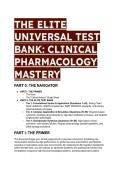
THE ELITE
UNIVERSAL TEST
BANK: CLINICAL
PHARMACOLOGY
MASTERY
PART 0: THE NAVIGATOR
● PART I: THE PRIMER
○ The Hook
○ The "Critical Axioms" Cheat Sheet
● PART II: THE ELITE TEST BANK
○ Tier 1: Foundational Syntax & Application (Questions 1–28): Testing "Hard
Deck" definitions, QSEN competencies, ISMP 2026/2027 standards, and primary
pharmacokinetic principles.
○ Tier 2: Complex Application & Simulation (Questions 29–58): Situation-based
outcomes, prototype drug interactions, high-alert medication protocols, and targeted
single-system pathologies.
○ Tier 3: Grandmaster Synthesis (Questions 59–88): High-stakes clinical
scenarios, multi-system failures, lifespan pharmacology (pediatric/geriatric), and
lethal synergy avoidance.
PART I: THE PRIMER
This document forges your clinical judgment into a precision instrument, translating rote
memorization directly into elite performance on global licensure examinations and flawless
execution in high-stakes acute care environments. By mastering the 88 cognitive checkpoints
within this test bank, you will cultivate an advanced academic and professional intuition that
immediately recognizes high-risk pharmacological patterns, averting catastrophic patient
,outcomes.
The "Critical Axioms" Cheat Sheet
Axiom Domain The Golden Rule Clinical Application
ISMP 2026 Directives Weight-based dosing requires Never use estimated weights or
absolute metric (kg) precision; household spoons. Unit-level
IV push requires dilution is strictly prohibited to
ready-to-administer (RTA) avert fatal calculations.
syringes.
The PINCH Protocol High-alert drugs (Potassium, Never administer PINCH class
Insulin, Narcotics, agents without paired baseline
Chemotherapy, Heparin) pharmacokinetic laboratory
demand independent validation.
double-verification.
Lifespan Pharmacokinetics Neonates lack mature hepatic Neonatal dosing mitigates high
enzymes; geriatrics suffer free-drug toxicity. Geriatric
natural renal clearance decline. dosing requires downward
adjustment based on creatinine
clearance.
QSEN Informatics Technology supports, but never
replaces, independent clinical
judgment.
PART II: THE ELITE TEST BANK
Tier 1: Foundational Syntax & Application
Q1: Under the 2026/2027 ISMP Targeted Medication Safety Best Practices, which protocol is
MANDATORY when preparing intravenous push (IVP) medications? A) Dilute all IVP
medications in a 10 mL flush syringe to reduce vein irritation. B) Utilize ready-to-administer
(RTA) syringes and strictly avoid unit-level dilution. C) Transfer the medication from a prefilled
syringe into a sterile secondary container. D) Administer all IVP medications over a minimum of
five minutes regardless of drug class.
● The Answer: B (Utilize ready-to-administer (RTA) syringes and strictly avoid unit-level
dilution.)
● Distractor Analysis:
○ A is incorrect: Bedside dilution in flush syringes introduces severe contamination
and miscalculation risks.
○ C is incorrect: Transferring medications breaks sterility and increases labeling
errors.
○ D is incorrect: Push rates are drug-specific; a universal five-minute rule is
technically invalid.
The Mentor's Analysis: The ISMP strictly forbids bedside dilution of IV push drugs to eradicate
contamination and dose calculation errors. Professional/Academic Intuition: If a drug requires
dilution, it must be performed in the pharmacy, never at the bedside.
Q2: A patient is prescribed an oral sustained-release (SR) antihypertensive but complains of
dysphagia. Based on the principles of safe administration, which action is the MOST
,ACCURATE? A) Crush the tablet and mix it with applesauce to facilitate swallowing. B) Cut the
tablet along the scored line to reduce its physical size. C) Withhold the dose and contact the
prescriber for a liquid or immediate-release alternative. D) Dissolve the intact tablet in 30 mL of
warm water before administration.
● The Answer: C (Withhold the dose and contact the prescriber for a liquid or
immediate-release alternative.)
● Distractor Analysis:
○ A is incorrect: Crushing an SR tablet destroys the extended-release mechanism,
causing immediate, toxic absorption.
○ B is incorrect: Cutting an SR tablet, even if scored, alters the controlled release of
the medication.
○ D is incorrect: Dissolving an SR tablet accelerates absorption and bypasses the
drug's pharmacokinetic design.
The Mentor's Analysis: Sustained-release, long-acting, and enteric-coated formulations rely on
intact physical structures to regulate absorption rates over time. Professional/Academic
Intuition: Never crush, chew, or split SR, ER, XL, or enteric-coated medications.
Q3: A prescriber orders continuous intravenous Heparin for a patient with a deep vein
thrombosis. Which foundational safety protocol MUST the nurse execute FIRST? A) Verify the
patient's baseline partial thromboplastin time (aPTT) and weight in kilograms. B) Administer a
test dose of protamine sulfate to assess for hypersensitivity. C) Dilute the heparin in a 500 mL
bag of 0.9% normal saline using a standard syringe. D) Estimate the patient's weight based on
their stated history to calculate the drip rate.
● The Answer: A (Verify the patient's baseline partial thromboplastin time (aPTT) and
weight in kilograms.)
● Distractor Analysis:
○ B is incorrect: Protamine sulfate is the antidote for heparin toxicity, not a
prophylactic test agent.
○ C is incorrect: ISMP 2026/2027 standards strictly prohibit unit-level dilution of
high-alert medications.
○ D is incorrect: Using estimated or historical weights for high-alert, weight-based
dosing is a lethal novice error.
The Mentor's Analysis: Heparin is a PINCH high-alert drug with a narrow therapeutic index.
Dosing is entirely dependent on exact metric weight and baseline coagulation metrics.
Professional/Academic Intuition: High-alert continuous infusions demand absolute metric
precision and baseline pharmacokinetic validation.
Q4: Following the administration of a highly protein-bound drug, a patient with severe
malnutrition exhibits signs of systemic toxicity despite receiving a standard dose. What is the
MOST LOGICAL pharmacokinetic explanation? A) Malnutrition accelerates hepatic enzyme
induction, increasing drug bioavailability. B) Hypoalbuminemia results in a higher concentration
of active, unbound free drug. C) Decreased gastric motility prolongs the absorption phase of the
medication. D) The patient's glomerular filtration rate has increased, preventing excretion.
● The Answer: B (Hypoalbuminemia results in a higher concentration of active, unbound
free drug.)
● Distractor Analysis:
○ A is incorrect: Enzyme induction typically decreases drug bioavailability by
accelerating metabolism.
○ C is incorrect: Prolonged absorption delays peak onset rather than causing
immediate toxicity.
, ○ D is incorrect: Increased GFR would clear the drug faster, reducing toxicity.
The Mentor's Analysis: Highly protein-bound drugs require albumin to remain inactive in the
bloodstream. Low albumin (due to malnutrition or liver failure) leaves excessive free drug to
flood receptors. Professional/Academic Intuition: Always correlate serum albumin levels with
the administration of highly protein-bound medications.
Q5: A patient with an autoimmune disease is prescribed oral Methotrexate. Which parameter
must be hard-stop verified in the electronic health record to avert a fatal error? A) The daily
dosage parameters for renal clearance. B) The weekly dosage regimen default for
non-oncologic indications. C) The simultaneous administration of a folate antagonist. D) The
patient's ability to self-administer subcutaneous injections.
● The Answer: B (The weekly dosage regimen default for non-oncologic indications.)
● Distractor Analysis:
○ A is incorrect: Methotrexate for autoimmune conditions is dosed weekly, not daily;
daily dosing is a classic fatal error.
○ C is incorrect: Folate is often supplemented, not antagonized, to reduce toxicity.
○ D is incorrect: The scenario specifies oral methotrexate, making injection ability
irrelevant.
The Mentor's Analysis: Inadvertent daily dosing of oral methotrexate intended for weekly
autoimmune treatment causes lethal bone marrow suppression. Professional/Academic
Intuition: Methotrexate for non-cancer indications is strictly a weekly medication.
Q6: An infant requires an antibacterial medication. The nurse notes the infant's liver is
immature. How does this physiological concept dictate the medication planning? A) The drug
will be metabolized faster, requiring a higher dose. B) The drug will undergo increased first-pass
effect, requiring an intravenous route. C) The infant will have decreased hepatic enzymes,
increasing the risk of drug toxicity. D) The infant's blood-brain barrier will block the drug,
requiring intrathecal delivery.
● The Answer: C (The infant will have decreased hepatic enzymes, increasing the risk of
drug toxicity.)
● Distractor Analysis:
○ A is incorrect: Immature livers metabolize drugs slower, not faster.
○ B is incorrect: Immature livers decrease the first-pass effect.
○ D is incorrect: Neonatal blood-brain barriers are highly permeable, not highly
restrictive.
The Mentor's Analysis: Neonates lack mature cytochrome P450 enzymes. Drugs remain in the
system longer, requiring precise, weight-based micro-dosing. Professional/Academic Intuition:
Immature hepatic function exponentially amplifies the half-life of pharmacologic agents.
Q7: According to QSEN competencies, how should a nurse integrate the "Informatics" domain
into medication safety? A) By memorizing all drug monographs to avoid relying on digital
systems. B) By overriding barcode scanning alerts during emergencies to prioritize speed. C) By
utilizing barcode verification technology to cross-reference the patient and the product. D) By
allowing the electronic health record to automatically calculate all doses without manual
verification.
● The Answer: C (By utilizing barcode verification technology to cross-reference the patient
and the product.)
● Distractor Analysis:
○ A is incorrect: QSEN advocates for minimizing reliance on human memory to
reduce errors.
○ B is incorrect: Overriding safety alerts is a primary cause of lethal medication errors.
UNIVERSAL TEST
BANK: CLINICAL
PHARMACOLOGY
MASTERY
PART 0: THE NAVIGATOR
● PART I: THE PRIMER
○ The Hook
○ The "Critical Axioms" Cheat Sheet
● PART II: THE ELITE TEST BANK
○ Tier 1: Foundational Syntax & Application (Questions 1–28): Testing "Hard
Deck" definitions, QSEN competencies, ISMP 2026/2027 standards, and primary
pharmacokinetic principles.
○ Tier 2: Complex Application & Simulation (Questions 29–58): Situation-based
outcomes, prototype drug interactions, high-alert medication protocols, and targeted
single-system pathologies.
○ Tier 3: Grandmaster Synthesis (Questions 59–88): High-stakes clinical
scenarios, multi-system failures, lifespan pharmacology (pediatric/geriatric), and
lethal synergy avoidance.
PART I: THE PRIMER
This document forges your clinical judgment into a precision instrument, translating rote
memorization directly into elite performance on global licensure examinations and flawless
execution in high-stakes acute care environments. By mastering the 88 cognitive checkpoints
within this test bank, you will cultivate an advanced academic and professional intuition that
immediately recognizes high-risk pharmacological patterns, averting catastrophic patient
,outcomes.
The "Critical Axioms" Cheat Sheet
Axiom Domain The Golden Rule Clinical Application
ISMP 2026 Directives Weight-based dosing requires Never use estimated weights or
absolute metric (kg) precision; household spoons. Unit-level
IV push requires dilution is strictly prohibited to
ready-to-administer (RTA) avert fatal calculations.
syringes.
The PINCH Protocol High-alert drugs (Potassium, Never administer PINCH class
Insulin, Narcotics, agents without paired baseline
Chemotherapy, Heparin) pharmacokinetic laboratory
demand independent validation.
double-verification.
Lifespan Pharmacokinetics Neonates lack mature hepatic Neonatal dosing mitigates high
enzymes; geriatrics suffer free-drug toxicity. Geriatric
natural renal clearance decline. dosing requires downward
adjustment based on creatinine
clearance.
QSEN Informatics Technology supports, but never
replaces, independent clinical
judgment.
PART II: THE ELITE TEST BANK
Tier 1: Foundational Syntax & Application
Q1: Under the 2026/2027 ISMP Targeted Medication Safety Best Practices, which protocol is
MANDATORY when preparing intravenous push (IVP) medications? A) Dilute all IVP
medications in a 10 mL flush syringe to reduce vein irritation. B) Utilize ready-to-administer
(RTA) syringes and strictly avoid unit-level dilution. C) Transfer the medication from a prefilled
syringe into a sterile secondary container. D) Administer all IVP medications over a minimum of
five minutes regardless of drug class.
● The Answer: B (Utilize ready-to-administer (RTA) syringes and strictly avoid unit-level
dilution.)
● Distractor Analysis:
○ A is incorrect: Bedside dilution in flush syringes introduces severe contamination
and miscalculation risks.
○ C is incorrect: Transferring medications breaks sterility and increases labeling
errors.
○ D is incorrect: Push rates are drug-specific; a universal five-minute rule is
technically invalid.
The Mentor's Analysis: The ISMP strictly forbids bedside dilution of IV push drugs to eradicate
contamination and dose calculation errors. Professional/Academic Intuition: If a drug requires
dilution, it must be performed in the pharmacy, never at the bedside.
Q2: A patient is prescribed an oral sustained-release (SR) antihypertensive but complains of
dysphagia. Based on the principles of safe administration, which action is the MOST
,ACCURATE? A) Crush the tablet and mix it with applesauce to facilitate swallowing. B) Cut the
tablet along the scored line to reduce its physical size. C) Withhold the dose and contact the
prescriber for a liquid or immediate-release alternative. D) Dissolve the intact tablet in 30 mL of
warm water before administration.
● The Answer: C (Withhold the dose and contact the prescriber for a liquid or
immediate-release alternative.)
● Distractor Analysis:
○ A is incorrect: Crushing an SR tablet destroys the extended-release mechanism,
causing immediate, toxic absorption.
○ B is incorrect: Cutting an SR tablet, even if scored, alters the controlled release of
the medication.
○ D is incorrect: Dissolving an SR tablet accelerates absorption and bypasses the
drug's pharmacokinetic design.
The Mentor's Analysis: Sustained-release, long-acting, and enteric-coated formulations rely on
intact physical structures to regulate absorption rates over time. Professional/Academic
Intuition: Never crush, chew, or split SR, ER, XL, or enteric-coated medications.
Q3: A prescriber orders continuous intravenous Heparin for a patient with a deep vein
thrombosis. Which foundational safety protocol MUST the nurse execute FIRST? A) Verify the
patient's baseline partial thromboplastin time (aPTT) and weight in kilograms. B) Administer a
test dose of protamine sulfate to assess for hypersensitivity. C) Dilute the heparin in a 500 mL
bag of 0.9% normal saline using a standard syringe. D) Estimate the patient's weight based on
their stated history to calculate the drip rate.
● The Answer: A (Verify the patient's baseline partial thromboplastin time (aPTT) and
weight in kilograms.)
● Distractor Analysis:
○ B is incorrect: Protamine sulfate is the antidote for heparin toxicity, not a
prophylactic test agent.
○ C is incorrect: ISMP 2026/2027 standards strictly prohibit unit-level dilution of
high-alert medications.
○ D is incorrect: Using estimated or historical weights for high-alert, weight-based
dosing is a lethal novice error.
The Mentor's Analysis: Heparin is a PINCH high-alert drug with a narrow therapeutic index.
Dosing is entirely dependent on exact metric weight and baseline coagulation metrics.
Professional/Academic Intuition: High-alert continuous infusions demand absolute metric
precision and baseline pharmacokinetic validation.
Q4: Following the administration of a highly protein-bound drug, a patient with severe
malnutrition exhibits signs of systemic toxicity despite receiving a standard dose. What is the
MOST LOGICAL pharmacokinetic explanation? A) Malnutrition accelerates hepatic enzyme
induction, increasing drug bioavailability. B) Hypoalbuminemia results in a higher concentration
of active, unbound free drug. C) Decreased gastric motility prolongs the absorption phase of the
medication. D) The patient's glomerular filtration rate has increased, preventing excretion.
● The Answer: B (Hypoalbuminemia results in a higher concentration of active, unbound
free drug.)
● Distractor Analysis:
○ A is incorrect: Enzyme induction typically decreases drug bioavailability by
accelerating metabolism.
○ C is incorrect: Prolonged absorption delays peak onset rather than causing
immediate toxicity.
, ○ D is incorrect: Increased GFR would clear the drug faster, reducing toxicity.
The Mentor's Analysis: Highly protein-bound drugs require albumin to remain inactive in the
bloodstream. Low albumin (due to malnutrition or liver failure) leaves excessive free drug to
flood receptors. Professional/Academic Intuition: Always correlate serum albumin levels with
the administration of highly protein-bound medications.
Q5: A patient with an autoimmune disease is prescribed oral Methotrexate. Which parameter
must be hard-stop verified in the electronic health record to avert a fatal error? A) The daily
dosage parameters for renal clearance. B) The weekly dosage regimen default for
non-oncologic indications. C) The simultaneous administration of a folate antagonist. D) The
patient's ability to self-administer subcutaneous injections.
● The Answer: B (The weekly dosage regimen default for non-oncologic indications.)
● Distractor Analysis:
○ A is incorrect: Methotrexate for autoimmune conditions is dosed weekly, not daily;
daily dosing is a classic fatal error.
○ C is incorrect: Folate is often supplemented, not antagonized, to reduce toxicity.
○ D is incorrect: The scenario specifies oral methotrexate, making injection ability
irrelevant.
The Mentor's Analysis: Inadvertent daily dosing of oral methotrexate intended for weekly
autoimmune treatment causes lethal bone marrow suppression. Professional/Academic
Intuition: Methotrexate for non-cancer indications is strictly a weekly medication.
Q6: An infant requires an antibacterial medication. The nurse notes the infant's liver is
immature. How does this physiological concept dictate the medication planning? A) The drug
will be metabolized faster, requiring a higher dose. B) The drug will undergo increased first-pass
effect, requiring an intravenous route. C) The infant will have decreased hepatic enzymes,
increasing the risk of drug toxicity. D) The infant's blood-brain barrier will block the drug,
requiring intrathecal delivery.
● The Answer: C (The infant will have decreased hepatic enzymes, increasing the risk of
drug toxicity.)
● Distractor Analysis:
○ A is incorrect: Immature livers metabolize drugs slower, not faster.
○ B is incorrect: Immature livers decrease the first-pass effect.
○ D is incorrect: Neonatal blood-brain barriers are highly permeable, not highly
restrictive.
The Mentor's Analysis: Neonates lack mature cytochrome P450 enzymes. Drugs remain in the
system longer, requiring precise, weight-based micro-dosing. Professional/Academic Intuition:
Immature hepatic function exponentially amplifies the half-life of pharmacologic agents.
Q7: According to QSEN competencies, how should a nurse integrate the "Informatics" domain
into medication safety? A) By memorizing all drug monographs to avoid relying on digital
systems. B) By overriding barcode scanning alerts during emergencies to prioritize speed. C) By
utilizing barcode verification technology to cross-reference the patient and the product. D) By
allowing the electronic health record to automatically calculate all doses without manual
verification.
● The Answer: C (By utilizing barcode verification technology to cross-reference the patient
and the product.)
● Distractor Analysis:
○ A is incorrect: QSEN advocates for minimizing reliance on human memory to
reduce errors.
○ B is incorrect: Overriding safety alerts is a primary cause of lethal medication errors.


