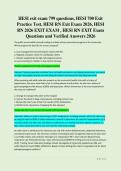
HESI exit exam 799 questions, HESI 700 Exit
Practice Test, HESI RN Exit Exam 2026, HESI
RN 2026 EXIT EXAM , HESI RN EXIT Exam
Questions and Verified Answers 2026
The public nurse health received funding to initiate primary prevention program in the community.
Which program the best fits the nurse's proposal?
a. Case management and screening for clients with HIV.
b. Regional relocation center for earthquake victims
c. Vitamin supplements for high-risk pregnant women.
d. Lead screening for children in low-income housing.
Vitamin supplements for high-risk pregnant women
Rational: Primary prevention activities focus on health promotions and disease preventions, so vitamin
for high-risk pregnant women provide adequate vitamin and mineral for fetal developmental.
When assessing and adult male who presents as the community health clinic with a history of
hypertension, the nurse note that he has 2+ pitting edema in both ankles. He also has a history of
gastroesophageal reflex disease (GERD) and depression. Which intervention is the most important for
the nurse to implement?
a. Arrange to transport the client to the hospital
b. Instruct the client to keep a food journal, including portions size.
c. Review the client's use of over the counter (OTC) medications.
d. Reinforce the importance of keeping the feet elevated.
Review the client's use of over the counter (OTC) medications
Rationale: Sodium is used in several types of OTC medications. Including antacids, which the client may
be using to treat his GERD. Further evaluation is need it to determine the need for hospitalization (A) A
food journal (B) may help over, but dietary modifications are needed now since edema is present. (C)
May relieve dependent edema, but not treat the underlying etiology.
An older client is admitted to the intensive care unit with severe abdominal pain, abdominal distention,
and absent bowel sound. The client has a history of smoking 2 packs of cigarettes daily for 50 years and
is currently restless and confused. Vital signs are: temperature 96`F, heart rate 122 beats/minute,
respiratory rate 36 breaths/minute, mean arterial pressure(MAP) 64 mmHg and central venous pressure
(CVP) 7 mmHg. Serum laboratory findings include: hemoglobin 6.5 grams/dl, platelets 6o, 000, and
white blood cell count (WBC) 3,000/mm3. Based on these findings this client is at greatest risk for which
pathophysiological condition?
1|Page
,a. Multiple organ dysfunction syndrome (MODS)
b. Disseminated intravascular coagulation (DIC)
c. Chronic obstructive disease.
d. Acquired immunodeficiency syndrome (AIDS)
Multiple organ dysfunction syndrome (MODS)
Rational: MODS are a progressive dysfunction of two or more major organs that requires medical
intervention to maintain homeostasis. This client has evidence of several organ systems that require
intervention, such as blood pressure, hemoglobin, WBC, and respiratory rate. DIC may develop as a
result of MODS. The other options are not correct.
A man expresses concern to the nurse about the care his mother is receiving while hospitalized. He
believes that her care is not based on any ethical standards and ask what type of care he should expect
from a public hospital. What action should the nurse take?
a. Provide the man and his mother with a copy of the Patient's Bill of Rights
b. Explain that the hospital adheres to all national accreditation standards
c. Advise the man to discuss his concerns with his mother's healthcare provider
d. Determine if he would like to review the hospital's manual of approved polices.
Provide the man and his mother with a copy of the Patient's Bill of Rights
Rationale: The Patient's Bill of Rights is a universally used tool that describes the rights of clients in all
healthcare settings and is essential in ensuring that clients care is provided in an ethical manner. (B) may
be perceived as defensive and does not provide the man with specific information about expected
standards of care. Concern about the quality of care should be addressed by the hospital staff rather
than C. All the healthcare agencies are required to maintain policy and procedure manual for the
purpose of standardizing delivery of care within the agencies, but the policy manual is unlikely to
provide useful information for clients or family members.
A client experiencing withdrawal from the benzodiazepines alprazolam (Xanax) is demonstrating severe
agitation and tremors. What is the best initial nursing action?
a. Administer naloxone (Narcan) per PNR protocol
b. Initiate seizure precautions
c. Obtain a serum drug screen
d. Instruct the family about withdrawal symptoms.
Initiate seizure precaution
Rationale: Withdrawal of CNS depressants, such as Xanax, results in rebound over-excitation of the CNS.
Since the client exhibiting tremors, the nurse should anticipate seizure activity and protect the client
2|Page
,The nurse is caring for a client who is taking a macrolide to treat a bacterial infection. Which finding
should the nurse report to the healthcare provider before administering the next dose?
a. Jaundice
b. Nausea
c. Fever
d. Fatigue
Jaundice
Rationale: Macrolides can cause hepatotoxicity, which is manifested by jaundice and should be reported
to the healthcare provider before further doses of the medication are administered, B is a common side
effect of macrolides. Fever and Fatigue are expected finding when a client has an infection.
A client with Alzheimer's disease (AD) is receiving trazodone (Desyrel), a recently prescribed atypical
antidepressant. The caregiver tells the home health nurse that the client's mood and sleep patterns are
improved, but there is no change in cognitive ability. How should the nurse respond to this information?
a. Explain that it may take several weeks for the medication to be effective
b. Confirm the desired effect of the medication has been achieved.
c. Notify the health care provider than a change may be needed.
d. Evaluate when and how the medication is being administered to the client.
Confirm the desired effect of the medication has been achieved.
Rationale: Trazodone oR Desyrel, an atypical antidepressant, is prescribed for client with AD to improve
mood and sleep.
A client with diabetic peripheral neuropathy has been taking pregabalin (Lyrica) for 4 days. Which
finding indicates to the nurse that the medication is effective?
a. Reduced level of pain
b. Full volume of pedal pulses
c. Granulating tissue in foot ulcer
d. Improved visual acuity.
Reduced level of pain
Rationale: Pregabalin is prescribed to decrease the pain associated with diabetic peripheral neuropathy.
A, C and D are not expected outcomes of this medication's effectiveness.
A group of nurse-managers is asked to engage in a needs assessment for a piece of equipment that will
be expensed to the organization's budget. Which question is most important to consider when analyzing
the cost-benefit for this piece of equipment?
a. How many departments can use this equipment?
3|Page
, b. Will the equipment require annual repair?
c. Is the cost of the equipment reasonable?
d. Can the equipment be updated each year?
How many departments can use this equipment?
While receiving a male postoperative client's staples de nurse observe that the client's eyes are closed
and his face and hands are clenched. The client states, "I just hate having staples removed". After
acknowledgement the client's anxiety, what action should the nurse implement?
a. Encourage the client to continue verbalize his anxiety
b. Attempt to distract the client with general conversation
c. Explain the procedure in detail while removing the staples
d. Reassure the client that this is a simple nursing procedure.
Attempt to distract the client with general conversation
Rational: Distract is an effective strategy hen a client experience anxiety during an uncomfortable
procedure. (A & D) increase the client's anxiety.
A male client is admitted for the removal of an internal fixation that was inserted for the fracture ankle.
During the admission history, he tells the nurse he recently received vancomycin (vancomycin) for a
methicillin-resistant Staphylococcus aureus (MRSA) wound infection. Which action should the nurse
take? (Select all that apply.)
a. Collect multiple site screening culture for MRSA
b. Call healthcare provider for a prescription for linezolid (Zyrovix)
c. Place the client on contact transmission precautions
d. Obtain sputum specimen for culture and sensitivity
e. Continue to monitor for client sign of infection.
A,C,E
Rationale: Until multi-site screening cultures come back negative (A), the client should be maintained on
contact isolation(C) to minimize the risk for nosocomial infection. Linezolid (Zyvox), a broad spectrum
anti-infecting, is not indicated, unless the client has an active skin structure infection cause by MRSA or
multidrug- resistant strains (MDRSP) of Staphylococcus aureus. A sputum culture is not indicated D)
based on the client's history is a wound infection.
A vacuum-assistive closure (VAC) device is being use to provide wound care for a client who has stage III
pressure ulcer on a below-the- knee (BKA) residual limb. Which intervention should the nurse
implement to ensure maximum effectiveness of the device?
a. Empty the device every 8 hours and change the dressing daily ensure sterility
b. Extended the transparent film dressing only to edge of wound to prevent tension.
c. Ensure the transparent dressing has no tears that might create vacuum leaks
d. Use an adhesive remover when changing the dressing to promote comfort.
4|Page
Practice Test, HESI RN Exit Exam 2026, HESI
RN 2026 EXIT EXAM , HESI RN EXIT Exam
Questions and Verified Answers 2026
The public nurse health received funding to initiate primary prevention program in the community.
Which program the best fits the nurse's proposal?
a. Case management and screening for clients with HIV.
b. Regional relocation center for earthquake victims
c. Vitamin supplements for high-risk pregnant women.
d. Lead screening for children in low-income housing.
Vitamin supplements for high-risk pregnant women
Rational: Primary prevention activities focus on health promotions and disease preventions, so vitamin
for high-risk pregnant women provide adequate vitamin and mineral for fetal developmental.
When assessing and adult male who presents as the community health clinic with a history of
hypertension, the nurse note that he has 2+ pitting edema in both ankles. He also has a history of
gastroesophageal reflex disease (GERD) and depression. Which intervention is the most important for
the nurse to implement?
a. Arrange to transport the client to the hospital
b. Instruct the client to keep a food journal, including portions size.
c. Review the client's use of over the counter (OTC) medications.
d. Reinforce the importance of keeping the feet elevated.
Review the client's use of over the counter (OTC) medications
Rationale: Sodium is used in several types of OTC medications. Including antacids, which the client may
be using to treat his GERD. Further evaluation is need it to determine the need for hospitalization (A) A
food journal (B) may help over, but dietary modifications are needed now since edema is present. (C)
May relieve dependent edema, but not treat the underlying etiology.
An older client is admitted to the intensive care unit with severe abdominal pain, abdominal distention,
and absent bowel sound. The client has a history of smoking 2 packs of cigarettes daily for 50 years and
is currently restless and confused. Vital signs are: temperature 96`F, heart rate 122 beats/minute,
respiratory rate 36 breaths/minute, mean arterial pressure(MAP) 64 mmHg and central venous pressure
(CVP) 7 mmHg. Serum laboratory findings include: hemoglobin 6.5 grams/dl, platelets 6o, 000, and
white blood cell count (WBC) 3,000/mm3. Based on these findings this client is at greatest risk for which
pathophysiological condition?
1|Page
,a. Multiple organ dysfunction syndrome (MODS)
b. Disseminated intravascular coagulation (DIC)
c. Chronic obstructive disease.
d. Acquired immunodeficiency syndrome (AIDS)
Multiple organ dysfunction syndrome (MODS)
Rational: MODS are a progressive dysfunction of two or more major organs that requires medical
intervention to maintain homeostasis. This client has evidence of several organ systems that require
intervention, such as blood pressure, hemoglobin, WBC, and respiratory rate. DIC may develop as a
result of MODS. The other options are not correct.
A man expresses concern to the nurse about the care his mother is receiving while hospitalized. He
believes that her care is not based on any ethical standards and ask what type of care he should expect
from a public hospital. What action should the nurse take?
a. Provide the man and his mother with a copy of the Patient's Bill of Rights
b. Explain that the hospital adheres to all national accreditation standards
c. Advise the man to discuss his concerns with his mother's healthcare provider
d. Determine if he would like to review the hospital's manual of approved polices.
Provide the man and his mother with a copy of the Patient's Bill of Rights
Rationale: The Patient's Bill of Rights is a universally used tool that describes the rights of clients in all
healthcare settings and is essential in ensuring that clients care is provided in an ethical manner. (B) may
be perceived as defensive and does not provide the man with specific information about expected
standards of care. Concern about the quality of care should be addressed by the hospital staff rather
than C. All the healthcare agencies are required to maintain policy and procedure manual for the
purpose of standardizing delivery of care within the agencies, but the policy manual is unlikely to
provide useful information for clients or family members.
A client experiencing withdrawal from the benzodiazepines alprazolam (Xanax) is demonstrating severe
agitation and tremors. What is the best initial nursing action?
a. Administer naloxone (Narcan) per PNR protocol
b. Initiate seizure precautions
c. Obtain a serum drug screen
d. Instruct the family about withdrawal symptoms.
Initiate seizure precaution
Rationale: Withdrawal of CNS depressants, such as Xanax, results in rebound over-excitation of the CNS.
Since the client exhibiting tremors, the nurse should anticipate seizure activity and protect the client
2|Page
,The nurse is caring for a client who is taking a macrolide to treat a bacterial infection. Which finding
should the nurse report to the healthcare provider before administering the next dose?
a. Jaundice
b. Nausea
c. Fever
d. Fatigue
Jaundice
Rationale: Macrolides can cause hepatotoxicity, which is manifested by jaundice and should be reported
to the healthcare provider before further doses of the medication are administered, B is a common side
effect of macrolides. Fever and Fatigue are expected finding when a client has an infection.
A client with Alzheimer's disease (AD) is receiving trazodone (Desyrel), a recently prescribed atypical
antidepressant. The caregiver tells the home health nurse that the client's mood and sleep patterns are
improved, but there is no change in cognitive ability. How should the nurse respond to this information?
a. Explain that it may take several weeks for the medication to be effective
b. Confirm the desired effect of the medication has been achieved.
c. Notify the health care provider than a change may be needed.
d. Evaluate when and how the medication is being administered to the client.
Confirm the desired effect of the medication has been achieved.
Rationale: Trazodone oR Desyrel, an atypical antidepressant, is prescribed for client with AD to improve
mood and sleep.
A client with diabetic peripheral neuropathy has been taking pregabalin (Lyrica) for 4 days. Which
finding indicates to the nurse that the medication is effective?
a. Reduced level of pain
b. Full volume of pedal pulses
c. Granulating tissue in foot ulcer
d. Improved visual acuity.
Reduced level of pain
Rationale: Pregabalin is prescribed to decrease the pain associated with diabetic peripheral neuropathy.
A, C and D are not expected outcomes of this medication's effectiveness.
A group of nurse-managers is asked to engage in a needs assessment for a piece of equipment that will
be expensed to the organization's budget. Which question is most important to consider when analyzing
the cost-benefit for this piece of equipment?
a. How many departments can use this equipment?
3|Page
, b. Will the equipment require annual repair?
c. Is the cost of the equipment reasonable?
d. Can the equipment be updated each year?
How many departments can use this equipment?
While receiving a male postoperative client's staples de nurse observe that the client's eyes are closed
and his face and hands are clenched. The client states, "I just hate having staples removed". After
acknowledgement the client's anxiety, what action should the nurse implement?
a. Encourage the client to continue verbalize his anxiety
b. Attempt to distract the client with general conversation
c. Explain the procedure in detail while removing the staples
d. Reassure the client that this is a simple nursing procedure.
Attempt to distract the client with general conversation
Rational: Distract is an effective strategy hen a client experience anxiety during an uncomfortable
procedure. (A & D) increase the client's anxiety.
A male client is admitted for the removal of an internal fixation that was inserted for the fracture ankle.
During the admission history, he tells the nurse he recently received vancomycin (vancomycin) for a
methicillin-resistant Staphylococcus aureus (MRSA) wound infection. Which action should the nurse
take? (Select all that apply.)
a. Collect multiple site screening culture for MRSA
b. Call healthcare provider for a prescription for linezolid (Zyrovix)
c. Place the client on contact transmission precautions
d. Obtain sputum specimen for culture and sensitivity
e. Continue to monitor for client sign of infection.
A,C,E
Rationale: Until multi-site screening cultures come back negative (A), the client should be maintained on
contact isolation(C) to minimize the risk for nosocomial infection. Linezolid (Zyvox), a broad spectrum
anti-infecting, is not indicated, unless the client has an active skin structure infection cause by MRSA or
multidrug- resistant strains (MDRSP) of Staphylococcus aureus. A sputum culture is not indicated D)
based on the client's history is a wound infection.
A vacuum-assistive closure (VAC) device is being use to provide wound care for a client who has stage III
pressure ulcer on a below-the- knee (BKA) residual limb. Which intervention should the nurse
implement to ensure maximum effectiveness of the device?
a. Empty the device every 8 hours and change the dressing daily ensure sterility
b. Extended the transparent film dressing only to edge of wound to prevent tension.
c. Ensure the transparent dressing has no tears that might create vacuum leaks
d. Use an adhesive remover when changing the dressing to promote comfort.
4|Page