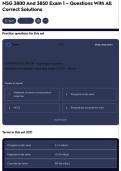
NSG 3800 And 3850 Exam 1 – Questions With All
Correct Solutions
Save
Practice questions for this set
Learn 1 /7 Study using Learn
HYPERVENTILATION - kussmaul response
excretion of carbonic acid and water (CO2) - Quick
Choose an answer
Metabolic Acidosis compensatory
1 2 Phosphorus lab value
response
3 HCTZ 4 Extracellular (outside the cell)
Don't know?
Terms in this set (127)
Phosphorus lab value 2-4.5 mEq/L
Magnesium lab value 1.5-2.5 mEq/L
Chloride lab value 98-106 mEq/L
,Intracellular (inside the cell) Magnesium
Phosphates
Potassium
Protein
Extracellular (outside the cell) Bicarbonate
Chloride
Sodium
What fluid does not transport lymph
electrolytes
vascular to interstitial fluid movement edema
Colloid osmotic pressure
interstitial to vascular fluid movement hydrostatic pressure
Hyper ADH retain more water
Hypo ADH more fluid excretion
Fluid Volume Deficit (hypovolemia) Weight loss (daily weight checks)
CM Increased USG (kidneys conserve H2O)
Postural hypotension
Increased HR
Flat neck veins
Lightheaded/dizzy
Oliguria
Poor skin turgor
dry mucus membranes
, Fluid Volume Excess (hypervolemia) Weight gain
CM Edema
Increased urine
Increased BP
Increased RR
Bounding pulse
JVD
Crackles
Changes in LOC
Confusion
HA
Seizures
Dyspnea
Orthopnea
Pulmonary edema (pink frothy sputum = drowning)
HCTZ causes hyponatremia
Hyponatremia Pathogenesis diuretic use causing high urine Na
diluted hyponatremia (most common)
depletional hyponatremia
Diluted Hyponatremia (most common) *Gain of more water than salt
causes excessive ADH (against peeing)
Hypotonic irrigations
Excessive water intake
Excessive D5W infusions
depletional hyponatremia causes *Loss of more salt than water
Diuretic use (thiazide)*****
Salt wasting renal disease
GI loss (emesis, diarrhea, GI suction
When would you most likely see Na NG Tube
levels < 120 ? GI suctioning
Correct Solutions
Save
Practice questions for this set
Learn 1 /7 Study using Learn
HYPERVENTILATION - kussmaul response
excretion of carbonic acid and water (CO2) - Quick
Choose an answer
Metabolic Acidosis compensatory
1 2 Phosphorus lab value
response
3 HCTZ 4 Extracellular (outside the cell)
Don't know?
Terms in this set (127)
Phosphorus lab value 2-4.5 mEq/L
Magnesium lab value 1.5-2.5 mEq/L
Chloride lab value 98-106 mEq/L
,Intracellular (inside the cell) Magnesium
Phosphates
Potassium
Protein
Extracellular (outside the cell) Bicarbonate
Chloride
Sodium
What fluid does not transport lymph
electrolytes
vascular to interstitial fluid movement edema
Colloid osmotic pressure
interstitial to vascular fluid movement hydrostatic pressure
Hyper ADH retain more water
Hypo ADH more fluid excretion
Fluid Volume Deficit (hypovolemia) Weight loss (daily weight checks)
CM Increased USG (kidneys conserve H2O)
Postural hypotension
Increased HR
Flat neck veins
Lightheaded/dizzy
Oliguria
Poor skin turgor
dry mucus membranes
, Fluid Volume Excess (hypervolemia) Weight gain
CM Edema
Increased urine
Increased BP
Increased RR
Bounding pulse
JVD
Crackles
Changes in LOC
Confusion
HA
Seizures
Dyspnea
Orthopnea
Pulmonary edema (pink frothy sputum = drowning)
HCTZ causes hyponatremia
Hyponatremia Pathogenesis diuretic use causing high urine Na
diluted hyponatremia (most common)
depletional hyponatremia
Diluted Hyponatremia (most common) *Gain of more water than salt
causes excessive ADH (against peeing)
Hypotonic irrigations
Excessive water intake
Excessive D5W infusions
depletional hyponatremia causes *Loss of more salt than water
Diuretic use (thiazide)*****
Salt wasting renal disease
GI loss (emesis, diarrhea, GI suction
When would you most likely see Na NG Tube
levels < 120 ? GI suctioning