

Maryland Stationary Engineer Grade 4: 100 Practice
Questions with Answers & Explanations – Complete Exam
Prep for Low-Pressure Boiler Operator License (Fire-Tube
Boilers, Safety Devices, Hot Water Systems, Gas & Oil
Burners, ASME Code)
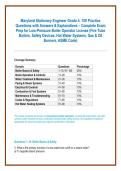
Coverage Summary
Domain Questions Percentage
Boiler Basics & Safety 1–10, 91–100 20%
Boiler Operation & Controls 11–20 10%
Water Treatment & Maintenance 21–30 10%
Piping & Steam Systems 31–40 10%
Electrical & Controls 41–50 10%
Combustion & Fuel Systems 51–60 10%
Maintenance & Troubleshooting 61–70 10%
Codes & Regulations 71–80 10%
Hot Water Heating Systems 81–90 10%
This Grade 4 practice set focuses on low-pressure boiler operation, covering fire-tube boilers, hot water
systems, basic electrical controls, combustion fundamentals, safety devices, and regulatory compliance
appropriate for entry-level stationary engineer certification in Maryland.
Questions 1–10: Boiler Basics & Safety
1. What is the primary function of a low-water fuel cutoff on a steam boiler?
a) To regulate steam pressure
,b) To add water automatically to the boiler
c) To shut off the fuel supply if the water level drops below a safe point
d) To control the burner firing rate
The low-water fuel cutoff is a critical safety device that interrupts the fuel supply to the
burner when the water level falls below the lowest safe operating point, preventing
overheating and catastrophic failure of the boiler pressure vessel.
2. What is the purpose of a safety valve on a boiler?
a) To control steam flow to the heating system
b) To automatically relieve excess pressure and prevent over-pressurization
c) To drain condensate from steam lines
d) To add water to the boiler
Safety valves are the primary overpressure protection device, designed to automatically
open at a set pressure and release steam to prevent the boiler pressure from exceeding the
maximum allowable working pressure (MAWP).
3. How often should the low-water fuel cutoff be tested on a boiler in operation?
a) Monthly
b) Annually
c) Weekly
d) Only during annual inspections
*ASME CSD-1 and typical jurisdictional requirements mandate that low-water fuel cutoffs be
tested at least weekly while the boiler is operating by slowly draining the water column to
simulate a low-water condition.*
4. What is the purpose of a gauge glass on a steam boiler?
a) To measure steam pressure
b) To provide a visual indication of the water level in the boiler
c) To add chemical treatment
d) To measure boiler water temperature
The gauge glass is a transparent tube that allows the operator to visually verify the water
level in the boiler, which is essential for safe operation and preventing low-water conditions.
5. What should you do if the gauge glass on a steam boiler breaks while the boiler is under
pressure?
a) Immediately shut down the boiler
b) Close the steam and water cocks to stop the escape of steam and water
,c) Continue operating and call a supervisor
d) Open the blowdown valve to reduce pressure
If a gauge glass breaks, the operator must immediately close the steam and water cocks to
stop the escape of steam and hot water, then allow the glass to cool before replacement to
prevent injury.
6. What is the purpose of a blowdown valve on a boiler?
a) To add water to the boiler
b) To remove sediment and concentrated solids from the boiler
c) To test the safety valve
d) To reduce steam pressure
Blowdown removes accumulated sludge and dissolved solids from the boiler, controlling
total dissolved solids (TDS) to prevent scale formation and carryover into the steam system.
7. What type of boiler is most commonly found in small commercial buildings?
a) Water-tube boiler
b) Fire-tube boiler
c) Electric boiler with high pressure
d) Nuclear boiler
Fire-tube boilers are commonly used in small to medium commercial applications because
they are compact, cost-effective, and operate at lower pressures suitable for heating
systems.
8. In a fire-tube boiler, where do the combustion gases travel?
a) Outside the tubes
b) Through the tubes
c) Through the steam drum only
d) Through the water column
In fire-tube boilers, hot combustion gases travel through the tubes while water surrounds the
tubes, absorbing heat to generate steam or hot water.
9. What is the function of a water column on a steam boiler?
a) To store feedwater
b) To provide a stilling chamber for accurate water level measurement
c) To add chemicals to the boiler
d) To increase steam pressure
, A water column is mounted externally on the boiler and provides a calm, stable water level
that allows the gauge glass and low-water fuel cutoffs to function accurately without
turbulence from inside the boiler drum.
10. What is the maximum pressure for a low-pressure heating boiler?
a) 15 psi steam / 30 psi hot water
b) *15 psi steam / 160 psi hot water*
c) 100 psi steam / 200 psi hot water
d) 150 psi steam / 300 psi hot water
*Low-pressure heating boilers are defined as operating at pressures not exceeding 15 psig
for steam or 160 psig for hot water, per ASME code definitions.*
Questions 11–20: Boiler Operation & Controls
11. What is the purpose of a pressuretrol (pressure control) on a steam boiler?
a) To measure water level
b) To regulate the burner operation based on steam pressure
c) To control feedwater flow
d) To test the safety valve
A pressuretrol senses steam pressure and cycles the burner on and off or modulates firing
rate to maintain the desired pressure within the operating range.
12. What is the function of an aquastat on a hot water boiler?
a) To measure water level
b) To control water temperature by cycling the burner
c) To regulate circulator pump operation
d) To add water to the system
An aquastat senses water temperature and controls the burner to maintain the desired
temperature setpoint for the hot water heating system.
13. What is the purpose of an expansion tank on a hot water boiler system?
a) To add water to the system
b) To provide space for water expansion as it is heated, preventing excessive
pressure
c) To store hot water for peak demand
d) To remove air from the system
Questions with Answers & Explanations – Complete Exam
Prep for Low-Pressure Boiler Operator License (Fire-Tube
Boilers, Safety Devices, Hot Water Systems, Gas & Oil
Burners, ASME Code)
Coverage Summary
Domain Questions Percentage
Boiler Basics & Safety 1–10, 91–100 20%
Boiler Operation & Controls 11–20 10%
Water Treatment & Maintenance 21–30 10%
Piping & Steam Systems 31–40 10%
Electrical & Controls 41–50 10%
Combustion & Fuel Systems 51–60 10%
Maintenance & Troubleshooting 61–70 10%
Codes & Regulations 71–80 10%
Hot Water Heating Systems 81–90 10%
This Grade 4 practice set focuses on low-pressure boiler operation, covering fire-tube boilers, hot water
systems, basic electrical controls, combustion fundamentals, safety devices, and regulatory compliance
appropriate for entry-level stationary engineer certification in Maryland.
Questions 1–10: Boiler Basics & Safety
1. What is the primary function of a low-water fuel cutoff on a steam boiler?
a) To regulate steam pressure
,b) To add water automatically to the boiler
c) To shut off the fuel supply if the water level drops below a safe point
d) To control the burner firing rate
The low-water fuel cutoff is a critical safety device that interrupts the fuel supply to the
burner when the water level falls below the lowest safe operating point, preventing
overheating and catastrophic failure of the boiler pressure vessel.
2. What is the purpose of a safety valve on a boiler?
a) To control steam flow to the heating system
b) To automatically relieve excess pressure and prevent over-pressurization
c) To drain condensate from steam lines
d) To add water to the boiler
Safety valves are the primary overpressure protection device, designed to automatically
open at a set pressure and release steam to prevent the boiler pressure from exceeding the
maximum allowable working pressure (MAWP).
3. How often should the low-water fuel cutoff be tested on a boiler in operation?
a) Monthly
b) Annually
c) Weekly
d) Only during annual inspections
*ASME CSD-1 and typical jurisdictional requirements mandate that low-water fuel cutoffs be
tested at least weekly while the boiler is operating by slowly draining the water column to
simulate a low-water condition.*
4. What is the purpose of a gauge glass on a steam boiler?
a) To measure steam pressure
b) To provide a visual indication of the water level in the boiler
c) To add chemical treatment
d) To measure boiler water temperature
The gauge glass is a transparent tube that allows the operator to visually verify the water
level in the boiler, which is essential for safe operation and preventing low-water conditions.
5. What should you do if the gauge glass on a steam boiler breaks while the boiler is under
pressure?
a) Immediately shut down the boiler
b) Close the steam and water cocks to stop the escape of steam and water
,c) Continue operating and call a supervisor
d) Open the blowdown valve to reduce pressure
If a gauge glass breaks, the operator must immediately close the steam and water cocks to
stop the escape of steam and hot water, then allow the glass to cool before replacement to
prevent injury.
6. What is the purpose of a blowdown valve on a boiler?
a) To add water to the boiler
b) To remove sediment and concentrated solids from the boiler
c) To test the safety valve
d) To reduce steam pressure
Blowdown removes accumulated sludge and dissolved solids from the boiler, controlling
total dissolved solids (TDS) to prevent scale formation and carryover into the steam system.
7. What type of boiler is most commonly found in small commercial buildings?
a) Water-tube boiler
b) Fire-tube boiler
c) Electric boiler with high pressure
d) Nuclear boiler
Fire-tube boilers are commonly used in small to medium commercial applications because
they are compact, cost-effective, and operate at lower pressures suitable for heating
systems.
8. In a fire-tube boiler, where do the combustion gases travel?
a) Outside the tubes
b) Through the tubes
c) Through the steam drum only
d) Through the water column
In fire-tube boilers, hot combustion gases travel through the tubes while water surrounds the
tubes, absorbing heat to generate steam or hot water.
9. What is the function of a water column on a steam boiler?
a) To store feedwater
b) To provide a stilling chamber for accurate water level measurement
c) To add chemicals to the boiler
d) To increase steam pressure
, A water column is mounted externally on the boiler and provides a calm, stable water level
that allows the gauge glass and low-water fuel cutoffs to function accurately without
turbulence from inside the boiler drum.
10. What is the maximum pressure for a low-pressure heating boiler?
a) 15 psi steam / 30 psi hot water
b) *15 psi steam / 160 psi hot water*
c) 100 psi steam / 200 psi hot water
d) 150 psi steam / 300 psi hot water
*Low-pressure heating boilers are defined as operating at pressures not exceeding 15 psig
for steam or 160 psig for hot water, per ASME code definitions.*
Questions 11–20: Boiler Operation & Controls
11. What is the purpose of a pressuretrol (pressure control) on a steam boiler?
a) To measure water level
b) To regulate the burner operation based on steam pressure
c) To control feedwater flow
d) To test the safety valve
A pressuretrol senses steam pressure and cycles the burner on and off or modulates firing
rate to maintain the desired pressure within the operating range.
12. What is the function of an aquastat on a hot water boiler?
a) To measure water level
b) To control water temperature by cycling the burner
c) To regulate circulator pump operation
d) To add water to the system
An aquastat senses water temperature and controls the burner to maintain the desired
temperature setpoint for the hot water heating system.
13. What is the purpose of an expansion tank on a hot water boiler system?
a) To add water to the system
b) To provide space for water expansion as it is heated, preventing excessive
pressure
c) To store hot water for peak demand
d) To remove air from the system


