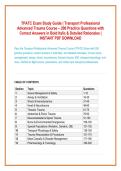
TPATC Exam Study Guide | Transport Professional
Advanced Trauma Course – 200 Practice Questions with
Correct Answers in Bold Italic & Detailed Rationales |
INSTANT PDF DOWNLOAD
Pass the Transport Professional Advanced Trauma Course (TPATC) Exam with 200
practice questions, correct answers in bold italic, and detailed rationales. Covers scene
management, airway, shock, neurotrauma, thoracic trauma, MCI, transport physiology, and
more. Perfect for flight nurses, paramedics, and critical care transport professionals.
TABLE OF CONTENTS
Section Topic Questions
1 Scene Management & Safety 1-15
2 Airway & Ventilation 16-30
3 Shock & Hemodynamics 31-45
4 Head & Neurotrauma 46-60
5 Thoracic Trauma 61-75
6 Abdominal & Pelvic Trauma 76-90
7 Musculoskeletal & Spinal Trauma 91-105
8 Burns & Environmental Emergencies 106-120
9 Special Populations (Pediatric, Geriatric, OB) 121-135
10 Transport Physiology & Safety 136-150
11 Trauma Resuscitation & Procedures 151-170
12 Mass Casualty & Disaster Management 171-185
13 Pharmacology & Toxicology 186-200
, SECTION 1: SCENE MANAGEMENT & SAFETY
1. You arrive at the scene of a motor vehicle collision. A vehicle is on fire, and there are
multiple patients. What is your priority action?
A) Begin triage of all patients
B) Ensure scene safety and request fire department
C) Immediately extricate the closest patient
D) Establish a landing zone for air transport
**Rationale: Scene safety is the highest priority for any transport professional. An active fire
poses immediate danger to responders and patients. The fire department must be
requested before any patient care or extrication begins. Triage and extrication cannot occur
until the scene is safe.
2. Which of the following BEST describes the purpose of a incident command system (ICS)
at a mass casualty incident?
A) To assign medical treatment to the highest acuity patients first
B) To establish a clear chain of command and organize resources
C) To ensure all patients are transported to the same hospital
D) To prioritize law enforcement over medical operations
**Rationale: ICS establishes a standardized organizational structure with clear roles and
communication channels. It ensures efficient resource allocation, scene management, and
coordination among multiple agencies. While triage determines treatment priority, ICS
provides the overall framework for operations.
3. During a nighttime scene operation, you are working near the roadway. What is the
MOST important safety measure?
, A) Wear dark clothing to blend in
B) Wear high-visibility reflective apparel
C) Park the ambulance 10 feet from the scene
D) Use only flashlights for illumination
**Rationale: High-visibility reflective apparel (ANSI-certified) is essential for scene safety,
especially at night or in low-light conditions. It ensures other responders and motorists can
see personnel. Dark clothing is dangerous. Vehicles should be positioned to create a
protective barrier with lights activated.
4. A helicopter is arriving for scene transport. Which of the following is a correct safety
consideration for establishing a landing zone (LZ)?
A) The LZ should be at least 50 feet from the scene
B) *The LZ should be a 100-foot by 100-foot area free of debris*
C) Vehicles can remain within the LZ if headlights are on
D) Approach the helicopter from the rear after landing
***Rationale: A proper LZ requires a 100x100 foot area (minimum) that is flat, firm, and
clear of debris, loose objects, and vehicles. The LZ should be at least 100-200 feet from the
scene. Personnel should approach from the front (pilot's line of sight) and never approach
the tail rotor area.*
5. You are called to a scene involving a hazardous materials (HazMat) incident. What
should you do FIRST?
A) Enter the scene to locate patients
B) Establish a safe perimeter and await HazMat team
C) Begin decontamination procedures
D) Request additional ambulances
, **Rationale: In HazMat incidents, the priority is to establish a safe perimeter and ensure
proper personal protective equipment (PPE) is available. Transport professionals should not
enter a HazMat scene without proper training, PPE, and HazMat team support. Patient care
begins after scene safety is ensured.
6. Which of the following is a key component of the "zone" system at a mass casualty
incident?
A) Red zone for minor injuries only
B) Hot zone = contaminated area, warm zone = decontamination, cold zone = support
C) All zones are the same distance from the incident
D) Zones are determined by patient acuity only
**Rationale: The zone system establishes: Hot Zone (contaminated/hazardous area – only
trained HazMat personnel), Warm Zone (decontamination area – where decontamination
occurs), Cold Zone (safe area – where triage, treatment, and transport occur). This system
ensures safety and organized operations.
7. You are transporting a trauma patient via ground ambulance. When should you notify the
receiving trauma center?
A) Only if the patient is in critical condition
B) As soon as possible after patient assessment, ideally before departure
C) Only upon arrival at the hospital
D) After every vital sign check
**Rationale: Early notification (pre-arrival) allows the trauma center to activate the trauma
team, prepare resources, and ensure immediate availability of operating rooms, blood
products, and specialists. This reduces time to definitive care and improves outcomes.
8. Which of the following is a correct guideline for ambulance placement at a highway crash
scene?
A) Park 10 feet behind the scene facing traffic
Advanced Trauma Course – 200 Practice Questions with
Correct Answers in Bold Italic & Detailed Rationales |
INSTANT PDF DOWNLOAD
Pass the Transport Professional Advanced Trauma Course (TPATC) Exam with 200
practice questions, correct answers in bold italic, and detailed rationales. Covers scene
management, airway, shock, neurotrauma, thoracic trauma, MCI, transport physiology, and
more. Perfect for flight nurses, paramedics, and critical care transport professionals.
TABLE OF CONTENTS
Section Topic Questions
1 Scene Management & Safety 1-15
2 Airway & Ventilation 16-30
3 Shock & Hemodynamics 31-45
4 Head & Neurotrauma 46-60
5 Thoracic Trauma 61-75
6 Abdominal & Pelvic Trauma 76-90
7 Musculoskeletal & Spinal Trauma 91-105
8 Burns & Environmental Emergencies 106-120
9 Special Populations (Pediatric, Geriatric, OB) 121-135
10 Transport Physiology & Safety 136-150
11 Trauma Resuscitation & Procedures 151-170
12 Mass Casualty & Disaster Management 171-185
13 Pharmacology & Toxicology 186-200
, SECTION 1: SCENE MANAGEMENT & SAFETY
1. You arrive at the scene of a motor vehicle collision. A vehicle is on fire, and there are
multiple patients. What is your priority action?
A) Begin triage of all patients
B) Ensure scene safety and request fire department
C) Immediately extricate the closest patient
D) Establish a landing zone for air transport
**Rationale: Scene safety is the highest priority for any transport professional. An active fire
poses immediate danger to responders and patients. The fire department must be
requested before any patient care or extrication begins. Triage and extrication cannot occur
until the scene is safe.
2. Which of the following BEST describes the purpose of a incident command system (ICS)
at a mass casualty incident?
A) To assign medical treatment to the highest acuity patients first
B) To establish a clear chain of command and organize resources
C) To ensure all patients are transported to the same hospital
D) To prioritize law enforcement over medical operations
**Rationale: ICS establishes a standardized organizational structure with clear roles and
communication channels. It ensures efficient resource allocation, scene management, and
coordination among multiple agencies. While triage determines treatment priority, ICS
provides the overall framework for operations.
3. During a nighttime scene operation, you are working near the roadway. What is the
MOST important safety measure?
, A) Wear dark clothing to blend in
B) Wear high-visibility reflective apparel
C) Park the ambulance 10 feet from the scene
D) Use only flashlights for illumination
**Rationale: High-visibility reflective apparel (ANSI-certified) is essential for scene safety,
especially at night or in low-light conditions. It ensures other responders and motorists can
see personnel. Dark clothing is dangerous. Vehicles should be positioned to create a
protective barrier with lights activated.
4. A helicopter is arriving for scene transport. Which of the following is a correct safety
consideration for establishing a landing zone (LZ)?
A) The LZ should be at least 50 feet from the scene
B) *The LZ should be a 100-foot by 100-foot area free of debris*
C) Vehicles can remain within the LZ if headlights are on
D) Approach the helicopter from the rear after landing
***Rationale: A proper LZ requires a 100x100 foot area (minimum) that is flat, firm, and
clear of debris, loose objects, and vehicles. The LZ should be at least 100-200 feet from the
scene. Personnel should approach from the front (pilot's line of sight) and never approach
the tail rotor area.*
5. You are called to a scene involving a hazardous materials (HazMat) incident. What
should you do FIRST?
A) Enter the scene to locate patients
B) Establish a safe perimeter and await HazMat team
C) Begin decontamination procedures
D) Request additional ambulances
, **Rationale: In HazMat incidents, the priority is to establish a safe perimeter and ensure
proper personal protective equipment (PPE) is available. Transport professionals should not
enter a HazMat scene without proper training, PPE, and HazMat team support. Patient care
begins after scene safety is ensured.
6. Which of the following is a key component of the "zone" system at a mass casualty
incident?
A) Red zone for minor injuries only
B) Hot zone = contaminated area, warm zone = decontamination, cold zone = support
C) All zones are the same distance from the incident
D) Zones are determined by patient acuity only
**Rationale: The zone system establishes: Hot Zone (contaminated/hazardous area – only
trained HazMat personnel), Warm Zone (decontamination area – where decontamination
occurs), Cold Zone (safe area – where triage, treatment, and transport occur). This system
ensures safety and organized operations.
7. You are transporting a trauma patient via ground ambulance. When should you notify the
receiving trauma center?
A) Only if the patient is in critical condition
B) As soon as possible after patient assessment, ideally before departure
C) Only upon arrival at the hospital
D) After every vital sign check
**Rationale: Early notification (pre-arrival) allows the trauma center to activate the trauma
team, prepare resources, and ensure immediate availability of operating rooms, blood
products, and specialists. This reduces time to definitive care and improves outcomes.
8. Which of the following is a correct guideline for ambulance placement at a highway crash
scene?
A) Park 10 feet behind the scene facing traffic