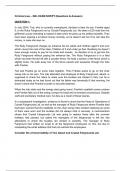
Deborah Tannen (1991)
Deborah Came
(2007)
,Deborah Tannen (1991)
o The difference starts in childhood, where parents use more words about
feelings to girls and use more verbs to boys. Males and females belong to
difference sub-cultures and therefore speak differently:
o Status vs. support – men see language as a means of asserting dominance; women see it as a way of confirmi
ideas.
o Independence vs. intimacy – men “go it alone”; women seek support.
o Advice vs. understanding – men see language as problem solving; women see it as a means of empathy.
o Information vs. feelings – males are concerned with the facts; women with emotions.
o Orders vs. proposals – men use imperatives; females use hidden directives.
o Conflict vs. compromise – men will argue; women will try to find a middle ground.
The Difference Theory
Deborah Came
(2007)
,Deborah Tannen (1991)
o The difference starts in childhood, where parents use more words about
feelings to girls and use more verbs to boys. Males and females belong to
difference sub-cultures and therefore speak differently:
o Status vs. support – men see language as a means of asserting dominance; women see it as a way of confirmi
ideas.
o Independence vs. intimacy – men “go it alone”; women seek support.
o Advice vs. understanding – men see language as problem solving; women see it as a means of empathy.
o Information vs. feelings – males are concerned with the facts; women with emotions.
o Orders vs. proposals – men use imperatives; females use hidden directives.
o Conflict vs. compromise – men will argue; women will try to find a middle ground.
The Difference Theory