Written by students who passed Immediately available after payment Read online or as PDF Wrong document? Swap it for free 4.6 TrustPilot
logo-home
Exam (elaborations)

Rasmussen NUR 2092 Health Assessment Exam 1 2026/2027 | Complete Study Guide with Q&A | Health History, Physical Exam Techniques, Vital Signs & Pain Assessment | Verified Answers with Rationales | Grade A+ | NGN-Aligned

Rating
-
Sold
-
Pages
27
Grade
A+
Uploaded on
26-03-2026
Written in
2025/2026

INSTANT PDF DOWNLOAD—This comprehensive study guide is specifically designed for Rasmussen University nursing students preparing for NUR 2092 Health Assessment Exam 1 for the 2026/2027 academic year. Based on verified exam materials from top-selling student resources, this resource contains expertly verified practice questions and 100% correct answers with detailed rationales to help you master core health assessment concepts and achieve a top score (Grade A+). This comprehensive guide covers all major topics tested on NUR 2092 Exam 1 : Health Assessment Foundations : Purpose of health assessment (establish baseline, identify problems, evaluate responses, plan care) . Types of assessment: comprehensive (full history and physical), focused (problem-specific), emergency (rapid life-saving), ongoing (follow-up) . Subjective data —what patient reports; objective data —what nurse observes/measures . The Nursing Process : Assessment (collect data), Diagnosis (analyze data, identify problems), Planning (set goals, interventions), Implementation (perform interventions), Evaluation (assess outcomes). Critical thinking —purposeful, goal-directed reasoning . Health History Components : Biographical data (name, age, gender, occupation, religion) . Chief complaint (reason for seeking care, direct quotes) . History of Present Illness (HPI) —OLDCARTS (Onset, Location, Duration, Characteristics, Aggravating/Alleviating, Radiation, Timing, Severity) . Past medical history —childhood illnesses, surgeries, hospitalizations, chronic conditions, medications, allergies . Family history —genogram for genetic risk . Functional assessment —ADLs, IADLs, coping, support systems . Review of systems (ROS) —systematic head-to-toe review . Cultural & Spiritual Assessment : Culture—shared beliefs, values, customs; influences health practices, communication, decision-making . Ethnocentrism—believing one's own culture is superior . Cultural competence—ability to provide care within patient's cultural context . Spiritual assessment—FICA (Faith, Importance, Influence, Community, Address/Action) . LEARN model—Listen, Explain, Acknowledge, Recommend, Negotiate . Communication Techniques : Therapeutic—active listening, open-ended questions, clarification, reflection, silence, summarizing . Nontherapeutic—closed-ended questions, giving advice, false reassurance, changing subject, why questions, judgmental responses . Interview phases—introduction/orientation, working (data collection), termination . PEACE mnemonic—Partnership, Empathy, Appreciation, Acknowledgement, Cultural competence, Empowerment . Physical Examination Techniques : Inspection—visual observation; first technique used . Palpation—touch to assess temperature (dorsal hand), texture, moisture, size, tenderness (finger pads), vibration (ulnar surface) . Percussion—tapping to assess density (direct, indirect). Auscultation—listening to body sounds with stethoscope . Order of assessment—inspection → palpation → percussion → auscultation (except abdomen: inspection → auscultation → percussion → palpation) . Vital Signs & Pain Assessment : Temperature—oral (97-99°F), rectal (0.5-1°F higher), axillary (0.5-1°F lower), tympanic, temporal. Pulse—60-100 bpm; radial most common; apical for cardiac patients. Respirations—12-20/min; count for full minute . Blood pressure—normal 120/80; cuff size 40% of arm circumference; Korotkoff sounds . Pain assessment—5th vital sign; PQRST (Provoked, Quality, Region, Severity, Timing); pain scales (Numeric 0-10, Wong-Baker FACES, FLACC for nonverbal) . General Survey & Mental Status : General survey—appearance, behavior, mobility, speech, vital signs . Mental status—A&O ×3 (person, place, time); MMSE for cognitive impairment . Levels of consciousness—alert, lethargic, obtunded, stuporous, comatose . Nutritional Assessment : 24-hour dietary recall—patient reports all food consumed in past 24 hours . Food diary—records intake over several days . BMI—weight (kg) / height (m²) ; normal 18.5-24.9 . Nutritional risk factors—older adults, low income, chronic illness, medications . Documentation & Legal Considerations : SOAP notes—Subjective, Objective, Assessment, Plan . PIE notes—Problem, Intervention, Evaluation . Narrative—chronological account . Electronic health record—legal document; use approved abbreviations, factual objective statements, avoid opinions . HIPAA—protects patient privacy; only share information on need-to-know basis . Safety & Infection Control : Standard precautions—hand hygiene, gloves, mask, eye protection . Transmission-based precautions—contact, droplet, airborne . Hand hygiene—most important infection prevention; soap and water vs. alcohol-based hand rub . Personal protective equipment (PPE) —donning order: gown, mask, goggles, gloves; doffing: gloves, goggles, gown, mask . Lifespan Considerations : Pediatric—sequence: least invasive to most invasive; parent present; developmental approach . Geriatric—allow extra time; assess functional status; hearing/vision deficits; polypharmacy; fall risk; cognitive status . Pregnant—positioning modifications; avoid supine hypotension . Sample Questions Include : "What is the correct order of assessment techniques for the abdomen?" → Inspection, auscultation, percussion, palpation (auscultation before palpation to prevent altering bowel sounds) "During palpation, which part of the hand is best for assessing skin temperature?" → Dorsal surface (most sensitive to temperature changes) "A patient reports pain as 'sharp, stabbing, and radiating down my left arm.' The nurse is assessing which component of pain?" → Quality and radiation (characteristics of pain) "What is the correct sequence for donning PPE?" → Gown, mask, goggles, gloves "A patient's BMI is calculated at 32. This falls into which category?" → Obese (BMI 30-34.9) "What is the most important infection control measure to prevent transmission of microorganisms?" → Hand hygiene "A patient is oriented to person, place, and time. This is documented as:" → Alert and oriented ×3 All questions include complete rationales based on current evidence-based practice, health assessment standards, and Rasmussen University curriculum requirements . DOCUMENT ACCESS: This study guide is available as an instant digital download (PDF) immediately upon purchase. Fully text-searchable, printable, and accessible anytime through your user account. 100% satisfaction guarantee. Trusted by thousands of Rasmussen nursing students for NUR 2092 exam preparation and mastering health assessment competencies .

Show more Read less

Content preview

1|Page


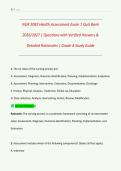
NUR 2092 Health Assessment Exam 1 Quiz Bank

2026/2027 | Questions with Verified Answers &

Detailed Rationales | Grade A Study Guide


1. The six steps of the nursing process are:

A. Assessment, Diagnosis, Outcome Identification, Planning, Implementation, Evaluation

B. Assessment, Planning, Intervention, Evaluation, Documentation, Discharge

C. History, Physical, Analysis, Treatment, Follow-up, Education

D. Data collection, Analysis, Goal setting, Action, Review, Modification

Correct Answer: A

Rationale: The nursing process is a systematic framework consisting of six interrelated

steps: Assessment, Diagnosis, Outcome Identification, Planning, Implementation, and

Evaluation.


2. Assessment includes which of the following components? (Select all that apply.)

A. Interview

,2|Page


B. Health history

C. Review of systems (ROS)

D. Physical examination

E. Functional assessment

Correct Answer: A, B, C, D, E

Rationale: A comprehensive assessment includes the interview, health history, review

of systems, physical examination, and functional, spiritual, and cultural assessments.


3. Subjective data refers to:

A. What the nurse observes during the physical exam

B. What the patient says

C. Laboratory test results

D. Diagnostic imaging findings

Correct Answer: B

Rationale: Subjective data are information that the patient reports, including symptoms,

feelings, perceptions, and health history. This data cannot be observed or measured by

the nurse.

, 3|Page


4. Objective data refers to:

A. What the patient reports about their symptoms

B. What the nurse observes, measures, or detects through examination

C. Information from family members

D. The patient's medical history

Correct Answer: B

Rationale: Objective data are observable and measurable findings that the nurse

collects through inspection, palpation, percussion, auscultation, and diagnostic testing.


5. The SMART component in outcome identification includes which of the following

elements? (Select all that apply.)

A. Specific

B. Measurable

C. Attainable

D. Relevant

E. Time-bound

Correct Answer: A, B, C, D, E

Rationale: SMART outcomes must be Specific, Measurable, Attainable, Relevant, and

Time-bound to ensure effective goal setting and evaluation.

Written for

Document information

Uploaded on
March 26, 2026
Number of pages
27
Written in
2025/2026
Type
Exam (elaborations)
Contains
Questions & answers

Subjects

$12.49
Get access to the full document:

Wrong document? Swap it for free Within 14 days of purchase and before downloading, you can choose a different document. You can simply spend the amount again.
Written by students who passed
Immediately available after payment
Read online or as PDF


Also available in package deal

Thumbnail
Package deal
Rasmussen NUR 2092 Health Assessment Exam 1 & 2 COMPLETE STUDY PACK
-
2 2026
$ 22.99 More info

Get to know the seller

Seller avatar
Reputation scores are based on the amount of documents a seller has sold for a fee and the reviews they have received for those documents. There are three levels: Bronze, Silver and Gold. The better the reputation, the more your can rely on the quality of the sellers work.
ExamitorMagnus Massachusetts Institute Of Technology
View profile
Follow You need to be logged in order to follow users or courses
Sold
117
Member since
2 year
Number of followers
7
Documents
1756
Last sold
1 week ago
Top Score

I am a professional writer with knowledge across diverse academic fields. I provide quality work and I guarantee superb, timely and original content. I know the pain of getting a shoddy work, and I would never wish this on any client! I guarantee a topnotch paper, with a fast High-score turnaround. I provide quality work guaranteed to give you an exemplary grade. Furthermore, I am a tutor of Research paper, Dissertation, proposal, management studies, economics, educational studies, sociology and psychology, marketing, Geography, History, Management, English, Literature, Education. Medical studies, Health Care studies and Nursing, Biology, Economics among other subjects.

Read more Read less
3.5

22 reviews

5
8
4
3
3
6
2
2
1
3

Why students choose Stuvia

Created by fellow students, verified by reviews

Quality you can trust: written by students who passed their tests and reviewed by others who've used these notes.

Didn't get what you expected? Choose another document

No worries! You can instantly pick a different document that better fits what you're looking for.

Pay as you like, start learning right away

No subscription, no commitments. Pay the way you're used to via credit card and download your PDF document instantly.

Student with book image

“Bought, downloaded, and aced it. It really can be that simple.”

Alisha Student

Working on your references?

Create accurate citations in APA, MLA and Harvard with our free citation generator.

Working on your references?

Frequently asked questions