Written by students who passed Immediately available after payment Read online or as PDF Wrong document? Swap it for free 4.6 TrustPilot
logo-home
Exam (elaborations)

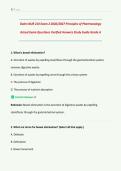
Galen NUR 210 Exam 2 2026/2027 Principles of Pharmacology Actual Exam Questions Verified Answers Study Guide Grade A

Rating
-
Sold
-
Pages
28
Grade
A+
Uploaded on
26-03-2026
Written in
2025/2026

INSTANT PDF DOWNLOAD—This comprehensive study guide is specifically designed for Galen College of Nursing students preparing for NUR 210 Principles of Pharmacology Exam 2 for the 2026/2027 academic year. Based on verified exam materials from top-selling student resources, this resource contains expertly verified practice questions and 100% correct answers with detailed rationales to help you master core pharmacology concepts and achieve a top score (Grade A+). This comprehensive guide covers all major topics tested on NUR 210 Exam 2 : Adrenergic Agonists (Sympathomimetics) : Epinephrine (nonselective) stimulates alpha-1, beta-1, and beta-2 receptors; effects include increased HR, bronchodilation, vasoconstriction, increased blood glucose. Used for anaphylaxis, status asthmaticus, cardiac arrest. Beta-2 agonists (albuterol) cause bronchodilation and increased blood flow; adverse effects include tachycardia, hypertension, tremors. Alpha-1 agonists cause vasoconstriction (increase BP). Therapeutic response target: HR 60-100 BPM . Adrenergic Antagonists (Blockers) : Alpha-1 blockers (-osin) cause vasodilation, decreased BP; used for hypertension and BPH; side effects: orthostatic hypotension, dizziness, headache; assess for first-dose syncope . Beta blockers (-olol) block beta-1 (decrease HR, contractility) and beta-2 (bronchoconstriction). Selective beta-1 blockers (metoprolol, atenolol) are safer for patients with COPD/asthma . Non-selective (propranolol) causes bronchoconstriction. Never stop abruptly—taper over 1-2 weeks to prevent rebound tachycardia, hypertension, MI . Cholinergic Agonists (Parasympathomimetics) : Bethanechol stimulates cholinergic receptors, contracts bladder, increases GI motility. Used for urinary retention (neurogenic bladder). Therapeutic response: increased urine output (30 mL/hr). Side effects: blurred vision, increased secretions, orthostatic hypotension, bradycardia. Contraindications: COPD/asthma, peptic ulcer, bradycardia, Parkinson's disease. Pilocarpine constricts pupils, promotes drainage of aqueous humor; used for glaucoma . Anticholinergics (Parasympatholytics) : Atropine inhibits acetylcholine, increases HR (vagal blockade), dries secretions, dilates pupils, decreases GI motility. Used preoperatively, for bradycardia, eye exams. Side effects: "dry them out"—dry mouth, blurred vision, constipation, urinary retention, inability to sweat (heat stroke risk). Contraindications: glaucoma, BPH, tachycardia, myasthenia gravis . Sedative-Hypnotics & Sleep Aids : Benzodiazepines (temazepam, flurazepam) potentiate GABA, reduce neuron excitability. Used for insomnia (short-term). Adverse effects: hypotension, respiratory depression, dependency, seizures upon withdrawal. Antidote: flumazenil. Non-benzodiazepines (zolpidem/Ambien, eszopiclone/Lunesta) inhibit neurotransmitters, cause CNS depression; duration 6-8 hours. Ramelteon (Rozerem) —melatonin receptor agonist. Non-pharmacologic sleep management: same bedtime/wake time, avoid caffeine/alcohol/nicotine 6 hours before bed, limit naps, warm bath, white noise . Anesthetics & Local Anesthetics : Balanced anesthesia uses multiple drugs (opioid, benzodiazepine, anticholinergic, short-acting barbiturate, inhaled gas, muscle relaxant). Midazolam (Versed) —benzodiazepine for conscious sedation; monitor respiratory depression; antidote: flumazenil. Topical anesthetics numb skin layers. Spinal/epidural administered into CSF; common side effect: headache; adverse reactions: hypotension, respiratory distress . Cardiac & Anti-inflammatory Drugs : Digoxin —cardiac glycoside increases contractility (positive inotropic), decreases HR (negative chronotropic). Hold if HR 60. Signs of toxicity: visual changes (yellow/green halos), bradycardia, nausea/anorexia. Monitor potassium levels (hypokalemia increases toxicity risk). Target serum level: 0.5-2 ng/mL . NSAIDs (ibuprofen, ketorolac) inhibit COX-1 and COX-2, decreasing prostaglandin synthesis. Monitor for GI upset, bleeding. COX-2 inhibitors (celecoxib) reduce GI effects but increase cardiovascular risk . Key Pharmacology Concepts : Selectivity —selective drugs bind to primary receptor sites; non-selective bind to multiple sites, increasing side effects. Potency —dose required to produce desired effect. Therapeutic window —dosing range for safest, most effective treatment. Toxicity —drug levels exceed therapeutic range. Agonist —activates receptor. Antagonist —blocks receptor. Synergistic effect —combined effect greater than sum of individual drugs. Adherence vs. compliance —adherence implies partnership; compliance implies one-sided direction . Sample Questions Include : "The nurse administers a selective beta2-adrenergic agonist (albuterol) to treat bronchospasm. This drug can potentially cause which side effect?" → Increased heart rate (beta-2 stimulation causes bronchodilation but can also cause tachycardia) "A patient with asthma requires a beta blocker. Which drug is safest?" → Metoprolol (Lopressor) (selective beta-1 blocker less likely to cause bronchoconstriction) "The nurse administers epinephrine for anaphylaxis. What is expected?" → Tachycardia, increased BP, bronchodilation (epinephrine stimulates alpha and beta receptors) "A patient with asthma has tremors, restlessness, and HR 120 after using albuterol. The nurse suspects:" → Overused the albuterol (signs of excessive beta-agonist stimulation) "What is the most important instruction for a patient starting digoxin?" → Hold dose if heart rate is below 60 beats per minute "What is the correct sequence for applying eye drops?" → Perform hand hygiene, wear gloves, gently pull skin below eye, apply drops to middle third of conjunctival sac, apply pressure over lacrimal duct, wait 2-5 minutes before next medication All questions include complete rationales based on current evidence-based practice, pharmacology standards, and Galen College curriculum requirements . DOCUMENT ACCESS: This study guide is available as an instant digital download (PDF) immediately upon purchase. Fully text-searchable, printable, and accessible anytime through your user account. 100% satisfaction guarantee. Trusted by thousands of Galen nursing students for NUR 210 exam preparation and mastering pharmacology competencies.

Show more Read less

Content preview

1|Page


Galen NUR 210 Exam 2 2026/2027 Principles of Pharmacology

Actual Exam Questions Verified Answers Study Guide Grade A


1. What is bowel elimination?

A. Excretion of wastes by expelling stool/feces through the gastrointestinal system;

removes digestive wastes

B. Excretion of wastes by expelling urine through the urinary system

C. The process of digestion

D. The process of nutrient absorption

Correct Answer: A

Rationale: Bowel elimination is the excretion of digestive wastes by expelling

stool/feces through the gastrointestinal system.


2. What are terms for bowel elimination? (Select all that apply.)

A. Defecate

B. Defecation

C. Bowel movement

,2|Page


D. Micturition

Correct Answer: A, B, C

Rationale: Terms for bowel elimination include defecate, defecation, and bowel

movement.


3. What is urinary elimination?

A. Excretion of digestive wastes by expelling stool

B. Excreting waste products by expelling urine using the urinary system; removes

metabolic waste

C. The process of fluid absorption

D. The process of nutrient metabolism

Correct Answer: B

Rationale: Urinary elimination is the excretion of metabolic waste by expelling urine

through the urinary system.


4. What are terms for urinary elimination? (Select all that apply.)

A. Micturition

B. Urination

C. Voiding

, 3|Page


D. Defecation

Correct Answer: A, B, C

Rationale: Terms for urinary elimination include micturition, urination, and voiding.


5. How much does the bladder typically hold before pressure builds and the urge to

urinate occurs?

A. 100-200 mL

B. 300-500 mL

C. 600-800 mL

D. 900-1000 mL

Correct Answer: B

Rationale: The bladder typically holds about 300-500 mL before pressure builds and the

urge to urinate occurs.


6. What is continence?

A. The inability to control elimination

B. The purposeful control of urinary and bowel elimination

C. The process of elimination

D. The frequency of elimination

Document information

Uploaded on
March 26, 2026
Number of pages
28
Written in
2025/2026
Type
Exam (elaborations)
Contains
Questions & answers
$12.49
Get access to the full document:

Wrong document? Swap it for free Within 14 days of purchase and before downloading, you can choose a different document. You can simply spend the amount again.
Written by students who passed
Immediately available after payment
Read online or as PDF


Also available in package deal

Thumbnail
Package deal
Galen NUR 210 Exam 1, 2, 3, 4 & Final Exams | Principles of Pharmacology | STUDY PACK
-
10 2026
$ 51.45 More info

Get to know the seller

Seller avatar
Reputation scores are based on the amount of documents a seller has sold for a fee and the reviews they have received for those documents. There are three levels: Bronze, Silver and Gold. The better the reputation, the more your can rely on the quality of the sellers work.
ExamitorMagnus Massachusetts Institute Of Technology
View profile
Follow You need to be logged in order to follow users or courses
Sold
117
Member since
2 year
Number of followers
7
Documents
1756
Last sold
1 week ago
Top Score

I am a professional writer with knowledge across diverse academic fields. I provide quality work and I guarantee superb, timely and original content. I know the pain of getting a shoddy work, and I would never wish this on any client! I guarantee a topnotch paper, with a fast High-score turnaround. I provide quality work guaranteed to give you an exemplary grade. Furthermore, I am a tutor of Research paper, Dissertation, proposal, management studies, economics, educational studies, sociology and psychology, marketing, Geography, History, Management, English, Literature, Education. Medical studies, Health Care studies and Nursing, Biology, Economics among other subjects.

Read more Read less
3.5

22 reviews

5
8
4
3
3
6
2
2
1
3

Why students choose Stuvia

Created by fellow students, verified by reviews

Quality you can trust: written by students who passed their tests and reviewed by others who've used these notes.

Didn't get what you expected? Choose another document

No worries! You can instantly pick a different document that better fits what you're looking for.

Pay as you like, start learning right away

No subscription, no commitments. Pay the way you're used to via credit card and download your PDF document instantly.

Student with book image

“Bought, downloaded, and aced it. It really can be that simple.”

Alisha Student

Working on your references?

Create accurate citations in APA, MLA and Harvard with our free citation generator.

Working on your references?

Frequently asked questions