
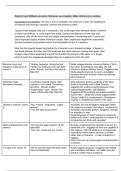
Explore how Williams presents Streetcar as a tragedy. Make reference to context.
Conventions of a tragedy - the hero’s end is inevitable, the presence of fate, the significance
of violence and revenge, hamartia, internal and external conflict.
Typical Greek tragedy only has 3 characters, you could argue that Streetcar doesn’t conform
to these conventions, or could argue that Stella, Stanley and Blanche are the only real
characters, and all the minor ones are simply representative of something else: Eunice and
Steve represent typical modern American couple, Mitch represents hegemonic masculinity,
and the prostitute and drunkard mirror and foreshadow B and S’s violence.
Idea that the tragedy began long before the characters even stepped onstage - it began in
the divide between the New and Old South and the clash between working and upper class,
it began when Stella deserted B and left her to suffer the trauma of BR alone, or it began
when B learnt her prejudiced ideologies that set S against her from the start.
Blanche’s rant and “Stanley hesitates, licking his lips” Stella antagonistically choosing Stanley (“full in
Stanley’s response to it, “Stella has embraced him with both the view”) foreshadows how later she will
scene 4 arms, fiercely, and full in the view of choose to believe Stanley over B. Suggests that
Blanche” Stella abandoning B at the end is inevitable
because the bond between them has already
been fractured.
Streetcar motif, “a streetcar named Desire, then AO3: Streetcar itself is symbolic of the New
throughout the play transfer to one called Cemeteries… South’s modernity and of New Orleans -
get off at - Elysian Fields!” suggests B’s ending is partly because of her
“brutal desire - just - Desire! The cultural displacement. (SB identity)
name of that rattle-trap streetcar” Suggests all the endings are already mapped
out for them - Stella will remain trapped within
“Desire” while B is condemned to Cemeteries -
insanity is metaphorical death of her spirit.
Stanley’s outburst, scene “Pig - Polack - disgusting - vulgar - Asyndetic list and derogatory language reflect
8 greasy!” the tirade he receives from others - explains his
“I am the king around here” frustration and builds pathos. Suggests revenge
for prejudice is nigh.
Regal language of “king” betrays his desire for
power and control - foreshadows his control of B
(conquering her body and sexuality)
Mitch’s debasement of B, “He tears the paper lantern off the Brutality (emphasised by repetition) mirrors S’s
scene 9 light-bulb” treatment of B - suggests all men are capable of
“Lies, lies, inside and out, all lies” this violence. Mitch’s adherence to hegemonic
masculinity allows him to become a symbol,
rather than a character - 3 main characters in
tragedy.
AO3: Post-war soc encouraged male domination
of women.
S’s rape of B, scene 10 “We’ve had this date with each other Builds tragedy because it suggests the ending
from the beginning” was inevitable and fated - no matter how she
acted B couldn’t have avoided it.
Conventions of a tragedy - the hero’s end is inevitable, the presence of fate, the significance
of violence and revenge, hamartia, internal and external conflict.
Typical Greek tragedy only has 3 characters, you could argue that Streetcar doesn’t conform
to these conventions, or could argue that Stella, Stanley and Blanche are the only real
characters, and all the minor ones are simply representative of something else: Eunice and
Steve represent typical modern American couple, Mitch represents hegemonic masculinity,
and the prostitute and drunkard mirror and foreshadow B and S’s violence.
Idea that the tragedy began long before the characters even stepped onstage - it began in
the divide between the New and Old South and the clash between working and upper class,
it began when Stella deserted B and left her to suffer the trauma of BR alone, or it began
when B learnt her prejudiced ideologies that set S against her from the start.
Blanche’s rant and “Stanley hesitates, licking his lips” Stella antagonistically choosing Stanley (“full in
Stanley’s response to it, “Stella has embraced him with both the view”) foreshadows how later she will
scene 4 arms, fiercely, and full in the view of choose to believe Stanley over B. Suggests that
Blanche” Stella abandoning B at the end is inevitable
because the bond between them has already
been fractured.
Streetcar motif, “a streetcar named Desire, then AO3: Streetcar itself is symbolic of the New
throughout the play transfer to one called Cemeteries… South’s modernity and of New Orleans -
get off at - Elysian Fields!” suggests B’s ending is partly because of her
“brutal desire - just - Desire! The cultural displacement. (SB identity)
name of that rattle-trap streetcar” Suggests all the endings are already mapped
out for them - Stella will remain trapped within
“Desire” while B is condemned to Cemeteries -
insanity is metaphorical death of her spirit.
Stanley’s outburst, scene “Pig - Polack - disgusting - vulgar - Asyndetic list and derogatory language reflect
8 greasy!” the tirade he receives from others - explains his
“I am the king around here” frustration and builds pathos. Suggests revenge
for prejudice is nigh.
Regal language of “king” betrays his desire for
power and control - foreshadows his control of B
(conquering her body and sexuality)
Mitch’s debasement of B, “He tears the paper lantern off the Brutality (emphasised by repetition) mirrors S’s
scene 9 light-bulb” treatment of B - suggests all men are capable of
“Lies, lies, inside and out, all lies” this violence. Mitch’s adherence to hegemonic
masculinity allows him to become a symbol,
rather than a character - 3 main characters in
tragedy.
AO3: Post-war soc encouraged male domination
of women.
S’s rape of B, scene 10 “We’ve had this date with each other Builds tragedy because it suggests the ending
from the beginning” was inevitable and fated - no matter how she
acted B couldn’t have avoided it.


