

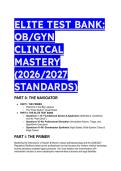
ELITE TEST BANK:
OB/GYN
CLINICAL
MASTERY
(2026/2027
STANDARDS)
PART 0: THE NAVIGATOR
● PART I: THE PRIMER
○ Welcome to the Big Leagues
○ The "Panic Button" Cheat Sheet
● PART II: THE ELITE TEST BANK
○ Questions 1–15: Foundational Syntax & Application (Definitions, Guidelines,
and the "Hard Deck")
○ Questions 16–40: Professional Simulation (Immediate Actions, Triage, and
Algorithmic Execution)
○ Questions 41–66: Grandmaster Synthesis (High-Stakes, Multi-System Crises &
Edge Cases)
PART I: THE PRIMER
Mastering the intersection of Hacker & Moore’s classic pathophysiology and the 2026/2027
Regulatory Redlines yields top-tier professional survival because the modern medical landscape
heavily penalizes outdated legacy practices. You must replace rote memorization with
mechanistic intuition to avert catastrophic maternal-fetal outcomes and legal liabilities.
,The "Panic Button" Cheat Sheet:
● Active Labor Arrest (2026): Active phase begins at exactly 6 cm. Arrest is ≥6 cm +
ruptured membranes + 4 hours adequate contractions OR 6 hours inadequate
contractions with oxytocin.
● Endometriosis (ACOG 2026): Clinical diagnosis is sufficient. Empiric medical treatment
comes first. Diagnostic laparoscopy is no longer required to initiate care.
● Preeclampsia Prophylaxis (SMFM 2026): Aspirin decreases preeclampsia risk but
independently increases peripartum transfusion risk by 1.42x. Execute the 16-point
checklist.
● Short Cervix (SMFM 2024/2026): ≤20 mm before 24 weeks receives vaginal
progesterone. Do not prescribe 17-OHPC.
● FHR Category II: Do not use routine maternal oxygen. Prioritize amnioinfusion, fluid
bolus, or repositioning.
PART II: THE ELITE TEST BANK
Questions 1–15: Foundational Syntax & Application
Q1: A nulliparous client at 39 weeks gestation is admitted in labor. Cervical examination reveals
6 cm dilation. The amniotic membranes are artificially ruptured. Following 4 hours of adequate
uterine contractions measured via intrauterine pressure catheter (IUPC), the cervix remains at 6
cm. Which intervention is the MOST APPROPRIATE IMMEDIATE action? A) Continue oxytocin
augmentation for an additional 2 hours to meet the 6-hour minimum requirement for arrest. B)
Proceed to cesarean delivery for active phase arrest. C) Administer an amnioinfusion to relieve
potential occult cord compression slowing descent. D) Transition the client to the latent phase
protocol and prescribe therapeutic rest.
● The Answer: B (Proceed to cesarean delivery for active phase arrest.)
● Distractor Analysis:
○ A is incorrect: The 6-hour threshold strictly applies to inadequate contractions. With
adequate contractions, 4 hours without cervical change at ≥6 cm defines active
phase arrest.
○ C is incorrect: Amnioinfusion is indicated for recurrent variable decelerations, not
mechanical dystocia or arrest of dilation.
○ D is incorrect: The client has reached 6 cm, which ACOG 2026 strictly defines as
the onset of the active phase. Labor cannot be retroactively downgraded to the
latent phase.
The Mentor's Analysis: The 2026 Zhang/ACOG labor curves recalibrated the baseline
parameters for labor arrest. The active phase begins at 6 cm, period. If the physiological engine
is running at full capacity (adequate contractions via IUPC) and the mechanical door refuses to
open (no cervical change for 4 hours with ruptured membranes), the physics of the pelvis
dictate a mechanical failure. Professional Intuition: Do not push a stalled engine; if the physics
fail after 4 hours of adequate force, operate.
Diagnostic Parameter Minimum Dilation Contraction Quality Time Threshold for
Arrest
Active Phase Arrest ≥ 6 cm + ROM Adequate (via IUPC) 4 Hours
Active Phase Arrest ≥ 6 cm + ROM Inadequate (+ 6 Hours
Oxytocin)
,Q2: A 24-year-old client presents with severe, cyclic pelvic pain, deep dyspareunia, and
dyschezia. Transvaginal ultrasonography (TVUS) reveals no endometriomas or structural
anomalies. The client desires immediate relief and future fertility. According to ACOG 2026
Clinical Practice Guideline No. 11, what is the MOST APPROPRIATE INITIAL management? A)
Schedule a diagnostic laparoscopy to confirm the presence of endometrial implants before
initiating therapy. B) Initiate empiric medical management with hormonal suppression based on
the clinical presentation. C) Order a serum CA-125 level to stratify the risk of deep infiltrating
endometriosis. D) Recommend a magnetic resonance imaging (MRI) of the pelvis to definitively
diagnose superficial peritoneal lesions.
● The Answer: B (Initiate empiric medical management with hormonal suppression based
on the clinical presentation.)
● Distractor Analysis:
○ A is incorrect: ACOG 2026 strictly shifts away from requiring surgical diagnosis.
Diagnostic laparoscopy delays care and subjects the patient to unnecessary
surgical risk for a clinical diagnosis.
○ C is incorrect: ACOG 2026 strongly recommends against using biomarkers like
CA-125 for endometriosis due to an overwhelming lack of diagnostic accuracy.
○ D is incorrect: While MRI can characterize deep endometriosis, it is not required to
initiate first-line empiric treatment for classic symptoms with a negative TVUS.
The Mentor's Analysis: The updated guidelines finally acknowledge that pelvic pain is a
functional crisis, not just an anatomical one. By authorizing a purely clinical diagnosis based on
symptom presentation, practitioners bypass the archaic 4-to-11-year diagnostic delay.
Professional Intuition: Treat the clinical smoke, do not force the patient to undergo surgery just
to prove there is a fire.
Q3: An asymptomatic 22-week pregnant client with a singleton gestation and no history of
spontaneous preterm birth undergoes a routine anatomical ultrasound. The transvaginal cervical
length is measured at 18 mm. Which pharmacologic intervention is the MOST APPROPRIATE
to reduce the risk of preterm birth? A) 17-alpha hydroxyprogesterone caproate (17-OHPC)
intramuscular injections weekly. B) Daily vaginal progesterone. C) Placement of a cervical
pessary. D) Prophylactic indomethacin.
● The Answer: B (Daily vaginal progesterone.)
● Distractor Analysis:
○ A is incorrect: SMFM 2024/2026 guidelines explicitly recommend against the use of
17-OHPC for the treatment of a short cervix due to proven lack of efficacy.
○ C is incorrect: Cervical pessaries are not recommended for the prevention of
preterm birth in singleton gestations with a short cervix.
○ D is incorrect: Indomethacin is a tocolytic used for acute preterm labor, not as a
prophylactic agent for an asymptomatic short cervix.
The Mentor's Analysis: The cervix is a dynamic connective tissue structure, not just a
muscular sphincter. Vaginal progesterone acts locally to prevent the degradation of the
extracellular matrix. The elite clinician knows 17-OHPC is obsolete legacy medicine for this
indication. Professional Intuition: Local structural problems require local hormonal
reinforcement. Deploy vaginal progesterone for lengths ≤20 mm.
Q4: A client in the active phase of labor exhibits a Category II fetal heart rate (FHR) tracing
characterized by minimal variability and recurrent late decelerations. The practitioner decides to
initiate intrauterine resuscitation. According to 2026 ACOG guidelines, which of the following
actions is STRONGLY RECOMMENDED AGAINST as a routine measure? A) Maternal
repositioning to the left lateral decubitus position. B) Administration of an intravenous fluid bolus.
, C) Administration of supplemental maternal oxygen. D) Cessation of the oxytocin infusion.
● The Answer: C (Administration of supplemental maternal oxygen.)
● Distractor Analysis:
○ A is incorrect: Repositioning is an explicitly recommended first-line resuscitation
technique to improve uteroplacental perfusion.
○ B is incorrect: Fluid boluses correct underlying maternal hypovolemia and optimize
placental blood flow.
○ D is incorrect: Stopping oxytocin immediately reduces uterine tone and improves
interval perfusion to the fetus.
The Mentor's Analysis: The archaic reflex to immediately place an oxygen mask on the mother
is dead. Fetal acidemia is a perfusion problem, not a maternal oxygenation problem. Forcing
hyperoxia creates dangerous free radicals without improving the fetal base excess.
Professional Intuition: Fix the plumbing (perfusion via fluid, position, or stopping contractions),
do not just increase the gas concentration.
Q5: A 28-year-old female presents to the outpatient clinic with lower abdominal pain and
significant cervical motion tenderness. She is diagnosed with pelvic inflammatory disease (PID).
She has no signs of tubo-ovarian abscess and tolerates oral intake. Based on 2026 CDC
guidelines, what is the MOST APPROPRIATE outpatient pharmacological regimen? A)
Ceftriaxone 500 mg IM x 1, plus Azithromycin 1 g PO x 1. B) Ceftriaxone 500 mg IM x 1, plus
Doxycycline 100 mg PO BID for 14 days, plus Metronidazole 500 mg PO BID for 14 days. C)
Cefoxitin 2 g IV, plus Doxycycline 100 mg PO BID for 14 days. D) Clindamycin 900 mg IV every
8 hours, plus Gentamicin.
● The Answer: B (Ceftriaxone 500 mg IM x 1, plus Doxycycline 100 mg PO BID for 14
days, plus Metronidazole 500 mg PO BID for 14 days.)
● Distractor Analysis:
○ A is incorrect: Azithromycin monotherapy is obsolete for PID due to rapidly rising
antimicrobial resistance and completely inadequate anaerobic coverage.
○ C is incorrect: Cefoxitin requires concurrent Probenecid if given IM for outpatient
therapy. Intravenous administration is an inpatient protocol.
○ D is incorrect: The Clindamycin and Gentamicin combination is a classic inpatient
parenteral regimen reserved for severe systemic illness or tubo-ovarian abscess.
The Mentor's Analysis: PID is a destructive, polymicrobial invasion. The modern standard
recognizes that covering gonorrhea and chlamydia alone is woefully insufficient; you must
aggressively cover the ascending vaginal anaerobes to prevent permanent tubal scarring.
Metronidazole is no longer optional; it is mandatory in the primary outpatient triad. Professional
Intuition: Protect the fallopian tubes at all costs by neutralizing the anaerobic
microenvironment. Add the Metronidazole.
Q6: A 26-year-old client presents with irregular menstrual cycles and moderate hirsutism. The
practitioner suspects Polycystic Ovary Syndrome (PCOS). According to the 2023/2026
International Evidence-based Guideline for PCOS, which diagnostic modality can now
REPLACE pelvic ultrasonography to confirm the presence of polycystic ovarian morphology in
an adult? A) Serum anti-Müllerian hormone (AMH) level. B) Fasting insulin-to-glucose ratio. C)
Serum luteinizing hormone (LH) to follicle-stimulating hormone (FSH) ratio > 2:1. D)
Transabdominal pelvic MRI.
● The Answer: A (Serum anti-Müllerian hormone (AMH) level.)
● Distractor Analysis:
○ B is incorrect: While insulin resistance is a profound metabolic consequence of
PCOS, it is not an official diagnostic criterion for confirming ovarian morphology.
OB/GYN
CLINICAL
MASTERY
(2026/2027
STANDARDS)
PART 0: THE NAVIGATOR
● PART I: THE PRIMER
○ Welcome to the Big Leagues
○ The "Panic Button" Cheat Sheet
● PART II: THE ELITE TEST BANK
○ Questions 1–15: Foundational Syntax & Application (Definitions, Guidelines,
and the "Hard Deck")
○ Questions 16–40: Professional Simulation (Immediate Actions, Triage, and
Algorithmic Execution)
○ Questions 41–66: Grandmaster Synthesis (High-Stakes, Multi-System Crises &
Edge Cases)
PART I: THE PRIMER
Mastering the intersection of Hacker & Moore’s classic pathophysiology and the 2026/2027
Regulatory Redlines yields top-tier professional survival because the modern medical landscape
heavily penalizes outdated legacy practices. You must replace rote memorization with
mechanistic intuition to avert catastrophic maternal-fetal outcomes and legal liabilities.
,The "Panic Button" Cheat Sheet:
● Active Labor Arrest (2026): Active phase begins at exactly 6 cm. Arrest is ≥6 cm +
ruptured membranes + 4 hours adequate contractions OR 6 hours inadequate
contractions with oxytocin.
● Endometriosis (ACOG 2026): Clinical diagnosis is sufficient. Empiric medical treatment
comes first. Diagnostic laparoscopy is no longer required to initiate care.
● Preeclampsia Prophylaxis (SMFM 2026): Aspirin decreases preeclampsia risk but
independently increases peripartum transfusion risk by 1.42x. Execute the 16-point
checklist.
● Short Cervix (SMFM 2024/2026): ≤20 mm before 24 weeks receives vaginal
progesterone. Do not prescribe 17-OHPC.
● FHR Category II: Do not use routine maternal oxygen. Prioritize amnioinfusion, fluid
bolus, or repositioning.
PART II: THE ELITE TEST BANK
Questions 1–15: Foundational Syntax & Application
Q1: A nulliparous client at 39 weeks gestation is admitted in labor. Cervical examination reveals
6 cm dilation. The amniotic membranes are artificially ruptured. Following 4 hours of adequate
uterine contractions measured via intrauterine pressure catheter (IUPC), the cervix remains at 6
cm. Which intervention is the MOST APPROPRIATE IMMEDIATE action? A) Continue oxytocin
augmentation for an additional 2 hours to meet the 6-hour minimum requirement for arrest. B)
Proceed to cesarean delivery for active phase arrest. C) Administer an amnioinfusion to relieve
potential occult cord compression slowing descent. D) Transition the client to the latent phase
protocol and prescribe therapeutic rest.
● The Answer: B (Proceed to cesarean delivery for active phase arrest.)
● Distractor Analysis:
○ A is incorrect: The 6-hour threshold strictly applies to inadequate contractions. With
adequate contractions, 4 hours without cervical change at ≥6 cm defines active
phase arrest.
○ C is incorrect: Amnioinfusion is indicated for recurrent variable decelerations, not
mechanical dystocia or arrest of dilation.
○ D is incorrect: The client has reached 6 cm, which ACOG 2026 strictly defines as
the onset of the active phase. Labor cannot be retroactively downgraded to the
latent phase.
The Mentor's Analysis: The 2026 Zhang/ACOG labor curves recalibrated the baseline
parameters for labor arrest. The active phase begins at 6 cm, period. If the physiological engine
is running at full capacity (adequate contractions via IUPC) and the mechanical door refuses to
open (no cervical change for 4 hours with ruptured membranes), the physics of the pelvis
dictate a mechanical failure. Professional Intuition: Do not push a stalled engine; if the physics
fail after 4 hours of adequate force, operate.
Diagnostic Parameter Minimum Dilation Contraction Quality Time Threshold for
Arrest
Active Phase Arrest ≥ 6 cm + ROM Adequate (via IUPC) 4 Hours
Active Phase Arrest ≥ 6 cm + ROM Inadequate (+ 6 Hours
Oxytocin)
,Q2: A 24-year-old client presents with severe, cyclic pelvic pain, deep dyspareunia, and
dyschezia. Transvaginal ultrasonography (TVUS) reveals no endometriomas or structural
anomalies. The client desires immediate relief and future fertility. According to ACOG 2026
Clinical Practice Guideline No. 11, what is the MOST APPROPRIATE INITIAL management? A)
Schedule a diagnostic laparoscopy to confirm the presence of endometrial implants before
initiating therapy. B) Initiate empiric medical management with hormonal suppression based on
the clinical presentation. C) Order a serum CA-125 level to stratify the risk of deep infiltrating
endometriosis. D) Recommend a magnetic resonance imaging (MRI) of the pelvis to definitively
diagnose superficial peritoneal lesions.
● The Answer: B (Initiate empiric medical management with hormonal suppression based
on the clinical presentation.)
● Distractor Analysis:
○ A is incorrect: ACOG 2026 strictly shifts away from requiring surgical diagnosis.
Diagnostic laparoscopy delays care and subjects the patient to unnecessary
surgical risk for a clinical diagnosis.
○ C is incorrect: ACOG 2026 strongly recommends against using biomarkers like
CA-125 for endometriosis due to an overwhelming lack of diagnostic accuracy.
○ D is incorrect: While MRI can characterize deep endometriosis, it is not required to
initiate first-line empiric treatment for classic symptoms with a negative TVUS.
The Mentor's Analysis: The updated guidelines finally acknowledge that pelvic pain is a
functional crisis, not just an anatomical one. By authorizing a purely clinical diagnosis based on
symptom presentation, practitioners bypass the archaic 4-to-11-year diagnostic delay.
Professional Intuition: Treat the clinical smoke, do not force the patient to undergo surgery just
to prove there is a fire.
Q3: An asymptomatic 22-week pregnant client with a singleton gestation and no history of
spontaneous preterm birth undergoes a routine anatomical ultrasound. The transvaginal cervical
length is measured at 18 mm. Which pharmacologic intervention is the MOST APPROPRIATE
to reduce the risk of preterm birth? A) 17-alpha hydroxyprogesterone caproate (17-OHPC)
intramuscular injections weekly. B) Daily vaginal progesterone. C) Placement of a cervical
pessary. D) Prophylactic indomethacin.
● The Answer: B (Daily vaginal progesterone.)
● Distractor Analysis:
○ A is incorrect: SMFM 2024/2026 guidelines explicitly recommend against the use of
17-OHPC for the treatment of a short cervix due to proven lack of efficacy.
○ C is incorrect: Cervical pessaries are not recommended for the prevention of
preterm birth in singleton gestations with a short cervix.
○ D is incorrect: Indomethacin is a tocolytic used for acute preterm labor, not as a
prophylactic agent for an asymptomatic short cervix.
The Mentor's Analysis: The cervix is a dynamic connective tissue structure, not just a
muscular sphincter. Vaginal progesterone acts locally to prevent the degradation of the
extracellular matrix. The elite clinician knows 17-OHPC is obsolete legacy medicine for this
indication. Professional Intuition: Local structural problems require local hormonal
reinforcement. Deploy vaginal progesterone for lengths ≤20 mm.
Q4: A client in the active phase of labor exhibits a Category II fetal heart rate (FHR) tracing
characterized by minimal variability and recurrent late decelerations. The practitioner decides to
initiate intrauterine resuscitation. According to 2026 ACOG guidelines, which of the following
actions is STRONGLY RECOMMENDED AGAINST as a routine measure? A) Maternal
repositioning to the left lateral decubitus position. B) Administration of an intravenous fluid bolus.
, C) Administration of supplemental maternal oxygen. D) Cessation of the oxytocin infusion.
● The Answer: C (Administration of supplemental maternal oxygen.)
● Distractor Analysis:
○ A is incorrect: Repositioning is an explicitly recommended first-line resuscitation
technique to improve uteroplacental perfusion.
○ B is incorrect: Fluid boluses correct underlying maternal hypovolemia and optimize
placental blood flow.
○ D is incorrect: Stopping oxytocin immediately reduces uterine tone and improves
interval perfusion to the fetus.
The Mentor's Analysis: The archaic reflex to immediately place an oxygen mask on the mother
is dead. Fetal acidemia is a perfusion problem, not a maternal oxygenation problem. Forcing
hyperoxia creates dangerous free radicals without improving the fetal base excess.
Professional Intuition: Fix the plumbing (perfusion via fluid, position, or stopping contractions),
do not just increase the gas concentration.
Q5: A 28-year-old female presents to the outpatient clinic with lower abdominal pain and
significant cervical motion tenderness. She is diagnosed with pelvic inflammatory disease (PID).
She has no signs of tubo-ovarian abscess and tolerates oral intake. Based on 2026 CDC
guidelines, what is the MOST APPROPRIATE outpatient pharmacological regimen? A)
Ceftriaxone 500 mg IM x 1, plus Azithromycin 1 g PO x 1. B) Ceftriaxone 500 mg IM x 1, plus
Doxycycline 100 mg PO BID for 14 days, plus Metronidazole 500 mg PO BID for 14 days. C)
Cefoxitin 2 g IV, plus Doxycycline 100 mg PO BID for 14 days. D) Clindamycin 900 mg IV every
8 hours, plus Gentamicin.
● The Answer: B (Ceftriaxone 500 mg IM x 1, plus Doxycycline 100 mg PO BID for 14
days, plus Metronidazole 500 mg PO BID for 14 days.)
● Distractor Analysis:
○ A is incorrect: Azithromycin monotherapy is obsolete for PID due to rapidly rising
antimicrobial resistance and completely inadequate anaerobic coverage.
○ C is incorrect: Cefoxitin requires concurrent Probenecid if given IM for outpatient
therapy. Intravenous administration is an inpatient protocol.
○ D is incorrect: The Clindamycin and Gentamicin combination is a classic inpatient
parenteral regimen reserved for severe systemic illness or tubo-ovarian abscess.
The Mentor's Analysis: PID is a destructive, polymicrobial invasion. The modern standard
recognizes that covering gonorrhea and chlamydia alone is woefully insufficient; you must
aggressively cover the ascending vaginal anaerobes to prevent permanent tubal scarring.
Metronidazole is no longer optional; it is mandatory in the primary outpatient triad. Professional
Intuition: Protect the fallopian tubes at all costs by neutralizing the anaerobic
microenvironment. Add the Metronidazole.
Q6: A 26-year-old client presents with irregular menstrual cycles and moderate hirsutism. The
practitioner suspects Polycystic Ovary Syndrome (PCOS). According to the 2023/2026
International Evidence-based Guideline for PCOS, which diagnostic modality can now
REPLACE pelvic ultrasonography to confirm the presence of polycystic ovarian morphology in
an adult? A) Serum anti-Müllerian hormone (AMH) level. B) Fasting insulin-to-glucose ratio. C)
Serum luteinizing hormone (LH) to follicle-stimulating hormone (FSH) ratio > 2:1. D)
Transabdominal pelvic MRI.
● The Answer: A (Serum anti-Müllerian hormone (AMH) level.)
● Distractor Analysis:
○ B is incorrect: While insulin resistance is a profound metabolic consequence of
PCOS, it is not an official diagnostic criterion for confirming ovarian morphology.



