
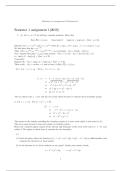
Solutions to assignment 01:Semester1:
Semester 1 assignment 1(2019)
1. (a) Let z1 ; z2 2 C be arbitrary complex numbers. Show that
Re(z1 z2 ) = jz1 jjz2 j if and only if [arg(z1 )] [arg(z2 )] = f2n : n 2 Zg:
Solution: Let z1 = r1 ei 1 and z2 = r2 ei 2 where 1 = arg z1 , 2 = arg z2 , r1 = jz1 j and r2 = jz2 j
We also have that z2 = r2 e i 2
Then z1 z2 = r1 ei 1 r2 e i 2 = r1 r2 ei( 1 2 ) = jz1 jjz2 j(cos( 1 2 ) + i sin( 1 2 ))( )
Now suppose Re(z1 z2 ) = jz1 jjz2 j then j(cos( 1 2 ) = 1 i.e ( 1 2 ) = 2n for all n 2 Z.
i.e. [arg(z1 )] [arg(z2 )] = f2n : n 2 Zg:
Conversely:
Suppose ( 1 2 ) = [arg(z1 )] [arg(z2 )] = f2n : n 2 Zg
Then cos( 1 2 ) = cos 2n = 1 and so from ( ) Re(z1 z2 ) = jz1 jjz2 j:
(b) i. Let z = x + iy . For fz : jz + ij = jz ijg :
jz + ij = jz ij , jx + i(y + 1)j = jx + i(y 1)j
p p
, x2 + (y + 1)2 = x2 + (y 1)2
, x2 + (y + 1)2 = x2 + (y 1)2
, y 2 + 2y + 1 = y 2 2y + 1
, 4y = 0 i.e. y = 0
The set asked is the x axis and the set is thus closed because it contains all its boundary points.
ii . Let z = x + iy For fz : jzj2 > z + zg :
jzj2 > z+z
, x2 + y 2 > x + iy + x iy
2 2
, x + y 2x > 0
, (x 1) + y 2 > 1
2
The answer is the ourside excluding the boundary points of a circle woth radius 1 and centre (1; 0):
The set is open because it does not contain its boundry points.
Hence the required region consists of the interior and boundary of the circle with centre at 1 2i and
radius 2: The region is closed since it contains its own boundary.
(c)
(i) Find all points where the function f (z) = (x3 + y 3 + 3y) + i(y 3 x3 + 3y) is di¤erentiable, and
compute the derivative at those points.
(ii) Is the function in (a) above analytic at any point? Justify your answer clearly.
u = x3 + y 3 + 3y ; v = y3 x3 + 3y:
1
, Moreover
ux = 3x2 vx = 3x2
uy = 3y 2 + 3 vy = 3y 2 + 3
These …rst partial derivatives are all continuous everywhere, so g will therefore be di¤erentiable wherever
the Cauchy-Riemann equations are satis…ed.
(See the section on su¢ cient conditions for di¤erentiability.) Now
ux = vy , 3x2 = 3y 2 + 3
, x2 y2 = 1 (*)
Similarly
uy = vx , 3y 2 + 3 = 3x2
, x2 y2 = 1 (**)
From both (*) and (**) we have that the function is only di¤erentiable on the hyperbola
with derivative
0
f (z) = ux + ivx
= 3x2 + i( 3x2 )
= 3x2 (1 i)
(ii) The function is nowhere analytic because any neighbourhood of a point on the hyperbola contains
points where the function does not have a derivaitve,
QUESTION 2
(a)
Let f = u(x; y) + iv(x; y)
Then we have
2 2
jf j = ju + ivj = u2 + v 2
and we also have
0 0
f (z) = f (u + iv) = ux + ivx = vy iuy
which gives
0 2
f (z) = (ux )2 + (vx )2 = (vy )2 + (uy )2
Then also because f is analytic we have u and v are harmonic and we have
uxx + uyy = 0 and vxx + vyy = 0
Now
@2 @2 @2 2 @2
2
jf j2 + 2 jf j2 = 2
(u + v 2 ) + 2 (u2 + v 2 )
@x @y @x @y
@ @ @ @
= [ (u2 + v 2 )] + [ (u2 + v 2 )]
@x @x @y @y
@ @
= [2uux + 2vvx ] + [2uuy + 2vvy ]
@x @y
= 2[uuxx + (ux )2 + vvxx + (vx )2 ] + 2[uuyy + (uy )2 + vvyy + (vy )2 ]
= 2[(ux )2 + (vx )2 + (vy )2 + (uy )2 + u[uxx + uyy ] + v [vxx + vyy ]]
2
, = 2[(ux )2 + (vx )2 + (vy )2 + (uy )2 ]
0 2
= 4 f (z)
(b)
sin z
tan z =
cos z
eiz e iz
2
= :
2i eiz + e iz
iz iz
e e
= iz iz
i(e + e )
Now suppose
eiz e iz
tan z = =i
i(eiz + e iz )
then eiz e iz
= i2 (eiz + e iz )
which implies 2eiz = 0 i.e. 2e y+ix
=0
y
and then also that 2 e (cos x + i sin x) = 0
y
But the last equation is impossible( a contradiciton) since e 6= 0 and (cos x + i sin x) 6= 0 so that
tan z 6= i
(c)
eiz + e iz e3 + e 3
cos z = cosh 3 , =
2 2
, eiz = e3 or e iz = e 3 (also eiz = e 3
or e iz
= e3 )
y+ix y ix
, e =e e = e3 or ey ix
= ey e ix
=e 3
(or the alternative cases).
, y= 3 and cos x + i sin x = 1 or y = 3 and cos x i sin x = 1
and alternatively y = 3 and cos x + i sin x = 1 or y = 3 and cos x i sin x = 1
In all of these cases this can only be true when x = 2n :
The solutions are all z such that z = 2n 3i:
3. Consider the following theorem:
Theorem: Let f : U ! C be a complex valued function with U Can open set. Suppose : [a; b] ! U is
continuously di¤erentiable and F : U ! C is a holomorphic function where F 0 (z) = f (z) for all z 2 U;
then
Z
f (z)dz = F (b) F (a):
Suppose f (z) := z1 does have an anti-derivative F on C n f0g, then by the above theorem with
: [0; 2 ] ! C n f0g; t 7! eit
we have that
Z
f (z)dz = F (2 ) F (0)
3
, = 0
If we calculate this however we note that
Z Z 2
ieiz
f (z)dz = dz
0 eiz
Z 2
= idz
0
2
= iz 0
= 2 i 6= 0
and we have a contradiction.
4.
(a) Z
z2 + 3
dz
z (z 2 4)
jz 1j=2
We have the poles of the function are z = 0 and z = 2 :Both the points 2 and 0 are interior of
the simple closed contour jz 1j = 2 since j0 1j = 1 < 2 and j2 1j = 1 < 2: However,
j 2 1j = 3 > 2 so that 2 lies outside the contour.
z 2 +3
Using partial fractions for we get z(z 2 4)
z2 + 3 A B C
= + +
z(z 2 4) z (z 2) (z + 2)
A(z 2 4) + Bz(z + 2) + Cz(z 2)
=
z(z 2 4)
from which we have A + B + C = 1( ); 2B 2C = 0 i.e. B C = 0( ) and 4A = 3 i.e. A = 3=4:
Thus ( ) becomes B + C = 74 and adding this up with ( ) we obtain 2B = 7=4 i.e:B = 87 and C = 7=8:
From the Cauchy integral formula we obtain
Z Z Z Z
z2 + 3 3 dz 7 dz 7 dz
dz = + +
z (z 2 4) 4 z 8 (z 2) 8 (z + 2)
jz 1j=2 jz 1j=2 jz 1j=2 jz 1j=2
3 7 i
= 2 i( + + 0) == 2 i(1=8) = :
4 8 4
(b) Z
cos z
dz
z (z 2 16)
jz 2j=1
Here we have that all the poles z = 0; z = 4 and z = 4 are all outside the simple closed contour
jz 2j = 1 since j0 2j = 2 > 1, j4 2j = 2 > 1 and j 4 2j = 6 > 1:
Consequently by Cauchy’s integration formula we have
Z
cos z
dz = 0:
z (z 2 16)
jz 2j=1
4
Semester 1 assignment 1(2019)
1. (a) Let z1 ; z2 2 C be arbitrary complex numbers. Show that
Re(z1 z2 ) = jz1 jjz2 j if and only if [arg(z1 )] [arg(z2 )] = f2n : n 2 Zg:
Solution: Let z1 = r1 ei 1 and z2 = r2 ei 2 where 1 = arg z1 , 2 = arg z2 , r1 = jz1 j and r2 = jz2 j
We also have that z2 = r2 e i 2
Then z1 z2 = r1 ei 1 r2 e i 2 = r1 r2 ei( 1 2 ) = jz1 jjz2 j(cos( 1 2 ) + i sin( 1 2 ))( )
Now suppose Re(z1 z2 ) = jz1 jjz2 j then j(cos( 1 2 ) = 1 i.e ( 1 2 ) = 2n for all n 2 Z.
i.e. [arg(z1 )] [arg(z2 )] = f2n : n 2 Zg:
Conversely:
Suppose ( 1 2 ) = [arg(z1 )] [arg(z2 )] = f2n : n 2 Zg
Then cos( 1 2 ) = cos 2n = 1 and so from ( ) Re(z1 z2 ) = jz1 jjz2 j:
(b) i. Let z = x + iy . For fz : jz + ij = jz ijg :
jz + ij = jz ij , jx + i(y + 1)j = jx + i(y 1)j
p p
, x2 + (y + 1)2 = x2 + (y 1)2
, x2 + (y + 1)2 = x2 + (y 1)2
, y 2 + 2y + 1 = y 2 2y + 1
, 4y = 0 i.e. y = 0
The set asked is the x axis and the set is thus closed because it contains all its boundary points.
ii . Let z = x + iy For fz : jzj2 > z + zg :
jzj2 > z+z
, x2 + y 2 > x + iy + x iy
2 2
, x + y 2x > 0
, (x 1) + y 2 > 1
2
The answer is the ourside excluding the boundary points of a circle woth radius 1 and centre (1; 0):
The set is open because it does not contain its boundry points.
Hence the required region consists of the interior and boundary of the circle with centre at 1 2i and
radius 2: The region is closed since it contains its own boundary.
(c)
(i) Find all points where the function f (z) = (x3 + y 3 + 3y) + i(y 3 x3 + 3y) is di¤erentiable, and
compute the derivative at those points.
(ii) Is the function in (a) above analytic at any point? Justify your answer clearly.
u = x3 + y 3 + 3y ; v = y3 x3 + 3y:
1
, Moreover
ux = 3x2 vx = 3x2
uy = 3y 2 + 3 vy = 3y 2 + 3
These …rst partial derivatives are all continuous everywhere, so g will therefore be di¤erentiable wherever
the Cauchy-Riemann equations are satis…ed.
(See the section on su¢ cient conditions for di¤erentiability.) Now
ux = vy , 3x2 = 3y 2 + 3
, x2 y2 = 1 (*)
Similarly
uy = vx , 3y 2 + 3 = 3x2
, x2 y2 = 1 (**)
From both (*) and (**) we have that the function is only di¤erentiable on the hyperbola
with derivative
0
f (z) = ux + ivx
= 3x2 + i( 3x2 )
= 3x2 (1 i)
(ii) The function is nowhere analytic because any neighbourhood of a point on the hyperbola contains
points where the function does not have a derivaitve,
QUESTION 2
(a)
Let f = u(x; y) + iv(x; y)
Then we have
2 2
jf j = ju + ivj = u2 + v 2
and we also have
0 0
f (z) = f (u + iv) = ux + ivx = vy iuy
which gives
0 2
f (z) = (ux )2 + (vx )2 = (vy )2 + (uy )2
Then also because f is analytic we have u and v are harmonic and we have
uxx + uyy = 0 and vxx + vyy = 0
Now
@2 @2 @2 2 @2
2
jf j2 + 2 jf j2 = 2
(u + v 2 ) + 2 (u2 + v 2 )
@x @y @x @y
@ @ @ @
= [ (u2 + v 2 )] + [ (u2 + v 2 )]
@x @x @y @y
@ @
= [2uux + 2vvx ] + [2uuy + 2vvy ]
@x @y
= 2[uuxx + (ux )2 + vvxx + (vx )2 ] + 2[uuyy + (uy )2 + vvyy + (vy )2 ]
= 2[(ux )2 + (vx )2 + (vy )2 + (uy )2 + u[uxx + uyy ] + v [vxx + vyy ]]
2
, = 2[(ux )2 + (vx )2 + (vy )2 + (uy )2 ]
0 2
= 4 f (z)
(b)
sin z
tan z =
cos z
eiz e iz
2
= :
2i eiz + e iz
iz iz
e e
= iz iz
i(e + e )
Now suppose
eiz e iz
tan z = =i
i(eiz + e iz )
then eiz e iz
= i2 (eiz + e iz )
which implies 2eiz = 0 i.e. 2e y+ix
=0
y
and then also that 2 e (cos x + i sin x) = 0
y
But the last equation is impossible( a contradiciton) since e 6= 0 and (cos x + i sin x) 6= 0 so that
tan z 6= i
(c)
eiz + e iz e3 + e 3
cos z = cosh 3 , =
2 2
, eiz = e3 or e iz = e 3 (also eiz = e 3
or e iz
= e3 )
y+ix y ix
, e =e e = e3 or ey ix
= ey e ix
=e 3
(or the alternative cases).
, y= 3 and cos x + i sin x = 1 or y = 3 and cos x i sin x = 1
and alternatively y = 3 and cos x + i sin x = 1 or y = 3 and cos x i sin x = 1
In all of these cases this can only be true when x = 2n :
The solutions are all z such that z = 2n 3i:
3. Consider the following theorem:
Theorem: Let f : U ! C be a complex valued function with U Can open set. Suppose : [a; b] ! U is
continuously di¤erentiable and F : U ! C is a holomorphic function where F 0 (z) = f (z) for all z 2 U;
then
Z
f (z)dz = F (b) F (a):
Suppose f (z) := z1 does have an anti-derivative F on C n f0g, then by the above theorem with
: [0; 2 ] ! C n f0g; t 7! eit
we have that
Z
f (z)dz = F (2 ) F (0)
3
, = 0
If we calculate this however we note that
Z Z 2
ieiz
f (z)dz = dz
0 eiz
Z 2
= idz
0
2
= iz 0
= 2 i 6= 0
and we have a contradiction.
4.
(a) Z
z2 + 3
dz
z (z 2 4)
jz 1j=2
We have the poles of the function are z = 0 and z = 2 :Both the points 2 and 0 are interior of
the simple closed contour jz 1j = 2 since j0 1j = 1 < 2 and j2 1j = 1 < 2: However,
j 2 1j = 3 > 2 so that 2 lies outside the contour.
z 2 +3
Using partial fractions for we get z(z 2 4)
z2 + 3 A B C
= + +
z(z 2 4) z (z 2) (z + 2)
A(z 2 4) + Bz(z + 2) + Cz(z 2)
=
z(z 2 4)
from which we have A + B + C = 1( ); 2B 2C = 0 i.e. B C = 0( ) and 4A = 3 i.e. A = 3=4:
Thus ( ) becomes B + C = 74 and adding this up with ( ) we obtain 2B = 7=4 i.e:B = 87 and C = 7=8:
From the Cauchy integral formula we obtain
Z Z Z Z
z2 + 3 3 dz 7 dz 7 dz
dz = + +
z (z 2 4) 4 z 8 (z 2) 8 (z + 2)
jz 1j=2 jz 1j=2 jz 1j=2 jz 1j=2
3 7 i
= 2 i( + + 0) == 2 i(1=8) = :
4 8 4
(b) Z
cos z
dz
z (z 2 16)
jz 2j=1
Here we have that all the poles z = 0; z = 4 and z = 4 are all outside the simple closed contour
jz 2j = 1 since j0 2j = 2 > 1, j4 2j = 2 > 1 and j 4 2j = 6 > 1:
Consequently by Cauchy’s integration formula we have
Z
cos z
dz = 0:
z (z 2 16)
jz 2j=1
4


