

Written by students who passed Immediately available after payment Read online or as PDF Wrong document? Swap it for free 4.6 TrustPilot
logo-home
Document preview thumbnail
Preview 2 out of 13 pages
Exam (elaborations)

CHEMISTRY OF LIFE | MOLECULES OF LIFE EXAM REVIEWED 2026 ALL 143 QUESTIONS WITH ACCURATE ANSWERS WITH RATIONALES GUARANTEED PASS(NEW!)

Document preview thumbnail
Preview 2 out of 13 pages

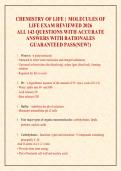
Master the foundational concepts of biology with this comprehensive study guide, "The Chemistry of Life: Molecules of Life." This essential resource breaks down complex topics into digestible Q&A flashcards, making it perfect for high school and introductory college biology students. CHEMISTRY OF LIFE | MOLECULES OF LIFE EXAM REVIEWED 2026 ALL 143 QUESTIONS WITH ACCURATE ANSWERS WITH RATIONALES GUARANTEED PASS(NEW!) 1. Water is: -a polar molecule - Attracted to other water molecules and charged substances - Universal solvent (does the dissolving), solute (gets dissolved), forming solution - Required for life to exist 2. Ph: - a logarithmic measure of the amount of H+ ions ( scale of 0-14) - Water: splits into H+ and OH- - Acid releases H+ - Base releases OH 3. Buffer: - stabilizes the ph of solutions - Maintains intracellular ph of cells 4. Four major types of organic macromolecules: carbohydrates, lipids, proteins, nucleic acids 5. Carbohydrates : functions, types and structures: • Compounds containing principally C, H, And O atoms in a 1:2:1 ratio • Provide short term energy • Part of bacterial cell wall and nucleic acids 6. Lipids : functions, types, and structures: - energy storage - Important in structure of all membranes - Non polar and hydrophobic 7. Chemistry: the study of matter and changes in matter caused by energy 8. Describe elements and atoms: an element is a substance that is composed of single type of atom and cannot be broken down by ordinary chemical reactions 9. An atom is: the basic unit of matter 10. Ionic bonds: - there is a transfer of electrons between atoms - The two resulting ions are held together by the attraction of their opposite charge 11. Covalent bonds: sharing of electrons between two atoms - Equal sharing is non polar covalent bond - Unequal sharing is polar covalent bond 12. Hydrogen bonds: - weak bond formed between hydrogen and negatively charged atom 13. Molecules: 2 or more atoms held together by chemical bonds 14. Compounds: atoms of different elements bonded together 15. Hydrophilic: water loving, soluble in water 16. Hydrophobic: water fearing, does not mix with h2o 17. Fatty acids: saturated and unsaturated 18. Saturated: fatty acid with no double bonds 19. Unsaturated (oils): fatty acid with one or more double bonds 20. Sterols: provide rigidity to cell membranes 21. Phospholipids: - essential part of cytoplasmic membranes 22. Lipid bilayer: polar heads oriented outward toward aqueous environments 23. Functions of protein: enzyme, catalysis, transport, signaling, regulation, motility, and support 24. Protein structure: chain of amino acids joined by peptide bonds 25. Dna: deoxyribonucleic acid, storage molecule for genetic instructions to carry out metabolism and reproduction 26. Rna: ribonucleic acid, expresses the information in dna 27. Nucleotide: Inside this PDF, you will explore the four major classes of organic macromolecules—carbohydrates, lipids, proteins, and nucleic acids—and their critical functions. Understand the unique properties of water, including its polarity and role as a universal solvent. Demystify chemical bonds (ionic, covalent, and hydrogen) and learn how buffers maintain pH balance in living organisms. From the structure of an atom to the function of enzymes as biological catalysts, this guide covers all the key terms and concepts needed to build a strong foundation in biochemistry and cell biology.

Content preview

CHEMISTRY OF LIFE | MOLECULES OF
LIFE EXAM REVIEWED 2026
ALL 143 QUESTIONS WITH ACCURATE
ANSWERS WITH RATIONALES
GUARANTEED PASS(NEW!)
1. Water is: -a polar molecule
- Attracted to other water molecules and charged substances
- Universal solvent (does the dissolving), solute (gets dissolved), forming
solution
- Required for life to exist

2. Ph: - a logarithmic measure of the amount of H+ ions ( scale of 0-14)
- Water: splits into H+ and OH-
- Acid releases H+
- Base releases OH

3. Buffer: - stabilizes the ph of solutions
- Maintains intracellular ph of cells

4. Four major types of organic macromolecules: carbohydrates, lipids,
proteins, nucleic acids

5. Carbohydrates : functions, types and structures: • Compounds containing
principally C, H,
And O atoms in a 1:2:1 ratio
• Provide short term energy
• Part of bacterial cell wall and nucleic acids

, 6. Lipids : functions, types, and structures: - energy storage
- Important in structure of all membranes
- Non polar and hydrophobic

7. Chemistry: the study of matter and changes in matter caused by energy

8. Describe elements and atoms: an element is a substance that is composed of
single type of atom and cannot be broken down by ordinary chemical
reactions

9. An atom is: the basic unit of matter

10. Ionic bonds: - there is a transfer of electrons between atoms
- The two resulting ions are held together by the attraction of their opposite
charge

11. Covalent bonds: sharing of electrons between two atoms
- Equal sharing is non polar covalent bond
- Unequal sharing is polar covalent bond

12. Hydrogen bonds: - weak bond formed between hydrogen and negatively
charged atom

13. Molecules: 2 or more atoms held together by chemical bonds

14. Compounds: atoms of different elements bonded together

15. Hydrophilic: water loving, soluble in water

Document information

Uploaded on
March 20, 2026
Number of pages
13
Written in
2025/2026
Type
Exam (elaborations)
Contains
Questions & answers
$12.49

Wrong document? Swap it for free Within 14 days of purchase and before downloading, you can choose a different document. You can simply spend the amount again.
Written by students who passed
Immediately available after payment
Read online or as PDF

Seller avatar
Reputation scores are based on the amount of documents a seller has sold for a fee and the reviews they have received for those documents. There are three levels: Bronze, Silver and Gold. The better the reputation, the more your can rely on the quality of the sellers work.
TutorGeoff
3.9
(14)
Sold
57
Followers
2
Items
637
Last sold
3 days ago


Why students choose Stuvia

Created by fellow students, verified by reviews

Quality you can trust: written by students who passed their tests and reviewed by others who've used these notes.

Didn't get what you expected? Choose another document

No worries! You can instantly pick a different document that better fits what you're looking for.

Pay as you like, start learning right away

No subscription, no commitments. Pay the way you're used to via credit card and download your PDF document instantly.

Student with book image

“Bought, downloaded, and aced it. It really can be that simple.”

Alisha Student

Working on your references?

Create accurate citations in APA, MLA and Harvard with our free citation generator.

Working on your references?

Frequently asked questions
