PHIL 347 Week 4 Checkpoint complete practice questions and answers for week
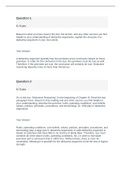
Question 1 5 / 5 pts Based on what you have read in the text, the lecture, and any other sources you find helpful to your understanding of deductive arguments, explain the structure of a deductive argument in your own words. Your Answer: A deductive argument typically has two premises and a conclusion based on those premises. In order for the conclusion to be true, the premises must be true as well. Therefore, if the premises are true, the conclusion will certainly be true. Deductive reasoning depends more on facts than inferences. Question 2 5 / 5 pts Go to the box “Deductive Reasoning” (in the beginning of Chapter 8). Read the last paragraph there. Based on that reading and any other sources you find helpful to your understanding, describe the part that “rules, operating conditions, core beliefs, values, policies, principles, procedures, and terminology” (p. 159) play in deductive arguments. Your Answer: Rules, operating conditions, core beliefs, values, policies, principles, procedures, and terminology play a large part in deductive arguments. A valid deductive argument is based on premises that have little to no chance of being false. Therefore, you must combine all of the above (rules, operating conditions, etc.) in order to formulate premises and a conclusion that is 100% true. Without these, there is room for uncertainty. Meaning it is possible for the deductive argument to fail the test of logical strength. Question 3 2 / 2 pts In the introduction to Chapter 8, the text sets forth a specific definition of the term “valid” as it applies to deductive arguments. What is that definition? Your Answer: The author to the textbook gives a specific definition of the term "valid" as it pertains to deductive arguments. According to the author, the term "valid", refers to an argument in which all of the premises are assumed to be true. Therefore, it is impossible for the conclusion to be false. Question 4 2 / 2 pts Use the following template to create a valid Denying the Consequent argument example: If_________________ then _______________ It is not the case that ______________________ Therefore, it is not the case that ________________ Your Answer: If the instructor is a fair instructor is a fair instructor, then I will leave a good rating for the instructor. It is not the case that the instructor I will leave a good rating for the instructor. Therefore, it is not the case that the instructor is a fair instructor. Question 5 2 / 2 pts Use the following template to create a valid Affirming the Antecedent argument example: If_______________ then____________ ________________________________ Therefore _______________________ Your Answer: If the instructor is a fair instructor, then I will leave a good rating. The instructor is a fair instructor. Therefore, I will leave a good rating.
Geschreven voor
- Instelling
-
American Public University
- Vak
-
PHIL 347
Documentinformatie
- Geüpload op
- 20 april 2021
- Aantal pagina's
- 10
- Geschreven in
- 2020/2021
- Type
- Tentamen (uitwerkingen)
- Bevat
- Onbekend
Onderwerpen
- the lecture
-
question 1 5 5 pts based on what you have read in the text
-
and any other sources you find helpful to your understanding of deductive arguments
-
explain the structure of a deductive arg

Ook beschikbaar in voordeelbundel