UNIT-I Introduction To Environmental
Studies
MEANING OF ENVIRONMENTAL STUDIES
The word “Environment” is originated from French environ means ‘around’ or ‘to surround’.
This means that environment includes things or objects or events that surround us.
NATURE OF ENVIRONMENTAL STUDIES
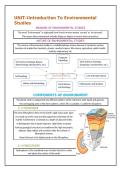
The science of Environment studies is a multidisciplinary science because it comprises various
branches of studies like chemistry, physics, medical science, life science, agriculture, public health.
sanitary engineering, etc.
Computer
Computer
Life Sciences (Zoology, Botany, Modelling
Modelling Earth Sciences (Geology,
Life Sciences (Zoology, Botany, Earth Sciences (Geology,
Biotechnology,
Biotechnology,Biochemistry,
Biochemistry, etc.)
etc.) Geography,
Geography,Geochemistry,
Geochemistry, etc.)
etc.)
Anthropology ENVIRONMENTAL STUDIES Law an
Anthropology ENVIRONMENTAL Law and Legal Aspects
STUDIES
History
Historyand
andArchaeology
Archaeology Social Science Mathematics and Statistics
Social Science Mathematics and Statistics
and
andSociology
Sociology
COMPONENTS OF ENVIRONMENT
The planet earth is categorized into different spheres which represent solid, liquid and gaseous.
The overlapping zone of the three spheres, where life is available, is called the biosphere.
1) LITHOSPHERE
The term lithosphere refers to the Earth’s rigid rocky outer layer.
It is made up of the crust and the uppermost solid layer of the
mantle. Furthermore, it extends to a depth of about 60 miles.
It disintegrates into a dozed separate, rigid blocks or plates.
Various geological structures or landforms like high mountains,
plateau, deep valleys and sea beds make the surface of
lithosphere uneven.
Mount Everest is the highest peak on the lithosphere.
2) HYDROSPHERE
hydrosphere is the combined mass of water found on, under
and above the surface of the earth.
, It has been estimated that there are 186 million cubic kilometers of water on earth.
This includes water in liquid and frozen forms in groundwater, oceans, lakes and streams.
Approximately 75% of Earth surface, an area of some 361 million square kilometers is covered by
ocean.
Water (H2O) on Earth
97% Saline Water 3
3% Fresh Water
(Ocean.
(Ocean, Sea)
Sea)
2%
2%Ice
IceCaps
Caps 1 (Rivers, Lake
1% Surface and Ground Water
(Glaciers) (Rivers, Lakes, Ponds, etc)
3) ATMOSPHERE
An atmosphere is a blanket of gases that surrounds
Earth.
4) TROPOSPHERE
Lowest layer
Temperature decreases with increase in altitude (-6.4
0C per km) in this layer).
The troposphere contains 75% of all air in the
atmosphere. Most clouds appear in this layer
because 99% of the water vapour in the atmosphere
if found here.
5) STRATOSPHERE
Above troposphere
Ozone layer
Ozone molecules in this layer absorb high-energy
ultraviolet (UV) light from the Sun and convert it into
heat.
6) MESOSPHERE
Above stratosphere
It extends to a height of about 85 km (53 miles) from
the ground.
The temperature grows colder as you rise up through
the mesosphere. The coldest parts of our
atmosphere are located in this layer and can reach -
90’C.
7) THERMOSPHERE
Studies
MEANING OF ENVIRONMENTAL STUDIES
The word “Environment” is originated from French environ means ‘around’ or ‘to surround’.
This means that environment includes things or objects or events that surround us.
NATURE OF ENVIRONMENTAL STUDIES
The science of Environment studies is a multidisciplinary science because it comprises various
branches of studies like chemistry, physics, medical science, life science, agriculture, public health.
sanitary engineering, etc.
Computer
Computer
Life Sciences (Zoology, Botany, Modelling
Modelling Earth Sciences (Geology,
Life Sciences (Zoology, Botany, Earth Sciences (Geology,
Biotechnology,
Biotechnology,Biochemistry,
Biochemistry, etc.)
etc.) Geography,
Geography,Geochemistry,
Geochemistry, etc.)
etc.)
Anthropology ENVIRONMENTAL STUDIES Law an
Anthropology ENVIRONMENTAL Law and Legal Aspects
STUDIES
History
Historyand
andArchaeology
Archaeology Social Science Mathematics and Statistics
Social Science Mathematics and Statistics
and
andSociology
Sociology
COMPONENTS OF ENVIRONMENT
The planet earth is categorized into different spheres which represent solid, liquid and gaseous.
The overlapping zone of the three spheres, where life is available, is called the biosphere.
1) LITHOSPHERE
The term lithosphere refers to the Earth’s rigid rocky outer layer.
It is made up of the crust and the uppermost solid layer of the
mantle. Furthermore, it extends to a depth of about 60 miles.
It disintegrates into a dozed separate, rigid blocks or plates.
Various geological structures or landforms like high mountains,
plateau, deep valleys and sea beds make the surface of
lithosphere uneven.
Mount Everest is the highest peak on the lithosphere.
2) HYDROSPHERE
hydrosphere is the combined mass of water found on, under
and above the surface of the earth.
, It has been estimated that there are 186 million cubic kilometers of water on earth.
This includes water in liquid and frozen forms in groundwater, oceans, lakes and streams.
Approximately 75% of Earth surface, an area of some 361 million square kilometers is covered by
ocean.
Water (H2O) on Earth
97% Saline Water 3
3% Fresh Water
(Ocean.
(Ocean, Sea)
Sea)
2%
2%Ice
IceCaps
Caps 1 (Rivers, Lake
1% Surface and Ground Water
(Glaciers) (Rivers, Lakes, Ponds, etc)
3) ATMOSPHERE
An atmosphere is a blanket of gases that surrounds
Earth.
4) TROPOSPHERE
Lowest layer
Temperature decreases with increase in altitude (-6.4
0C per km) in this layer).
The troposphere contains 75% of all air in the
atmosphere. Most clouds appear in this layer
because 99% of the water vapour in the atmosphere
if found here.
5) STRATOSPHERE
Above troposphere
Ozone layer
Ozone molecules in this layer absorb high-energy
ultraviolet (UV) light from the Sun and convert it into
heat.
6) MESOSPHERE
Above stratosphere
It extends to a height of about 85 km (53 miles) from
the ground.
The temperature grows colder as you rise up through
the mesosphere. The coldest parts of our
atmosphere are located in this layer and can reach -
90’C.
7) THERMOSPHERE