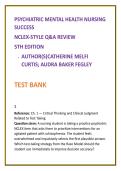
PSYCHIATRIC MENTAL HEALTH NURSING
SUCCESS
NCLEX-STYLE Q&A REVIEW
5TH EDITION
• AUTHOR(S)CATHERINE MELFI
CURTIS; AUDRA BAKER FEGLEY
TEST BANK
1
Reference: Ch. 1 — Critical Thinking and Clinical Judgment
Related to Test Taking
Question stem: A nursing student is taking a practice psychiatric
NCLEX item that asks them to prioritize interventions for an
agitated patient with schizophrenia. The student feels
overwhelmed and impulsively selects the first plausible answer.
Which test-taking strategy from the Race Model should the
student use immediately to improve decision accuracy?
,A. Answer quickly to finish more questions.
B. Re-read the stem and identify the risk before options.
C. Choose the option that seems most familiar from lectures.
D. Skip and return later without marking rationale.
Correct answer: B
Rationale — Correct: Re-reading the stem and identifying the
risk aligns with the Race Model’s emphasis on Recognize and
Analyze elements, focusing the student on safety priorities
before option comparison. This reduces impulsive selection and
improves clinical judgment.
Rationale — Incorrect A: Answering quickly increases
guesswork and reduces accuracy on application/analysis items.
Rationale — Incorrect C: Familiarity bias can cue recall errors
and does not ensure the safest or most appropriate
intervention.
Rationale — Incorrect D: Skipping without marking rationale
loses context and wastes cognitive resources on NGN style
items.
Teaching point: Identify safety risks in the stem before
comparing answers.
Citation: Curtis, C. M., & Fegley, A. B. (2023). Psychiatric Mental
Health Nursing Success: NCLEX-Style Q&A Review (5th ed.).
2
,Reference: Ch. 1 — Critical Thinking and Clinical Judgment
Related to Test Taking
Question stem: During a psychiatric clinical exam, a patient
says, “I can’t sleep and feel hopeless; I’ve thought about ending
it.” The nurse must respond while also preparing for an NGN
clinical-judgment style question. Which first action best reflects
clinical judgment and testing strategy?
A. Ask if the patient has access to means and a current plan.
B. Reassure the patient that feelings will pass and document
later.
C. Ignore question and immediately notify instructor.
D. Advise the patient to distract themselves with activities.
Correct answer: A
Rationale — Correct: Asking about access and a plan directly
assesses suicide risk — the highest priority for safety — and
aligns with CJMM recognition of risk; it’s the immediate clinical
action and correct cognitive approach for testing.
Rationale — Incorrect B: Reassurance without assessment is
unsafe and fails to identify imminent risk.
Rationale — Incorrect C: Notifying is appropriate after
assessment; immediate safety data must be gathered first.
Rationale — Incorrect D: Suggesting distraction without
assessment minimizes risk and is inappropriate.
Teaching point: Assess suicidal intent and means immediately
— safety first.
Citation: Curtis & Fegley (2023).
, 3
Reference: Ch. 1 — Critical Thinking and Clinical Judgment
Related to Test Taking
Question stem: A student sits a timed psychiatric exam and
encounters a complex NGN item requiring sequential steps.
They feel stuck. Which meta-cognitive strategy from the chapter
helps break the problem into manageable parts?
A. Use retrospective reflection after the test only.
B. Apply “If…then” questioning to outline actions.
C. Skip to shorter micro-items always first.
D. Trust first impression as final.
Correct answer: B
Rationale — Correct: The “If…then” inquisitive strategy breaks
scenarios into conditional steps, aiding analysis and planning
during NGN items and real clinical reasoning.
Rationale — Incorrect A: Retrospective reflection is valuable
but not helpful when actively solving an item.
Rationale — Incorrect C: Skipping may harm time management;
it’s better to decompose the difficult item.
Rationale — Incorrect D: Relying solely on first impressions
risks cognitive errors and misprioritization.
Teaching point: Use conditional (“If…then”) reasoning to
sequence care steps.
Citation: Curtis & Fegley (2023).
SUCCESS
NCLEX-STYLE Q&A REVIEW
5TH EDITION
• AUTHOR(S)CATHERINE MELFI
CURTIS; AUDRA BAKER FEGLEY
TEST BANK
1
Reference: Ch. 1 — Critical Thinking and Clinical Judgment
Related to Test Taking
Question stem: A nursing student is taking a practice psychiatric
NCLEX item that asks them to prioritize interventions for an
agitated patient with schizophrenia. The student feels
overwhelmed and impulsively selects the first plausible answer.
Which test-taking strategy from the Race Model should the
student use immediately to improve decision accuracy?
,A. Answer quickly to finish more questions.
B. Re-read the stem and identify the risk before options.
C. Choose the option that seems most familiar from lectures.
D. Skip and return later without marking rationale.
Correct answer: B
Rationale — Correct: Re-reading the stem and identifying the
risk aligns with the Race Model’s emphasis on Recognize and
Analyze elements, focusing the student on safety priorities
before option comparison. This reduces impulsive selection and
improves clinical judgment.
Rationale — Incorrect A: Answering quickly increases
guesswork and reduces accuracy on application/analysis items.
Rationale — Incorrect C: Familiarity bias can cue recall errors
and does not ensure the safest or most appropriate
intervention.
Rationale — Incorrect D: Skipping without marking rationale
loses context and wastes cognitive resources on NGN style
items.
Teaching point: Identify safety risks in the stem before
comparing answers.
Citation: Curtis, C. M., & Fegley, A. B. (2023). Psychiatric Mental
Health Nursing Success: NCLEX-Style Q&A Review (5th ed.).
2
,Reference: Ch. 1 — Critical Thinking and Clinical Judgment
Related to Test Taking
Question stem: During a psychiatric clinical exam, a patient
says, “I can’t sleep and feel hopeless; I’ve thought about ending
it.” The nurse must respond while also preparing for an NGN
clinical-judgment style question. Which first action best reflects
clinical judgment and testing strategy?
A. Ask if the patient has access to means and a current plan.
B. Reassure the patient that feelings will pass and document
later.
C. Ignore question and immediately notify instructor.
D. Advise the patient to distract themselves with activities.
Correct answer: A
Rationale — Correct: Asking about access and a plan directly
assesses suicide risk — the highest priority for safety — and
aligns with CJMM recognition of risk; it’s the immediate clinical
action and correct cognitive approach for testing.
Rationale — Incorrect B: Reassurance without assessment is
unsafe and fails to identify imminent risk.
Rationale — Incorrect C: Notifying is appropriate after
assessment; immediate safety data must be gathered first.
Rationale — Incorrect D: Suggesting distraction without
assessment minimizes risk and is inappropriate.
Teaching point: Assess suicidal intent and means immediately
— safety first.
Citation: Curtis & Fegley (2023).
, 3
Reference: Ch. 1 — Critical Thinking and Clinical Judgment
Related to Test Taking
Question stem: A student sits a timed psychiatric exam and
encounters a complex NGN item requiring sequential steps.
They feel stuck. Which meta-cognitive strategy from the chapter
helps break the problem into manageable parts?
A. Use retrospective reflection after the test only.
B. Apply “If…then” questioning to outline actions.
C. Skip to shorter micro-items always first.
D. Trust first impression as final.
Correct answer: B
Rationale — Correct: The “If…then” inquisitive strategy breaks
scenarios into conditional steps, aiding analysis and planning
during NGN items and real clinical reasoning.
Rationale — Incorrect A: Retrospective reflection is valuable
but not helpful when actively solving an item.
Rationale — Incorrect C: Skipping may harm time management;
it’s better to decompose the difficult item.
Rationale — Incorrect D: Relying solely on first impressions
risks cognitive errors and misprioritization.
Teaching point: Use conditional (“If…then”) reasoning to
sequence care steps.
Citation: Curtis & Fegley (2023).