

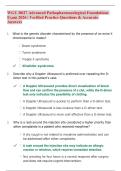
WGU D027 Advanced Pathopharmacological Foundations
Exam 2026 | Verified Practice Questions & Accurate
Answers
1. What is the genetic disorder characterized by the presence of an extra X
chromosome in males?
Down syndrome
Turner syndrome
Fragile X syndrome
Klinefelter syndrome
2. Describe why a Doppler Ultrasound is preferred over repeating the D-
dimer test in this patient's case.
A Doppler Ultrasound provides direct visualization of blood
flow and can confirm the presence of a clot, while the D-dimer
test only indicates the possibility of clotting.
A Doppler Ultrasound is quicker to perform than a D-dimer test.
A Doppler Ultrasound is less invasive than a D-dimer test.
A Doppler Ultrasound is more cost-effective than a D-dimer test.
3. Why is a rash around the injection site considered a higher priority than
other complaints in a patient who received morphine?
A dry cough is not related to morphine administration and can
be addressed after other complaints.
A rash around the injection site may indicate an allergic
reaction or infection, which requires immediate attention.
Not urinating for four hours is a normal response after surgery
and does not require urgent intervention.
, Not having a bowel movement for 36 hours is a common side
effect of morphine and can be managed later.
4. What is the primary concern for the 65-year-old man with dementia
who is one day post-operation of a transurethral resection of his
prostate?
Passing blood-tinged urine through his foley.
Having serosanguinous drainage from his JP drain.
Experiencing three loose stools over the past 12 hours.
Requesting pain medications every six hours.
5. A 58-year-old woman comes in complaining of retrosternal chest pain,
worsening with recumbent position. She states she has had a low-grade
fever for two days. Upon exam, the patient has a friction rub. An EKG
reveals sinus tachycardia with inflammatory changes. An ultrasound is
performed, and she is diagnosed with acute pericarditis. Which
condition would make pericarditis more likely in this patient?
Lupus
Asthma
Hypertension
Stroke
6. What is the primary concern for a patient who has received morphine
and presents with multiple complaints?
A dry cough off and on for the past hour
A rash around the injection site going up the left arm
Not having a bowel movement for the past 36 hours
Not urinating in the past four hours
, 7. A patient with COPD is experiencing increased shortness of breath after
starting a new medication. Which class of medication should the
healthcare provider review for potential adverse effects?
Diuretics
Beta blockers
Long-acting nitrates
Calcium channel blockers
8. What is the current source of insulin used in modern medical practice?
It is derived from porcine sources.
It is now synthetically made.
It is derived from bovine sources.
It is extracted from human pancreas.
9. A 60-year-old male patient with a history of lupus presents with chest
pain and a pericardial friction rub. What would be the most appropriate
initial nursing intervention?
Provide patient education on lifestyle changes.
Administer pain medication immediately.
Assess the patient's vital signs and cardiac status.
Schedule an echocardiogram without further assessment.
10. A priority assessment for a patient receiving an alpha or beta
adrenergic antagonists would include?
Heart rate
Respiratory rate
Urine output
Exam 2026 | Verified Practice Questions & Accurate
Answers
1. What is the genetic disorder characterized by the presence of an extra X
chromosome in males?
Down syndrome
Turner syndrome
Fragile X syndrome
Klinefelter syndrome
2. Describe why a Doppler Ultrasound is preferred over repeating the D-
dimer test in this patient's case.
A Doppler Ultrasound provides direct visualization of blood
flow and can confirm the presence of a clot, while the D-dimer
test only indicates the possibility of clotting.
A Doppler Ultrasound is quicker to perform than a D-dimer test.
A Doppler Ultrasound is less invasive than a D-dimer test.
A Doppler Ultrasound is more cost-effective than a D-dimer test.
3. Why is a rash around the injection site considered a higher priority than
other complaints in a patient who received morphine?
A dry cough is not related to morphine administration and can
be addressed after other complaints.
A rash around the injection site may indicate an allergic
reaction or infection, which requires immediate attention.
Not urinating for four hours is a normal response after surgery
and does not require urgent intervention.
, Not having a bowel movement for 36 hours is a common side
effect of morphine and can be managed later.
4. What is the primary concern for the 65-year-old man with dementia
who is one day post-operation of a transurethral resection of his
prostate?
Passing blood-tinged urine through his foley.
Having serosanguinous drainage from his JP drain.
Experiencing three loose stools over the past 12 hours.
Requesting pain medications every six hours.
5. A 58-year-old woman comes in complaining of retrosternal chest pain,
worsening with recumbent position. She states she has had a low-grade
fever for two days. Upon exam, the patient has a friction rub. An EKG
reveals sinus tachycardia with inflammatory changes. An ultrasound is
performed, and she is diagnosed with acute pericarditis. Which
condition would make pericarditis more likely in this patient?
Lupus
Asthma
Hypertension
Stroke
6. What is the primary concern for a patient who has received morphine
and presents with multiple complaints?
A dry cough off and on for the past hour
A rash around the injection site going up the left arm
Not having a bowel movement for the past 36 hours
Not urinating in the past four hours
, 7. A patient with COPD is experiencing increased shortness of breath after
starting a new medication. Which class of medication should the
healthcare provider review for potential adverse effects?
Diuretics
Beta blockers
Long-acting nitrates
Calcium channel blockers
8. What is the current source of insulin used in modern medical practice?
It is derived from porcine sources.
It is now synthetically made.
It is derived from bovine sources.
It is extracted from human pancreas.
9. A 60-year-old male patient with a history of lupus presents with chest
pain and a pericardial friction rub. What would be the most appropriate
initial nursing intervention?
Provide patient education on lifestyle changes.
Administer pain medication immediately.
Assess the patient's vital signs and cardiac status.
Schedule an echocardiogram without further assessment.
10. A priority assessment for a patient receiving an alpha or beta
adrenergic antagonists would include?
Heart rate
Respiratory rate
Urine output


