

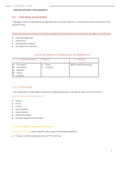
8.1 Individual personalities:
= Managers need to understand & manage behaviour of human resources – as they activate other org resources (fin,
physical & info)
Factors that determine behaviour & influence job performance & relationships with peers, managers & subordinates:
Unique backgrounds,
experiences,
characteristics needs &
perceptions of individuals
CONCEPTUAL APPROACH TO INDIVIDUALS IN THE ORGANISATION
1. Individual qualities 3.Output 2. Behaviour
Personality Talent MARS model of behaviour
Perceptions Creativity
Attitude
Values
Emotions
8.1.1 Personality:
= the combination of traits determining how an individual perceives, evaluates & reacts to his environment
FACTORS INFLUENCING PERSONALITY
Society
Family
Culture
External factors
Internal factors
Genetic hereditary
Personal experiences & attitudes
8.1.2 Workplace personality testing:
PERSONALITY TESTS = used to identify, select, appoint & promote employees
Purpose = identify individuals who will “fit” in with org
1
, ADVANATGES OF WORKPLACE PERSONALITY TESTS
Reduce risks
Eliminate bias
Diminish staff turnover
Attract new generations
Foster leaders
8.2 The Big Five personality dimensions (Barrick & Mount):
5 dimensions affect work-related behavioural outputs
Play crucial role in enabling individuals to develop skills & competencies they need to perform well
Influence behaviour of individuals in orgs & subsequently have a positive or negative influence on performance of
org as well
THE BIG 5 DIMENSIONS
1. Openness to experience
2. Conscientiousness
3. Extroversion
4. Agreeableness
5. Neuroticism (emotional stability)
1. OPENNESS TO EXPERIENCE
= People who have broad interests & willing to take risks
TRAITS
Sensitivity
Flexibility
Creativity
Broad-mindedness
Imagination
2. CONSCIENTIOUSNESS
Measure of reliability = people who are careful, organised, dependable & responsible
TRAITS
Greater will to achieve & perform
Perseverance
Working hard
Dimension most closely linked to job performance
2
= Managers need to understand & manage behaviour of human resources – as they activate other org resources (fin,
physical & info)
Factors that determine behaviour & influence job performance & relationships with peers, managers & subordinates:
Unique backgrounds,
experiences,
characteristics needs &
perceptions of individuals
CONCEPTUAL APPROACH TO INDIVIDUALS IN THE ORGANISATION
1. Individual qualities 3.Output 2. Behaviour
Personality Talent MARS model of behaviour
Perceptions Creativity
Attitude
Values
Emotions
8.1.1 Personality:
= the combination of traits determining how an individual perceives, evaluates & reacts to his environment
FACTORS INFLUENCING PERSONALITY
Society
Family
Culture
External factors
Internal factors
Genetic hereditary
Personal experiences & attitudes
8.1.2 Workplace personality testing:
PERSONALITY TESTS = used to identify, select, appoint & promote employees
Purpose = identify individuals who will “fit” in with org
1
, ADVANATGES OF WORKPLACE PERSONALITY TESTS
Reduce risks
Eliminate bias
Diminish staff turnover
Attract new generations
Foster leaders
8.2 The Big Five personality dimensions (Barrick & Mount):
5 dimensions affect work-related behavioural outputs
Play crucial role in enabling individuals to develop skills & competencies they need to perform well
Influence behaviour of individuals in orgs & subsequently have a positive or negative influence on performance of
org as well
THE BIG 5 DIMENSIONS
1. Openness to experience
2. Conscientiousness
3. Extroversion
4. Agreeableness
5. Neuroticism (emotional stability)
1. OPENNESS TO EXPERIENCE
= People who have broad interests & willing to take risks
TRAITS
Sensitivity
Flexibility
Creativity
Broad-mindedness
Imagination
2. CONSCIENTIOUSNESS
Measure of reliability = people who are careful, organised, dependable & responsible
TRAITS
Greater will to achieve & perform
Perseverance
Working hard
Dimension most closely linked to job performance
2


