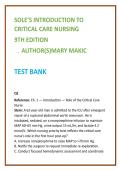
SOLE’S INTRODUCTION TO
CRITICAL CARE NURSING
9TH EDITION
• AUTHOR(S)MARY MAKIC
TEST BANK
Q1
Reference: Ch. 1 — Introduction — Role of the Critical Care
Nurse
Stem: A 62-year-old man is admitted to the ICU after emergent
repair of a ruptured abdominal aortic aneurysm. He is
intubated, sedated, on a norepinephrine infusion to maintain
MAP 60–65 mm Hg, urine output 15 mL/hr, and lactate 4.2
mmol/L. Which nursing priority best reflects the critical care
nurse’s role in the first hour post-op?
A. Increase norepinephrine to raise MAP to >70 mm Hg.
B. Notify the surgeon to request immediate re-exploration.
C. Conduct focused hemodynamic assessment and coordinate
,care with team.
D. Hold all IV fluids to avoid worsening edema.
Correct Answer: C
Rationale — Correct: The critical care nurse’s immediate role is
focused hemodynamic assessment (check CVP/monitoring,
trends, urine output, bleeding) and coordinating care
(collaborate with surgery, anesthesia). This aligns with rapid
recognition, safety, and collaborative planning for a critically ill
postoperative patient.
Rationale — Incorrect A: Automatically increasing vasopressor
without assessment may mask hypovolemia or ongoing
bleeding; priorities are assessment and team coordination.
Rationale — Incorrect B: Re-exploration is premature without
data indicating ongoing hemorrhage; nurse should first assess
and notify team with findings.
Rationale — Incorrect D: Holding fluids indiscriminately risks
worsening hypoperfusion given low urine output and elevated
lactate.
Teaching Point: Immediate structured assessment and team
coordination are the nurse’s top priorities after high-risk
surgery.
Citation: Makic, M. B. F. (2025). Sole’s Introduction to Critical
Care Nursing (9th ed.). Ch. 1.
Q2
,Reference: Ch. 1 — Critical Care Nursing — Quality and Safety
Emphasis
Stem: A quality review shows increased central line-associated
bloodstream infection (CLABSI) rates on one ICU shift. As the
charge nurse, which change to unit processes best aligns with
evidence-based safety emphasis?
A. Assign only senior nurses to insert all central lines.
B. Institute a standardized central line maintenance checklist
and audit compliance.
C. Increase antibiotic prophylaxis for all central line insertions.
D. Move all central line insertions to the ED.
Correct Answer: B
Rationale — Correct: Evidence supports standardized
maintenance bundles and audit/feedback to lower CLABSI rates.
The nurse’s role in quality and safety is implementing checklists,
monitoring compliance, and educating staff.
Rationale — Incorrect A: While experience matters, simply
assigning senior nurses ignores system factors and does not
standardize practice.
Rationale — Incorrect C: Routine antibiotic prophylaxis is not
recommended for central line maintenance and can increase
resistance.
Rationale — Incorrect D: Relocating insertions is a systems
change without evidence it reduces infections and may disrupt
continuity.
, Teaching Point: Standardized maintenance bundles plus audits
reduce CLABSI more reliably than ad hoc changes.
Citation: Makic, M. B. F. (2025). Sole’s Introduction to Critical
Care Nursing (9th ed.). Ch. 1.
Q3
Reference: Ch. 1 — Professional Organizations — Advocacy and
Standards
Stem: The ICU is revising policy on early mobility. Which action
best demonstrates the critical care nurse using professional
organization guidance to drive practice change?
A. Implement mobility exercises based on bedside nurse
preference.
B. Use current professional organization guidelines to design
unit protocol and staff training.
C. Require physical therapy only for patients extubated >48
hours.
D. Stop mobilizing patients until all physicians approve
individually.
Correct Answer: B
Rationale — Correct: Using professional organization guidance
to create protocols and training demonstrates evidence-based,
standardized practice aligned with quality initiatives. Nurses
lead translation of guidelines into local policy.
Rationale — Incorrect A: Bedside preference leads to variability
CRITICAL CARE NURSING
9TH EDITION
• AUTHOR(S)MARY MAKIC
TEST BANK
Q1
Reference: Ch. 1 — Introduction — Role of the Critical Care
Nurse
Stem: A 62-year-old man is admitted to the ICU after emergent
repair of a ruptured abdominal aortic aneurysm. He is
intubated, sedated, on a norepinephrine infusion to maintain
MAP 60–65 mm Hg, urine output 15 mL/hr, and lactate 4.2
mmol/L. Which nursing priority best reflects the critical care
nurse’s role in the first hour post-op?
A. Increase norepinephrine to raise MAP to >70 mm Hg.
B. Notify the surgeon to request immediate re-exploration.
C. Conduct focused hemodynamic assessment and coordinate
,care with team.
D. Hold all IV fluids to avoid worsening edema.
Correct Answer: C
Rationale — Correct: The critical care nurse’s immediate role is
focused hemodynamic assessment (check CVP/monitoring,
trends, urine output, bleeding) and coordinating care
(collaborate with surgery, anesthesia). This aligns with rapid
recognition, safety, and collaborative planning for a critically ill
postoperative patient.
Rationale — Incorrect A: Automatically increasing vasopressor
without assessment may mask hypovolemia or ongoing
bleeding; priorities are assessment and team coordination.
Rationale — Incorrect B: Re-exploration is premature without
data indicating ongoing hemorrhage; nurse should first assess
and notify team with findings.
Rationale — Incorrect D: Holding fluids indiscriminately risks
worsening hypoperfusion given low urine output and elevated
lactate.
Teaching Point: Immediate structured assessment and team
coordination are the nurse’s top priorities after high-risk
surgery.
Citation: Makic, M. B. F. (2025). Sole’s Introduction to Critical
Care Nursing (9th ed.). Ch. 1.
Q2
,Reference: Ch. 1 — Critical Care Nursing — Quality and Safety
Emphasis
Stem: A quality review shows increased central line-associated
bloodstream infection (CLABSI) rates on one ICU shift. As the
charge nurse, which change to unit processes best aligns with
evidence-based safety emphasis?
A. Assign only senior nurses to insert all central lines.
B. Institute a standardized central line maintenance checklist
and audit compliance.
C. Increase antibiotic prophylaxis for all central line insertions.
D. Move all central line insertions to the ED.
Correct Answer: B
Rationale — Correct: Evidence supports standardized
maintenance bundles and audit/feedback to lower CLABSI rates.
The nurse’s role in quality and safety is implementing checklists,
monitoring compliance, and educating staff.
Rationale — Incorrect A: While experience matters, simply
assigning senior nurses ignores system factors and does not
standardize practice.
Rationale — Incorrect C: Routine antibiotic prophylaxis is not
recommended for central line maintenance and can increase
resistance.
Rationale — Incorrect D: Relocating insertions is a systems
change without evidence it reduces infections and may disrupt
continuity.
, Teaching Point: Standardized maintenance bundles plus audits
reduce CLABSI more reliably than ad hoc changes.
Citation: Makic, M. B. F. (2025). Sole’s Introduction to Critical
Care Nursing (9th ed.). Ch. 1.
Q3
Reference: Ch. 1 — Professional Organizations — Advocacy and
Standards
Stem: The ICU is revising policy on early mobility. Which action
best demonstrates the critical care nurse using professional
organization guidance to drive practice change?
A. Implement mobility exercises based on bedside nurse
preference.
B. Use current professional organization guidelines to design
unit protocol and staff training.
C. Require physical therapy only for patients extubated >48
hours.
D. Stop mobilizing patients until all physicians approve
individually.
Correct Answer: B
Rationale — Correct: Using professional organization guidance
to create protocols and training demonstrates evidence-based,
standardized practice aligned with quality initiatives. Nurses
lead translation of guidelines into local policy.
Rationale — Incorrect A: Bedside preference leads to variability