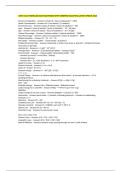
CHEM 1211 FORMULAS EXAM QUESTIONS WITH VERRIFIED SOLUTIONS LATEST UPDATE 2026
Percent Composition - Answers ( (mass X) / (mass compound) ) * 100%
Molar Concentration - Answers M = (mol solute) / (L solution)
Percent by mass - Answers ( (mass of solute) / (mass of solution) ) * 100
ppm - Answers ( (mass of solute) / (mass of solution) ) * 10 ^ (6) ppm
ppb - Answers ( (mass of solute) / (mass of solution) ) * 10 ^ (9) ppb
Volume Percentage - Answers ( (volume solute) / (volume solution) ) * 100%
Mass Percentage - Answers ( (mass of component) / (mass of solution) ) * 100%
Dilution Equation - Answers C1 * V1 = C2 * V2
Mol Solute - Answers g solute * ( (mol solute) / (g solute) )
Empirical Formula Mass - Answers (molecular or molar mass (amu or (g/mol) ) / (empirical formula
mass (amu or (g/mol) )
electron (e) - Answers e = 1.602 * 10^(-19) C
Average Mass - Answers = ∑ (fractional abundance * isotopic mass) i
Percent Yield - Answers = ( (actual yield) / (theoretical yield) ) * 100
- Answers q=c×m×ΔT =c×m×(Tfina −Tinitial)
- Answers ΔU=q+w
- Answers ΔH° = ∑ n × ΔH° (products) − ∑ n × ΔH° (reactants)
speed of a wave - Answers c=λν
Planck's Formula - Answers E = hν = hc/λ
where h = 6.626 × 10⁻³⁴ J s
Electron energy - Answers E = - (kZ^(2)) / (n^(2))
n = 1, 2, 3, ...
Formal Charge - Answers = # valence shell electrons (free atom) − # one pair electrons − 1/2 #
bonding electrons
Bond energy for a diatomic molecule - Answers XY(g) ⟶ X(g) + Y(g)
DX-Y = ΔH°
Enthalpy change - Answers ΔH = ƩDbonds broken - ƩDbonds formed
Lattice energy for a solid MX - Answers MX(s) ⟶ M^(n+) (g) + X^(n−) (g)
ΔHlattice
Lattice energy for an ionic crystal - Answers ΔHlattice = (C(Z+)(Z−)) / (Ro)
bond order - Answers bond order = ( (number of bonding electron) − (number of antibonding
electrons) ) / 2
Ideal Gas - Answers PV = nRT
Combined Gas Law - Answers (P1 V1) / T1 = (P2 V2) / T2
Ideal gas constant - Answers R = 0.08206 L atm mol ^(-1)K^(-1)
Boyle's Law - Answers P1 V1 = P2 V2
Amonton's Law - Answers (or Gay-Lussac's Law)
(P1) / (T1) = (P2) / (T2)
Charles's Law - Answers (V1) / (T1) = (V2) / (T2)
Avogadro's Law - Answers (V1) / (N1) = (V2) / (N2)
Rate of diffusion - Answers (amount of gas passing through an area) / (unit of time)
Percent Composition - Answers ( (mass X) / (mass compound) ) * 100%
Molar Concentration - Answers M = (mol solute) / (L solution)
Percent by mass - Answers ( (mass of solute) / (mass of solution) ) * 100
ppm - Answers ( (mass of solute) / (mass of solution) ) * 10 ^ (6) ppm
ppb - Answers ( (mass of solute) / (mass of solution) ) * 10 ^ (9) ppb
Volume Percentage - Answers ( (volume solute) / (volume solution) ) * 100%
Mass Percentage - Answers ( (mass of component) / (mass of solution) ) * 100%
Dilution Equation - Answers C1 * V1 = C2 * V2
Mol Solute - Answers g solute * ( (mol solute) / (g solute) )
Empirical Formula Mass - Answers (molecular or molar mass (amu or (g/mol) ) / (empirical formula
mass (amu or (g/mol) )
electron (e) - Answers e = 1.602 * 10^(-19) C
Average Mass - Answers = ∑ (fractional abundance * isotopic mass) i
Percent Yield - Answers = ( (actual yield) / (theoretical yield) ) * 100
- Answers q=c×m×ΔT =c×m×(Tfina −Tinitial)
- Answers ΔU=q+w
- Answers ΔH° = ∑ n × ΔH° (products) − ∑ n × ΔH° (reactants)
speed of a wave - Answers c=λν
Planck's Formula - Answers E = hν = hc/λ
where h = 6.626 × 10⁻³⁴ J s
Electron energy - Answers E = - (kZ^(2)) / (n^(2))
n = 1, 2, 3, ...
Formal Charge - Answers = # valence shell electrons (free atom) − # one pair electrons − 1/2 #
bonding electrons
Bond energy for a diatomic molecule - Answers XY(g) ⟶ X(g) + Y(g)
DX-Y = ΔH°
Enthalpy change - Answers ΔH = ƩDbonds broken - ƩDbonds formed
Lattice energy for a solid MX - Answers MX(s) ⟶ M^(n+) (g) + X^(n−) (g)
ΔHlattice
Lattice energy for an ionic crystal - Answers ΔHlattice = (C(Z+)(Z−)) / (Ro)
bond order - Answers bond order = ( (number of bonding electron) − (number of antibonding
electrons) ) / 2
Ideal Gas - Answers PV = nRT
Combined Gas Law - Answers (P1 V1) / T1 = (P2 V2) / T2
Ideal gas constant - Answers R = 0.08206 L atm mol ^(-1)K^(-1)
Boyle's Law - Answers P1 V1 = P2 V2
Amonton's Law - Answers (or Gay-Lussac's Law)
(P1) / (T1) = (P2) / (T2)
Charles's Law - Answers (V1) / (T1) = (V2) / (T2)
Avogadro's Law - Answers (V1) / (N1) = (V2) / (N2)
Rate of diffusion - Answers (amount of gas passing through an area) / (unit of time)