Producing Intellectual Property
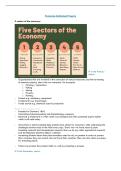
5 sectors of the economy:
IP in the Primary
sector:
- Organisations that are involved in the extraction of natural resources and the harvesting
of natural products, deal with raw materials. For example:
o Farming / Agriculture
o Fishing
o Mining
o Forestry
o Hunting
- Patents e.g. machinery, equipment
- Trademarks e.g. brand logos
- Trade secrets e.g. chemicals used in production
Bayer in the primary sector:
- Founded in Germany 1863
- International pharmaceutical and biotechnology company
- Received a trademark in 1904 which was stamped onto their patented aspirin tablet
which is still sold today
- Innovations in plant breeding help enable more choice for consumers while addressing the
challenges farmers face in the field every day. That’s why we invest more in plant
breeding research and development annually than we do any other agricultural research
and development platform (Bayer website).
- Increasing biotech means that plant breeders need to rely on patents in order to protect
their varieties, they can control who can farm their varieties. They can also claim a process
for breeding plants.
- Patent can protect the product itself, as well as protecting a process
IP in the Secondary sector:
, - Organisations which primarily deal with processing, manufacturing and construction, they
take products from the primary sector to create goods. For example:
o Manufacturing
o Construction
o Fabrication
o Assembly / production
o Distillation
o Filtration/Purification
- Patents e.g. machinery, materials
- Geographical indications e.g. types of food products
- Trademarks e.g. brands
- Design rights e.g. coke can
- Trade secrets e.g. coke recipe
Geographical indication:
- A geographical indication (GI) is a sign used on products that have a specific
geographical origin and possess qualities or a reputation that are due to that origin. In
order to function as a GI, a sign must identify a product as originating in a given place.
- A geographical indication right enables those who have the right to use the indication to
prevent its use by a third party whose product does not conform to the applicable
standards.
- However, a protected geographical indication does not enable the holder to prevent
someone from making a product using the same techniques as those set out in the
standards for that indication. Protection for a geographical indication is usually obtained
by acquiring a right over the sign that constitutes the indication (World Intellectual
Property Office).
- GI provides individuals with a stamp of authority over the patent
Examples:
- Moet champagne – comes from the champagne region in France due to the grapes being
produced there → only champagne from this region of France can be sold with that name
provided
o Cannot be produced in another country – grapes are grown in France
- Darjeeling Tea – leaves derived from the region in India
- Cognac – production and ageing conditions are recorded and regulated in the
specifications, which guarantee its originality and uniqueness (France)
- Parma Ham – the area of production is unique to the Province of Parma (Italy)
- Feta Cheese – milk used must exclusively come from particular Geek regions
IP in the Tertiary sector:
- Organisations that are involved in offering services including retail, banking and
entertainment, often referred to as the service sector. For example:
o Transport and distribution
o Tourism
o Insurance and financial services
o Healthcare
o Legal services
o Hospitality
o Beauty & Hairdressing
- Copyright e.g. music, film, theatre
- Design rights e.g. app design for ordering services
- Trademarks e.g. brands
5 sectors of the economy:
IP in the Primary
sector:
- Organisations that are involved in the extraction of natural resources and the harvesting
of natural products, deal with raw materials. For example:
o Farming / Agriculture
o Fishing
o Mining
o Forestry
o Hunting
- Patents e.g. machinery, equipment
- Trademarks e.g. brand logos
- Trade secrets e.g. chemicals used in production
Bayer in the primary sector:
- Founded in Germany 1863
- International pharmaceutical and biotechnology company
- Received a trademark in 1904 which was stamped onto their patented aspirin tablet
which is still sold today
- Innovations in plant breeding help enable more choice for consumers while addressing the
challenges farmers face in the field every day. That’s why we invest more in plant
breeding research and development annually than we do any other agricultural research
and development platform (Bayer website).
- Increasing biotech means that plant breeders need to rely on patents in order to protect
their varieties, they can control who can farm their varieties. They can also claim a process
for breeding plants.
- Patent can protect the product itself, as well as protecting a process
IP in the Secondary sector:
, - Organisations which primarily deal with processing, manufacturing and construction, they
take products from the primary sector to create goods. For example:
o Manufacturing
o Construction
o Fabrication
o Assembly / production
o Distillation
o Filtration/Purification
- Patents e.g. machinery, materials
- Geographical indications e.g. types of food products
- Trademarks e.g. brands
- Design rights e.g. coke can
- Trade secrets e.g. coke recipe
Geographical indication:
- A geographical indication (GI) is a sign used on products that have a specific
geographical origin and possess qualities or a reputation that are due to that origin. In
order to function as a GI, a sign must identify a product as originating in a given place.
- A geographical indication right enables those who have the right to use the indication to
prevent its use by a third party whose product does not conform to the applicable
standards.
- However, a protected geographical indication does not enable the holder to prevent
someone from making a product using the same techniques as those set out in the
standards for that indication. Protection for a geographical indication is usually obtained
by acquiring a right over the sign that constitutes the indication (World Intellectual
Property Office).
- GI provides individuals with a stamp of authority over the patent
Examples:
- Moet champagne – comes from the champagne region in France due to the grapes being
produced there → only champagne from this region of France can be sold with that name
provided
o Cannot be produced in another country – grapes are grown in France
- Darjeeling Tea – leaves derived from the region in India
- Cognac – production and ageing conditions are recorded and regulated in the
specifications, which guarantee its originality and uniqueness (France)
- Parma Ham – the area of production is unique to the Province of Parma (Italy)
- Feta Cheese – milk used must exclusively come from particular Geek regions
IP in the Tertiary sector:
- Organisations that are involved in offering services including retail, banking and
entertainment, often referred to as the service sector. For example:
o Transport and distribution
o Tourism
o Insurance and financial services
o Healthcare
o Legal services
o Hospitality
o Beauty & Hairdressing
- Copyright e.g. music, film, theatre
- Design rights e.g. app design for ordering services
- Trademarks e.g. brands