2 DERIVATIVES OF FUNCTIONS
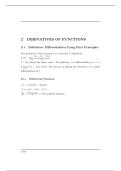
2.1 Definition: Differentiation Using First Principles
The derivative of the function f is a function f 0 defined by;
f (x + h) − f (x)
f 0 (x) = lim
h→0 h
∀ x for which this limit exists. The function f is differentiable at x = a
if lim f (x) = f (a) exists. The process of finding the derivative f 0 is called
x→a
differentiation of f .
2.1.1 Differential Notation:
4x = h(small − change)
4 y = f (x + 4x) − f (x)
4y f (x+h)−f (x)
4x
= h
⇒ The gradient function
2020
, If y = f (x),we often write
dy
dx
= f 0 (x)
Example
Apply the definition of the derivative directly to differentiate the function:
f (x) = x2
2020
2.1 Definition: Differentiation Using First Principles
The derivative of the function f is a function f 0 defined by;
f (x + h) − f (x)
f 0 (x) = lim
h→0 h
∀ x for which this limit exists. The function f is differentiable at x = a
if lim f (x) = f (a) exists. The process of finding the derivative f 0 is called
x→a
differentiation of f .
2.1.1 Differential Notation:
4x = h(small − change)
4 y = f (x + 4x) − f (x)
4y f (x+h)−f (x)
4x
= h
⇒ The gradient function
2020
, If y = f (x),we often write
dy
dx
= f 0 (x)
Example
Apply the definition of the derivative directly to differentiate the function:
f (x) = x2
2020