

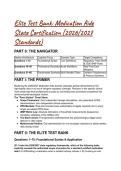
Elite Test Bank: Medication Aide
State Certification (2026/2027
Standards)
PART 0: THE NAVIGATOR
Section Architecture Cognitive Focus Scenario Type Target Competency
Questions 1–15 Foundational Syntax Core Definitions Regulatory "Hard Deck"
& 2026 ISMP Rules
Questions 16–40 Professional Simulation Acute Workflows Real-Time Error
Mitigation
Questions 41–66 Grandmaster Synthesis Multi-Variable Crises Geriatric Polypharmacy
& Protocol Synthesis
PART I: THE PRIMER
Mastering the 2026/2027 Medication Aide domain separates tactical administrators from
high-liability risks in an era of stringent regulatory oversight. Precision in this specific clinical
niche yields high-level professional success by converting basic procedural compliance into
advanced pharmacological intuition.
The "Panic Button" Cheat Sheet:
● Scope Parameters: Zero independent dosage calculations; zero parenteral (IV/IM)
administrations; zero independent clinical assessments.
● PRN Mandate: Real-time licensed nurse authorization is legally required prior to every
single as-needed (PRN) dose.
● ISMP Metric Law: Absolute elimination of household measurements (teaspoons);
mandatory utilization of the milliliter (mL).
● The Beers Axiom: First-generation antihistamines and anticholinergics trigger acute
delirium in older adults.
● Methotrexate Redline: Oral administration for non-oncologic indications is strictly weekly;
daily dosing is fatal.
PART II: THE ELITE TEST BANK
Questions 1–15: Foundational Syntax & Application
Q1: Under the 2026/2027 state regulatory frameworks, which of the following tasks
explicitly exceeds the authorized scope of practice for a standard certified medication
aide? A) Withholding a medication when a resident actively refuses it. B) Crushing an oral
,medication after receiving explicit licensed nurse authorization. C) Converting a prescriber's
weight-based order from milligrams per kilogram into a final administered volume. D) Applying a
physician-ordered topical medication to an intact epidermal surface.
● The Answer: C (Converting a prescriber's weight-based order from milligrams per
kilogram into a final administered volume.)
● Distractor Analysis: Options A, B, and D represent core, legally protected functions of
the medication aide. Option C requires advanced pharmacological mathematics and
clinical validation, which are illegal for an aide to perform independently.
● The Mentor's Analysis: The medication aide operates strictly under delegation for
concrete, non-variable tasks. Dosage calculation requires licensure and clinical
assessment capabilities. Performing mathematical conversions steps outside the legal
"Hard Deck," stripping the aide of all liability protections.
Q2: The "10 Rights of Medication Administration" serve as the absolute baseline for
clinical safety. Which action represents a direct, catastrophic violation of the "Right
Documentation" protocol? A) Signing the electronic medication administration record (eMAR)
immediately before handing the medication cup to the resident. B) Documenting a resident's
refusal to take a scheduled medication. C) Recording vital signs in the resident's chart prior to
administering a cardiac medication. D) Notifying the supervising nurse of an illegible pharmacy
label.
● The Answer: A (Signing the electronic medication administration record (eMAR)
immediately before handing the medication cup to the resident.)
● Distractor Analysis: Options B, C, and D are mandatory safety checkpoints. Option A is
a dangerous amateur trap known as "pre-charting."
● The Mentor's Analysis: The "Right Documentation" dictates that signing the eMAR must
occur only after visualizing the resident swallow the medication. Pre-charting constitutes
the falsification of medical records. If the resident subsequently drops the pill, aspirates,
or refuses the dose after the chart is signed, the legal record becomes a fraudulent
document.
Q3: According to the Institute for Safe Medication Practices (ISMP) 2026 Targeted
Medication Safety Best Practices, what is the mandatory standard for preparing and
administering oral liquid medications? A) Dispensing the liquid using standardized
household tablespoons to ensure patient familiarity. B) Dispensing and measuring the liquid
exclusively utilizing the metric milliliter (mL) unit of measure. C) Pouring the liquid into an
uncalibrated paper cup. D) Administering the medication based on visual estimation within a
dram-calibrated cup.
● The Answer: B (Dispensing and measuring the liquid exclusively utilizing the metric
milliliter (mL) unit of measure.)
● Distractor Analysis: Options A, C, and D rely on outdated, highly variable measurement
systems that are historically responsible for widespread pediatric and geriatric overdoses.
● The Mentor's Analysis: The ISMP unequivocally mandates the total elimination of
"teaspoon" and "tablespoon" nomenclature. A standard household spoon can vary in
volume by up to 50%. The milliliter is the absolute, non-negotiable metric standard for oral
liquid precision.
Q4: A resident with a percutaneous endoscopic gastrostomy (PEG) tube requires
scheduled medications. What is the operational standard for a standard medication aide
regarding enteral administration? A) Administer the medications provided they are finely
crushed and dissolved in sterile water. B) Administer the medications only after verifying tube
placement with a stethoscope. C) Withhold administration, as standard medication aides are
, universally prohibited from utilizing invasive gastrostomy tubes. D) Administer the medications
utilizing a gravity-drip syringe rather than a plunger push.
● The Answer: C (Withhold administration, as standard medication aides are universally
prohibited from utilizing invasive gastrostomy tubes.)
● Distractor Analysis: Options A, B, and D assume the aide possesses the legal authority
to utilize an invasive enteral device. Standard aides lack the training to assess gastric
residuals or verify visceral placement.
● The Mentor's Analysis: Administering via a PEG tube escalates the acuity of the
procedure. Failure to properly flush or verify placement can result in fatal aspiration
pneumonia or tube occlusion. Unless explicitly certified as an advanced aide with enteral
privileges, this is a non-negotiable physical boundary.
Q5: The pharmacodynamic principle of a medication's "half-life" dictates: A) The time
required for the body's hepatic and renal systems to eliminate 50% of the active drug from
systemic circulation. B) The expiration date of the medication after the manufacturer's seal is
broken. C) The exact time the medication reaches its peak therapeutic effect in the central
nervous system. D) The mandatory waiting period required between PRN dosages.
● The Answer: A (The time required for the body's hepatic and renal systems to eliminate
50% of the active drug from systemic circulation.)
● Distractor Analysis: Option B defines shelf-life. Option C defines peak onset time.
Option D is an administrative scheduling parameter, not a physiological measurement.
● The Mentor's Analysis: Understanding half-life allows the practitioner to anticipate drug
accumulation. In older adults with declining renal or hepatic function, a standard drug's
half-life stretches exponentially. This turns a normal maintenance dose into a toxic,
stacking accumulation, demanding heightened observational acuity from the aide.
Q6: A prescriber orders a sustained-release (SR) antihypertensive capsule. The resident
has difficulty swallowing and requests the capsule be opened and mixed into
applesauce. What is the physiological consequence of executing this request? A)
Enhanced therapeutic efficacy due to rapid gastric absorption. B) Immediate "dose dumping,"
leading to profound systemic toxicity, severe hypotension, and potential cardiovascular collapse.
C) Neutralization of the active pharmaceutical ingredient by the acidic applesauce. D) Slower
absorption, extending the duration of the drug's effect beyond 24 hours.
● The Answer: B (Immediate "dose dumping," leading to profound systemic toxicity, severe
hypotension, and potential cardiovascular collapse.)
● Distractor Analysis: Option A mislabels lethal toxicity as "efficacy." Option C is
chemically inaccurate. Option D is the exact opposite of the physical reality.
● The Mentor's Analysis: Sustained-release, extended-release, and enteric-coated
formulations rely on complex structural architecture to deploy drugs slowly over 12 to 24
hours. Crushing or opening this architecture destroys the time-release mechanism,
dumping a massive, unmitigated chemical load into the bloodstream instantly.
Q7: The term "polypharmacy" in the 2026/2027 geriatric care ecosystem is most
accurately defined as: A) The safe and highly effective use of multiple antibiotics to treat a
resistant systemic infection. B) The routine, concurrent use of multiple medications (typically five
or more), exponentially increasing the risk of adverse drug events and prescribing cascades. C)
The illicit diversion of controlled substances by licensed healthcare personnel. D) The
mathematical process of calculating creatinine clearance prior to dosing.
● The Answer: B (The routine, concurrent use of multiple medications (typically five or
more), exponentially increasing the risk of adverse drug events and prescribing
cascades.)
State Certification (2026/2027
Standards)
PART 0: THE NAVIGATOR
Section Architecture Cognitive Focus Scenario Type Target Competency
Questions 1–15 Foundational Syntax Core Definitions Regulatory "Hard Deck"
& 2026 ISMP Rules
Questions 16–40 Professional Simulation Acute Workflows Real-Time Error
Mitigation
Questions 41–66 Grandmaster Synthesis Multi-Variable Crises Geriatric Polypharmacy
& Protocol Synthesis
PART I: THE PRIMER
Mastering the 2026/2027 Medication Aide domain separates tactical administrators from
high-liability risks in an era of stringent regulatory oversight. Precision in this specific clinical
niche yields high-level professional success by converting basic procedural compliance into
advanced pharmacological intuition.
The "Panic Button" Cheat Sheet:
● Scope Parameters: Zero independent dosage calculations; zero parenteral (IV/IM)
administrations; zero independent clinical assessments.
● PRN Mandate: Real-time licensed nurse authorization is legally required prior to every
single as-needed (PRN) dose.
● ISMP Metric Law: Absolute elimination of household measurements (teaspoons);
mandatory utilization of the milliliter (mL).
● The Beers Axiom: First-generation antihistamines and anticholinergics trigger acute
delirium in older adults.
● Methotrexate Redline: Oral administration for non-oncologic indications is strictly weekly;
daily dosing is fatal.
PART II: THE ELITE TEST BANK
Questions 1–15: Foundational Syntax & Application
Q1: Under the 2026/2027 state regulatory frameworks, which of the following tasks
explicitly exceeds the authorized scope of practice for a standard certified medication
aide? A) Withholding a medication when a resident actively refuses it. B) Crushing an oral
,medication after receiving explicit licensed nurse authorization. C) Converting a prescriber's
weight-based order from milligrams per kilogram into a final administered volume. D) Applying a
physician-ordered topical medication to an intact epidermal surface.
● The Answer: C (Converting a prescriber's weight-based order from milligrams per
kilogram into a final administered volume.)
● Distractor Analysis: Options A, B, and D represent core, legally protected functions of
the medication aide. Option C requires advanced pharmacological mathematics and
clinical validation, which are illegal for an aide to perform independently.
● The Mentor's Analysis: The medication aide operates strictly under delegation for
concrete, non-variable tasks. Dosage calculation requires licensure and clinical
assessment capabilities. Performing mathematical conversions steps outside the legal
"Hard Deck," stripping the aide of all liability protections.
Q2: The "10 Rights of Medication Administration" serve as the absolute baseline for
clinical safety. Which action represents a direct, catastrophic violation of the "Right
Documentation" protocol? A) Signing the electronic medication administration record (eMAR)
immediately before handing the medication cup to the resident. B) Documenting a resident's
refusal to take a scheduled medication. C) Recording vital signs in the resident's chart prior to
administering a cardiac medication. D) Notifying the supervising nurse of an illegible pharmacy
label.
● The Answer: A (Signing the electronic medication administration record (eMAR)
immediately before handing the medication cup to the resident.)
● Distractor Analysis: Options B, C, and D are mandatory safety checkpoints. Option A is
a dangerous amateur trap known as "pre-charting."
● The Mentor's Analysis: The "Right Documentation" dictates that signing the eMAR must
occur only after visualizing the resident swallow the medication. Pre-charting constitutes
the falsification of medical records. If the resident subsequently drops the pill, aspirates,
or refuses the dose after the chart is signed, the legal record becomes a fraudulent
document.
Q3: According to the Institute for Safe Medication Practices (ISMP) 2026 Targeted
Medication Safety Best Practices, what is the mandatory standard for preparing and
administering oral liquid medications? A) Dispensing the liquid using standardized
household tablespoons to ensure patient familiarity. B) Dispensing and measuring the liquid
exclusively utilizing the metric milliliter (mL) unit of measure. C) Pouring the liquid into an
uncalibrated paper cup. D) Administering the medication based on visual estimation within a
dram-calibrated cup.
● The Answer: B (Dispensing and measuring the liquid exclusively utilizing the metric
milliliter (mL) unit of measure.)
● Distractor Analysis: Options A, C, and D rely on outdated, highly variable measurement
systems that are historically responsible for widespread pediatric and geriatric overdoses.
● The Mentor's Analysis: The ISMP unequivocally mandates the total elimination of
"teaspoon" and "tablespoon" nomenclature. A standard household spoon can vary in
volume by up to 50%. The milliliter is the absolute, non-negotiable metric standard for oral
liquid precision.
Q4: A resident with a percutaneous endoscopic gastrostomy (PEG) tube requires
scheduled medications. What is the operational standard for a standard medication aide
regarding enteral administration? A) Administer the medications provided they are finely
crushed and dissolved in sterile water. B) Administer the medications only after verifying tube
placement with a stethoscope. C) Withhold administration, as standard medication aides are
, universally prohibited from utilizing invasive gastrostomy tubes. D) Administer the medications
utilizing a gravity-drip syringe rather than a plunger push.
● The Answer: C (Withhold administration, as standard medication aides are universally
prohibited from utilizing invasive gastrostomy tubes.)
● Distractor Analysis: Options A, B, and D assume the aide possesses the legal authority
to utilize an invasive enteral device. Standard aides lack the training to assess gastric
residuals or verify visceral placement.
● The Mentor's Analysis: Administering via a PEG tube escalates the acuity of the
procedure. Failure to properly flush or verify placement can result in fatal aspiration
pneumonia or tube occlusion. Unless explicitly certified as an advanced aide with enteral
privileges, this is a non-negotiable physical boundary.
Q5: The pharmacodynamic principle of a medication's "half-life" dictates: A) The time
required for the body's hepatic and renal systems to eliminate 50% of the active drug from
systemic circulation. B) The expiration date of the medication after the manufacturer's seal is
broken. C) The exact time the medication reaches its peak therapeutic effect in the central
nervous system. D) The mandatory waiting period required between PRN dosages.
● The Answer: A (The time required for the body's hepatic and renal systems to eliminate
50% of the active drug from systemic circulation.)
● Distractor Analysis: Option B defines shelf-life. Option C defines peak onset time.
Option D is an administrative scheduling parameter, not a physiological measurement.
● The Mentor's Analysis: Understanding half-life allows the practitioner to anticipate drug
accumulation. In older adults with declining renal or hepatic function, a standard drug's
half-life stretches exponentially. This turns a normal maintenance dose into a toxic,
stacking accumulation, demanding heightened observational acuity from the aide.
Q6: A prescriber orders a sustained-release (SR) antihypertensive capsule. The resident
has difficulty swallowing and requests the capsule be opened and mixed into
applesauce. What is the physiological consequence of executing this request? A)
Enhanced therapeutic efficacy due to rapid gastric absorption. B) Immediate "dose dumping,"
leading to profound systemic toxicity, severe hypotension, and potential cardiovascular collapse.
C) Neutralization of the active pharmaceutical ingredient by the acidic applesauce. D) Slower
absorption, extending the duration of the drug's effect beyond 24 hours.
● The Answer: B (Immediate "dose dumping," leading to profound systemic toxicity, severe
hypotension, and potential cardiovascular collapse.)
● Distractor Analysis: Option A mislabels lethal toxicity as "efficacy." Option C is
chemically inaccurate. Option D is the exact opposite of the physical reality.
● The Mentor's Analysis: Sustained-release, extended-release, and enteric-coated
formulations rely on complex structural architecture to deploy drugs slowly over 12 to 24
hours. Crushing or opening this architecture destroys the time-release mechanism,
dumping a massive, unmitigated chemical load into the bloodstream instantly.
Q7: The term "polypharmacy" in the 2026/2027 geriatric care ecosystem is most
accurately defined as: A) The safe and highly effective use of multiple antibiotics to treat a
resistant systemic infection. B) The routine, concurrent use of multiple medications (typically five
or more), exponentially increasing the risk of adverse drug events and prescribing cascades. C)
The illicit diversion of controlled substances by licensed healthcare personnel. D) The
mathematical process of calculating creatinine clearance prior to dosing.
● The Answer: B (The routine, concurrent use of multiple medications (typically five or
more), exponentially increasing the risk of adverse drug events and prescribing
cascades.)


