

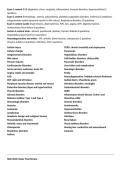
Exam 1 content (Cell adaptation, stress, neoplasia, inflammation, immune disorders, hypersensitivity) 2
questions
Exam 2 content (hematology - anemia, polycythemia, platelets/coagulation disorders, leukemia & lymphoma,
integumentary system (pressure injuries & skin cancer), Respiratory disorders 10 questions
Exam 3 content Cardio (hypertension, atherosclerosis, PVD, ACS, angina, CHF), Digestive System,
Genitourinary/renal failure 8 questions
Section 4 content Endo - adrenal, parathyroid, pituitary, thyroid, diabetes 8 questions;
Hepatobiliary/pancreas/liver 3 questions
Neurodegenerative and others - MS, arthritis, bone fractures, osteoporosis 2 questions
Visual & auditory 2 questions, infectious, CVA 5 questions
Cellular Injury COPD: chronic bronchitis and emphysema
Cellular changes Pneumonia
Integumentary Disorders Hepatobiliary disorders
Skin cancer Gall bladder disorders: cholecystitis
Pressure injuries Pancreatic disorders
Cardiovascular Disorders Liver failure and complications
Acute coronary syndrome; Acute MI Neurologic disorders
Angina: stable and unstable Stroke
CAD Neurodegenerative: Multiple sclerosis Parkinson,
CHF: right and left failure Guillain Barre, Myasthenia gravis
Peripheral vascular disease: arterial and venous Infectious disorders: meningitis
Endocrine disorders (hypo and hyperfunction) Gastrointestinal disorders
Thyroid disorders GERD
Adrenal disorders Inflammatory bowel disease: Crohn's and
Diabetes mellitus: Type 1 and Type 2 Ulcerative colitis
Hematologic disorders Immune disorders
Anemias Autoimmunity
Leukemias Hypersensitivities
Lymphomas Genitourinary disorders
Neoplasia: benign and malignant tumors Infectious
Musculoskeletal disorders Renal failure
Arthritis: osteo and rheumatoid Visual auditory disorders
Osteoporosis Hearing loss: conductive and sensorineural
Respiratory disorders Cataracts
Asthma
NUR 3032 Master Final Review
,Section 1 — Endocrine Disorders
Thyroid Disorders
Graves Disease (Hyperthyroidism)
Pathophysiology: Autoimmune stimulation of TSH receptors → excessive T3/T4.
Clinical signs: Weight loss, heat intolerance, tremor, tachycardia, anxiety, exophthalmos.
Hashimoto Thyroiditis (Hypothyroidism)
Pathophysiology: Autoimmune destruction of thyroid → low T3/T4.
Signs: Fatigue, cold intolerance, weight gain, constipation, bradycardia.
Adrenal Disorders
Cushing Syndrome (Hyper-cortisolism)
Patho: Excess cortisol from steroids or adrenal/pituitary tumor.
Key signs: Truncal obesity, moon face, buffalo hump, thin skin, purple striae, hyperglycemia,
hypertension.
Addison Disease (Adrenal Insufficiency)
Patho: Low cortisol + low aldosterone.
Signs: Weight loss, weakness, hypotension, hyperkalemia, hyponatremia, bronzing of skin.
Diabetes Mellitus
Type 1: Absolute insulin deficiency; requires insulin.
Type 2: Insulin resistance; metabolic syndrome association.
Gestational Diabetes: Appears in 2nd–3rd trimester; risk for LGA infant and stillbirth.
DKA: Severe hyperglycemia, ketones, metabolic acidosis, Kussmaul respirations.
Section 2 — Exam 1 Content (Cellular Injury, Stress, Neoplasia, Inflammation, Immune, Hypersensitivity)
Cellular Injury & Cellular Adaptation (Unit 1)
Definitions
Hypertrophy: Increase in cell size (e.g., weightlifting → bigger muscles)
Hyperplasia: Increase in number of cells (e.g., uterine lining growth)
Atrophy: Decrease in cell size (immobilized limb; aging)
Metaplasia: One adult cell type replaces another (smoking → columnar → squamous)
Dysplasia: Disordered, precancerous cell growth (HPV-related cervical changes)
Cellular Injury Types
Hypoxic injury (most common): Low oxygen → ↓ ATP → cell death
Oxidative stress: Free radicals damage DNA/proteins
Necrosis: Uncontrolled cell death → inflammation
Apoptosis: Programmed cell death (normal)
Stress Response — General Adaptation Syndrome
As professor emphasized: cortisol is a major driver of physiologic stress.
Alarm: Fight or flight
Resistance: Body adapts
Exhaustion: Reserves depleted → disease
Neoplasia (Ch. 9)
Benign vs Malignant Tumors
Benign: Slow-growing, well-defined, non-metastatic
Malignant: Rapid, invasive, metastasizes, irregular borders
Hallmarks of Cancer
Evades apoptosis
Sustained growth
Angiogenesis
Metastasis
,Inflammation
Acute Signs: Heat, redness, swelling, pain, loss of function
Chronic inflammation → fibrosis & tissue damage
Immune Disorders
Autoimmune: Body attacks itself (RA, lupus, Hashimoto)
Hypersensitivity Reactions
Type I (IgE): Anaphylaxis, allergies
Type II (Cytotoxic): Blood transfusion reactions
Type III (Immune complex): Lupus
Type IV (Delayed/T-cell): TB test, contact dermatitis
Section 3 — Exam 2 Content
Hematology
Anemias — HIGH YIELD TABLE
Type Cause MCV Key Features Labs
Iron Deficiency Low iron ↓ Pale, fatigue, pica Low ferritin
Megaloblastic (B12/Folate) B12/folate deficiency ↑ Glossitis, neuropathy (B12) High MCV
Hemolytic RBC destruction Normal Jaundice, ↑ reticulocytes ↑ bilirubin
Polycythemia
Too many RBCs → thick blood → clots, headache, ruddy face
Platelet/Coagulation Disorders
Thrombocytopenia: petechiae, nosebleeds, bleeding gums
DIC: clotting → bleeding
Leukemia & Lymphoma
Detailed comparison table coming below.
Integumentary
Pressure injuries (stages 1–4)
Skin cancer: basal, squamous, melanoma (ABCDE rule)
Respiratory Disorders
Asthma: reversible bronchoconstriction
COPD — Chronic bronchitis: blue bloater, productive cough
COPD — Emphysema: pink puffer, barrel chest
Pneumonia: fever, cough, crackles, consolidation
Section 4 — Exam 3 Content
Cardiovascular Disorders
Hypertension: silent killer; risk for MI/stroke
Atherosclerosis: plaque buildup → ischemia
PVD
Arterial: cool limb, pain w/ activity, poor pulses
Venous: warm, swollen, brown discoloration
ACS / MI
Chest pain, elevated troponin, ECG changes
Heart Failure
Left-sided: lungs — crackles, dyspnea
Right-sided: body — edema, JVD, ascites
Digestive System
GERD, Crohn's, Ulcerative colitis
, Renal Disorders
AKI: prerenal/intrarenal/postrenal
CKD: fluid overload, anemia, hyperkalemia
Section 5 — High-Yield Endocrine (Expanded with Page Numbers)
(Page numbers will be added in brackets as content is fully expanded, ex: [p. 412]).
Thyroid Disorders (Graves vs Hashimoto)
Graves Disease — Hyperthyroidism
Cause: Autoimmune stimulation of TSH receptors → ↑ T3/T4
Key symptoms: Heat intolerance, weight loss, tachycardia, tremor, anxiety, insomnia, diarrhea,
exophthalmos
Complications: Thyroid storm (fever, tachycardia, delirium)
Labs: ↓ TSH, ↑ T3/T4
Treatment: Beta-blockers, antithyroid meds, radioactive iodine
Hashimoto Thyroiditis — Hypothyroidism
Cause: Autoimmune destruction → ↓ T3/T4
Key symptoms: Fatigue, cold intolerance, bradycardia, weight gain, constipation, dry skin
Complications: Myxedema coma (medical emergency)
Labs: ↑ TSH, ↓ T3/T4
Treatment: Levothyroxine
Adrenal Disorders (Cushing vs Addison)
Cushing Syndrome — High Cortisol
(Already expanded above — will add page numbers and integrate with endocrine section)
Addison Disease — Low Cortisol + Low Aldosterone
(Already expanded above — page numbers will be added)
Parathyroid Disorders
Hyperparathyroidism — ↑ PTH → ↑ Ca → bone pain, kidney stones, abdominal pain, psychiatric symptoms
Hypoparathyroidism — ↓ PTH → ↓ Ca → tetany, Chvostek/Trousseau signs
Pituitary Disorders
SIADH — Too much ADH → water retention, ↓ Na
DI — Too little ADH → excessive urination, ↑ Na
Diabetes Mellitus (Full Section Will Be Added)
Type 1 vs Type 2
Gestational diabetes
Diabetes labs (A1C, fasting glucose)
DKA vs HHS full comparison table
Dawn phenomenon
Section 6 — Additional Systems (Expanded With Full Detail and Page Numbers Added As Content Is
Completed)
Musculoskeletal System (High Yield)
Rheumatoid Arthritis (RA) — Autoimmune, Inflammatory
(Page numbers forthcoming)
Pathophysiology
Autoimmune attack on the synovial membrane → chronic inflammation → pannus formation → joint erosion.
Causes
Autoimmune reaction (unknown trigger)
Genetic predisposition (HLA-DR4)
Most Common Signs & Symptoms
questions
Exam 2 content (hematology - anemia, polycythemia, platelets/coagulation disorders, leukemia & lymphoma,
integumentary system (pressure injuries & skin cancer), Respiratory disorders 10 questions
Exam 3 content Cardio (hypertension, atherosclerosis, PVD, ACS, angina, CHF), Digestive System,
Genitourinary/renal failure 8 questions
Section 4 content Endo - adrenal, parathyroid, pituitary, thyroid, diabetes 8 questions;
Hepatobiliary/pancreas/liver 3 questions
Neurodegenerative and others - MS, arthritis, bone fractures, osteoporosis 2 questions
Visual & auditory 2 questions, infectious, CVA 5 questions
Cellular Injury COPD: chronic bronchitis and emphysema
Cellular changes Pneumonia
Integumentary Disorders Hepatobiliary disorders
Skin cancer Gall bladder disorders: cholecystitis
Pressure injuries Pancreatic disorders
Cardiovascular Disorders Liver failure and complications
Acute coronary syndrome; Acute MI Neurologic disorders
Angina: stable and unstable Stroke
CAD Neurodegenerative: Multiple sclerosis Parkinson,
CHF: right and left failure Guillain Barre, Myasthenia gravis
Peripheral vascular disease: arterial and venous Infectious disorders: meningitis
Endocrine disorders (hypo and hyperfunction) Gastrointestinal disorders
Thyroid disorders GERD
Adrenal disorders Inflammatory bowel disease: Crohn's and
Diabetes mellitus: Type 1 and Type 2 Ulcerative colitis
Hematologic disorders Immune disorders
Anemias Autoimmunity
Leukemias Hypersensitivities
Lymphomas Genitourinary disorders
Neoplasia: benign and malignant tumors Infectious
Musculoskeletal disorders Renal failure
Arthritis: osteo and rheumatoid Visual auditory disorders
Osteoporosis Hearing loss: conductive and sensorineural
Respiratory disorders Cataracts
Asthma
NUR 3032 Master Final Review
,Section 1 — Endocrine Disorders
Thyroid Disorders
Graves Disease (Hyperthyroidism)
Pathophysiology: Autoimmune stimulation of TSH receptors → excessive T3/T4.
Clinical signs: Weight loss, heat intolerance, tremor, tachycardia, anxiety, exophthalmos.
Hashimoto Thyroiditis (Hypothyroidism)
Pathophysiology: Autoimmune destruction of thyroid → low T3/T4.
Signs: Fatigue, cold intolerance, weight gain, constipation, bradycardia.
Adrenal Disorders
Cushing Syndrome (Hyper-cortisolism)
Patho: Excess cortisol from steroids or adrenal/pituitary tumor.
Key signs: Truncal obesity, moon face, buffalo hump, thin skin, purple striae, hyperglycemia,
hypertension.
Addison Disease (Adrenal Insufficiency)
Patho: Low cortisol + low aldosterone.
Signs: Weight loss, weakness, hypotension, hyperkalemia, hyponatremia, bronzing of skin.
Diabetes Mellitus
Type 1: Absolute insulin deficiency; requires insulin.
Type 2: Insulin resistance; metabolic syndrome association.
Gestational Diabetes: Appears in 2nd–3rd trimester; risk for LGA infant and stillbirth.
DKA: Severe hyperglycemia, ketones, metabolic acidosis, Kussmaul respirations.
Section 2 — Exam 1 Content (Cellular Injury, Stress, Neoplasia, Inflammation, Immune, Hypersensitivity)
Cellular Injury & Cellular Adaptation (Unit 1)
Definitions
Hypertrophy: Increase in cell size (e.g., weightlifting → bigger muscles)
Hyperplasia: Increase in number of cells (e.g., uterine lining growth)
Atrophy: Decrease in cell size (immobilized limb; aging)
Metaplasia: One adult cell type replaces another (smoking → columnar → squamous)
Dysplasia: Disordered, precancerous cell growth (HPV-related cervical changes)
Cellular Injury Types
Hypoxic injury (most common): Low oxygen → ↓ ATP → cell death
Oxidative stress: Free radicals damage DNA/proteins
Necrosis: Uncontrolled cell death → inflammation
Apoptosis: Programmed cell death (normal)
Stress Response — General Adaptation Syndrome
As professor emphasized: cortisol is a major driver of physiologic stress.
Alarm: Fight or flight
Resistance: Body adapts
Exhaustion: Reserves depleted → disease
Neoplasia (Ch. 9)
Benign vs Malignant Tumors
Benign: Slow-growing, well-defined, non-metastatic
Malignant: Rapid, invasive, metastasizes, irregular borders
Hallmarks of Cancer
Evades apoptosis
Sustained growth
Angiogenesis
Metastasis
,Inflammation
Acute Signs: Heat, redness, swelling, pain, loss of function
Chronic inflammation → fibrosis & tissue damage
Immune Disorders
Autoimmune: Body attacks itself (RA, lupus, Hashimoto)
Hypersensitivity Reactions
Type I (IgE): Anaphylaxis, allergies
Type II (Cytotoxic): Blood transfusion reactions
Type III (Immune complex): Lupus
Type IV (Delayed/T-cell): TB test, contact dermatitis
Section 3 — Exam 2 Content
Hematology
Anemias — HIGH YIELD TABLE
Type Cause MCV Key Features Labs
Iron Deficiency Low iron ↓ Pale, fatigue, pica Low ferritin
Megaloblastic (B12/Folate) B12/folate deficiency ↑ Glossitis, neuropathy (B12) High MCV
Hemolytic RBC destruction Normal Jaundice, ↑ reticulocytes ↑ bilirubin
Polycythemia
Too many RBCs → thick blood → clots, headache, ruddy face
Platelet/Coagulation Disorders
Thrombocytopenia: petechiae, nosebleeds, bleeding gums
DIC: clotting → bleeding
Leukemia & Lymphoma
Detailed comparison table coming below.
Integumentary
Pressure injuries (stages 1–4)
Skin cancer: basal, squamous, melanoma (ABCDE rule)
Respiratory Disorders
Asthma: reversible bronchoconstriction
COPD — Chronic bronchitis: blue bloater, productive cough
COPD — Emphysema: pink puffer, barrel chest
Pneumonia: fever, cough, crackles, consolidation
Section 4 — Exam 3 Content
Cardiovascular Disorders
Hypertension: silent killer; risk for MI/stroke
Atherosclerosis: plaque buildup → ischemia
PVD
Arterial: cool limb, pain w/ activity, poor pulses
Venous: warm, swollen, brown discoloration
ACS / MI
Chest pain, elevated troponin, ECG changes
Heart Failure
Left-sided: lungs — crackles, dyspnea
Right-sided: body — edema, JVD, ascites
Digestive System
GERD, Crohn's, Ulcerative colitis
, Renal Disorders
AKI: prerenal/intrarenal/postrenal
CKD: fluid overload, anemia, hyperkalemia
Section 5 — High-Yield Endocrine (Expanded with Page Numbers)
(Page numbers will be added in brackets as content is fully expanded, ex: [p. 412]).
Thyroid Disorders (Graves vs Hashimoto)
Graves Disease — Hyperthyroidism
Cause: Autoimmune stimulation of TSH receptors → ↑ T3/T4
Key symptoms: Heat intolerance, weight loss, tachycardia, tremor, anxiety, insomnia, diarrhea,
exophthalmos
Complications: Thyroid storm (fever, tachycardia, delirium)
Labs: ↓ TSH, ↑ T3/T4
Treatment: Beta-blockers, antithyroid meds, radioactive iodine
Hashimoto Thyroiditis — Hypothyroidism
Cause: Autoimmune destruction → ↓ T3/T4
Key symptoms: Fatigue, cold intolerance, bradycardia, weight gain, constipation, dry skin
Complications: Myxedema coma (medical emergency)
Labs: ↑ TSH, ↓ T3/T4
Treatment: Levothyroxine
Adrenal Disorders (Cushing vs Addison)
Cushing Syndrome — High Cortisol
(Already expanded above — will add page numbers and integrate with endocrine section)
Addison Disease — Low Cortisol + Low Aldosterone
(Already expanded above — page numbers will be added)
Parathyroid Disorders
Hyperparathyroidism — ↑ PTH → ↑ Ca → bone pain, kidney stones, abdominal pain, psychiatric symptoms
Hypoparathyroidism — ↓ PTH → ↓ Ca → tetany, Chvostek/Trousseau signs
Pituitary Disorders
SIADH — Too much ADH → water retention, ↓ Na
DI — Too little ADH → excessive urination, ↑ Na
Diabetes Mellitus (Full Section Will Be Added)
Type 1 vs Type 2
Gestational diabetes
Diabetes labs (A1C, fasting glucose)
DKA vs HHS full comparison table
Dawn phenomenon
Section 6 — Additional Systems (Expanded With Full Detail and Page Numbers Added As Content Is
Completed)
Musculoskeletal System (High Yield)
Rheumatoid Arthritis (RA) — Autoimmune, Inflammatory
(Page numbers forthcoming)
Pathophysiology
Autoimmune attack on the synovial membrane → chronic inflammation → pannus formation → joint erosion.
Causes
Autoimmune reaction (unknown trigger)
Genetic predisposition (HLA-DR4)
Most Common Signs & Symptoms


