Electrolytes and Imbalances_ Key ConceptsElectrolytes
for Nursingand
Study
Imbalances_
Guide Key Concepts for Nursing Study Guide 2026-03-04
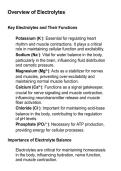
Overview of Electrolytes
Key Electrolytes and Their Functions
Potassium (K⁺): Essential for regulating heart
rhythm and muscle contractions. It plays a critical
role in maintaining cellular function and excitability.
Sodium (Na⁺): Vital for water balance in the body,
particularly in the brain, influencing fluid distribution
and osmotic pressure.
Magnesium (Mg²⁺): Acts as a stabilizer for nerves
and muscles, preventing over-excitability and
maintaining normal muscle function.
Calcium (Ca²⁺): Functions as a signal gatekeeper,
crucial for nerve signaling and muscle contraction,
influencing neurotransmitter release and muscle
fiber activation.
Chloride (Cl⁻): Important for maintaining acid-base
balance in the body, contributing to the regulation
of pH levels.
Phosphate (PO₄³⁻): Necessary for ATP production,
providing energy for cellular processes.
Importance of Electrolyte Balance
Electrolytes are critical for maintaining homeostasis
in the body, influencing hydration, nerve function,
and muscle contraction.
Page 1 Electrolytes and Imbalances_ Key Concepts for Nursing Study Guide.pdf
,Electrolytes and Imbalances_ Key ConceptsElectrolytes
for Nursingand
Study
Imbalances_
Guide Key Concepts for Nursing Study Guide 2026-03-04
Imbalances can lead to severe health issues,
including neurological symptoms, cardiac
dysrhythmias, and muscle dysfunction.
Regular monitoring of electrolyte levels is essential
in clinical settings, especially for patients with
underlying health conditions.
Electrolyte imbalances can arise from various
factors, including dehydration, kidney dysfunction,
and certain medications.
Understanding the role of each electrolyte helps in
diagnosing and treating related disorders
effectively.
Case studies show that timely correction of
electrolyte imbalances can prevent serious
complications.
Hyponatremia and Hypernatremia
Hyponatremia
Normal Function: Sodium is crucial for water
balance and preventing brain swelling.
Pathophysiology: Low sodium levels lead to
water influx into brain cells, causing cerebral
edema.
Symptoms: Include headache, confusion,
seizures, nausea, and decreased level of
consciousness (LOC).
Page 2 Electrolytes and Imbalances_ Key Concepts for Nursing Study Guide.pdf
, Electrolytes and Imbalances_ Key ConceptsElectrolytes
for Nursingand
Study
Imbalances_
Guide Key Concepts for Nursing Study Guide 2026-03-04
Mechanism: Dilution of sodium causes swelling of
brain cells, leading to neurological symptoms.
Primary Concerns: Focus on neuro checks,
seizure precautions, and gradual sodium correction
to avoid osmotic demyelination.
Illustration: Diagram showing the movement of
water into brain cells during hyponatremia.
Hypernatremia
Normal Function: Sodium regulates water
balance and prevents brain swelling.
Pathophysiology: High sodium levels draw water
out of cells, leading to dehydration.
Symptoms: Include thirst, restlessness, irritability,
dry mucosa, and neurological changes.
Mechanism: Brain cells shrink due to water loss,
resulting in neurological symptoms.
Page 3 Electrolytes and Imbalances_ Key Concepts for Nursing Study Guide.pdf
for Nursingand
Study
Imbalances_
Guide Key Concepts for Nursing Study Guide 2026-03-04
Overview of Electrolytes
Key Electrolytes and Their Functions
Potassium (K⁺): Essential for regulating heart
rhythm and muscle contractions. It plays a critical
role in maintaining cellular function and excitability.
Sodium (Na⁺): Vital for water balance in the body,
particularly in the brain, influencing fluid distribution
and osmotic pressure.
Magnesium (Mg²⁺): Acts as a stabilizer for nerves
and muscles, preventing over-excitability and
maintaining normal muscle function.
Calcium (Ca²⁺): Functions as a signal gatekeeper,
crucial for nerve signaling and muscle contraction,
influencing neurotransmitter release and muscle
fiber activation.
Chloride (Cl⁻): Important for maintaining acid-base
balance in the body, contributing to the regulation
of pH levels.
Phosphate (PO₄³⁻): Necessary for ATP production,
providing energy for cellular processes.
Importance of Electrolyte Balance
Electrolytes are critical for maintaining homeostasis
in the body, influencing hydration, nerve function,
and muscle contraction.
Page 1 Electrolytes and Imbalances_ Key Concepts for Nursing Study Guide.pdf
,Electrolytes and Imbalances_ Key ConceptsElectrolytes
for Nursingand
Study
Imbalances_
Guide Key Concepts for Nursing Study Guide 2026-03-04
Imbalances can lead to severe health issues,
including neurological symptoms, cardiac
dysrhythmias, and muscle dysfunction.
Regular monitoring of electrolyte levels is essential
in clinical settings, especially for patients with
underlying health conditions.
Electrolyte imbalances can arise from various
factors, including dehydration, kidney dysfunction,
and certain medications.
Understanding the role of each electrolyte helps in
diagnosing and treating related disorders
effectively.
Case studies show that timely correction of
electrolyte imbalances can prevent serious
complications.
Hyponatremia and Hypernatremia
Hyponatremia
Normal Function: Sodium is crucial for water
balance and preventing brain swelling.
Pathophysiology: Low sodium levels lead to
water influx into brain cells, causing cerebral
edema.
Symptoms: Include headache, confusion,
seizures, nausea, and decreased level of
consciousness (LOC).
Page 2 Electrolytes and Imbalances_ Key Concepts for Nursing Study Guide.pdf
, Electrolytes and Imbalances_ Key ConceptsElectrolytes
for Nursingand
Study
Imbalances_
Guide Key Concepts for Nursing Study Guide 2026-03-04
Mechanism: Dilution of sodium causes swelling of
brain cells, leading to neurological symptoms.
Primary Concerns: Focus on neuro checks,
seizure precautions, and gradual sodium correction
to avoid osmotic demyelination.
Illustration: Diagram showing the movement of
water into brain cells during hyponatremia.
Hypernatremia
Normal Function: Sodium regulates water
balance and prevents brain swelling.
Pathophysiology: High sodium levels draw water
out of cells, leading to dehydration.
Symptoms: Include thirst, restlessness, irritability,
dry mucosa, and neurological changes.
Mechanism: Brain cells shrink due to water loss,
resulting in neurological symptoms.
Page 3 Electrolytes and Imbalances_ Key Concepts for Nursing Study Guide.pdf