24th October 2019
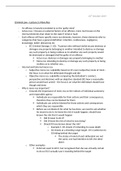
Criminal Law – Lecture 5: Mens Rea
- An offence is loosely translated to as the ‘guilty mind’
- Actus reus = focuses on external factors of an offence, mens rea focuses on the
internal elements that relate to the state if mind or fault
- Each offence will have specific mens rea elements; however, these elements refer to
categories that have a general definition: intention, recklessness, negligence,
knowledge, belief, dishonesty etc
o EG Criminal Damage, S 1(1): “A person who without lawful excuse destroys or
damages any property belonging to another intended to destroy or damage
any such property or being reckless as to whether any such property would
be destroyed or damaged shall be guilty of an offence
Actus reus: destroys or damages any property belonging to another
Mens rea: intending to destroy or damage any such property or being
reckless as to whether any…
- Internal and External mens rea:
o Subjective mens rea: culpability based on D’s own (subjective) state of mind –
the focus is on what the defendant thought and did
o Objective mens rea: culpability comparing the defendant’s conduct,
perspective and decisions with an objective standard (EG how a reasonable
person would have acted) – the focus is on what the defendant should have
though and done
- Why is mens rea important?
o Grounds the importance of mens rea on the notions of individual autonomy
and responsible agency
Individuals are responsible for their actions and their consequences,
therefore they can be blamed for them
Individuals can only be blamed for those actions and consequences
which they are responsible
Before we can blame D for what he has done, we need to ask whether
he meant to do it; he knew the risk it would happen; should have
known the risk that it would happen
Did D mean to do it?
Did D know the risk of what he was doing?
Should D have known about the risk?
o Example 1: D1 shoots V1 intending to cause death
o D2 shoots at a shooting range target. V2 is (unknown to
D) hiding behind the target
The states of mind of each defendant are not
the same, one had intention to kill, the other
didn’t
o Other examples:
D did not want to kill V, but recognised that she was virtually certain
to do so EG D actually saw V standing behind the target
Criminal Law – Lecture 5: Mens Rea
- An offence is loosely translated to as the ‘guilty mind’
- Actus reus = focuses on external factors of an offence, mens rea focuses on the
internal elements that relate to the state if mind or fault
- Each offence will have specific mens rea elements; however, these elements refer to
categories that have a general definition: intention, recklessness, negligence,
knowledge, belief, dishonesty etc
o EG Criminal Damage, S 1(1): “A person who without lawful excuse destroys or
damages any property belonging to another intended to destroy or damage
any such property or being reckless as to whether any such property would
be destroyed or damaged shall be guilty of an offence
Actus reus: destroys or damages any property belonging to another
Mens rea: intending to destroy or damage any such property or being
reckless as to whether any…
- Internal and External mens rea:
o Subjective mens rea: culpability based on D’s own (subjective) state of mind –
the focus is on what the defendant thought and did
o Objective mens rea: culpability comparing the defendant’s conduct,
perspective and decisions with an objective standard (EG how a reasonable
person would have acted) – the focus is on what the defendant should have
though and done
- Why is mens rea important?
o Grounds the importance of mens rea on the notions of individual autonomy
and responsible agency
Individuals are responsible for their actions and their consequences,
therefore they can be blamed for them
Individuals can only be blamed for those actions and consequences
which they are responsible
Before we can blame D for what he has done, we need to ask whether
he meant to do it; he knew the risk it would happen; should have
known the risk that it would happen
Did D mean to do it?
Did D know the risk of what he was doing?
Should D have known about the risk?
o Example 1: D1 shoots V1 intending to cause death
o D2 shoots at a shooting range target. V2 is (unknown to
D) hiding behind the target
The states of mind of each defendant are not
the same, one had intention to kill, the other
didn’t
o Other examples:
D did not want to kill V, but recognised that she was virtually certain
to do so EG D actually saw V standing behind the target