Separation and purification –
Pure substances and mixtures
- The word 'pure' is used in chemistry in a different way from its everyday meaning.
For example, shops sell cartons labelled as 'pure' orange juice. The label means that
the contents are just orange juice, with no other substances added. However, the
juice is not pure in the chemical sense, because it contains different substances
mixed together. In chemistry:
a pure substance consists only of one element or one compound
a mixture consists of two or more different substances, not chemically joined together
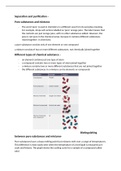
Different types of chemical substance –
- an element contains just one type of atom
- a compound contains two or more types of atom joined together
- a mixture contains two or more different substances that are not joined together
- the different substances in a mixture can be elements or compounds
Distinguishing
between pure substances and mixtures-
Pure substances have a sharp melting point but mixtures melt over a range of temperatures.
This difference is most easily seen when the temperature of a hot liquid is measured as it
cools and freezes. The graph shows the cooling curve for a sample of a compound called
salol.
, The temperature stays the same
while a pure substance changes
state
The horizontal part of the graph
shows that the salol has a sharp
melting point, so it is pure. Impure
salol (a mixture of salol and other
substances) would produce a
gradual decrease over a range of
temperatures as it freezes.
The temperature changes
slightly as an impure substance
changes state
Filtration and
crystallisation
Filtration
Filtration is used to separate
an insoluble solid from a liquid.
It is useful for separating sand
from a mixture of sand and
water, or excess reactant from
a solution.
Filtration works because the
filter paper has tiny holes, or
pores, in it. These are large enough to let small molecules and dissolved ions through, but
not the much larger particles of undissolved solid.
Pure substances and mixtures
- The word 'pure' is used in chemistry in a different way from its everyday meaning.
For example, shops sell cartons labelled as 'pure' orange juice. The label means that
the contents are just orange juice, with no other substances added. However, the
juice is not pure in the chemical sense, because it contains different substances
mixed together. In chemistry:
a pure substance consists only of one element or one compound
a mixture consists of two or more different substances, not chemically joined together
Different types of chemical substance –
- an element contains just one type of atom
- a compound contains two or more types of atom joined together
- a mixture contains two or more different substances that are not joined together
- the different substances in a mixture can be elements or compounds
Distinguishing
between pure substances and mixtures-
Pure substances have a sharp melting point but mixtures melt over a range of temperatures.
This difference is most easily seen when the temperature of a hot liquid is measured as it
cools and freezes. The graph shows the cooling curve for a sample of a compound called
salol.
, The temperature stays the same
while a pure substance changes
state
The horizontal part of the graph
shows that the salol has a sharp
melting point, so it is pure. Impure
salol (a mixture of salol and other
substances) would produce a
gradual decrease over a range of
temperatures as it freezes.
The temperature changes
slightly as an impure substance
changes state
Filtration and
crystallisation
Filtration
Filtration is used to separate
an insoluble solid from a liquid.
It is useful for separating sand
from a mixture of sand and
water, or excess reactant from
a solution.
Filtration works because the
filter paper has tiny holes, or
pores, in it. These are large enough to let small molecules and dissolved ions through, but
not the much larger particles of undissolved solid.