

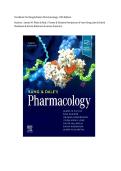
Test Bank For Rang & Dale's Pharmacology, 10th Edition
Authors : James M. Ritter & Rod J. Flower & Graeme Henderson & Yoon Kong Loke & David
MacEwan & Emma Robinson & James Fullerton
, Chapter 1: What is Pharmacology?
Rang & Dale’s Pharmacology, 10th Edition – Comprehensive Question Bank
PART I: Multiple-Choice Questions (1–40)
1. Pharmacology is best defined as:
A. The study of medicines used only in hospitals
B. The study of drug preparation and dispensing
C. The science of substances that interact with living systems through chemical processes
D. The study of disease mechanisms only
ANS: C
Rationale:
Pharmacology is the science of substances that interact with living systems via chemical
processes, especially by binding to regulatory molecules and modifying function.
• A is incorrect: Pharmacology is not limited to hospital medicines.
• B describes pharmacy practice.
• D describes pathology.
2. Pharmacodynamics primarily deals with:
A. Drug absorption and metabolism
B. What the body does to the drug
C. What the drug does to the body
D. Drug elimination pathways
ANS: C
Rationale:
Pharmacodynamics studies mechanisms of drug action and drug effects.
• A, B, and D relate to pharmacokinetics (ADME processes).
3. Pharmacokinetics focuses on:
, A. Drug–receptor interactions
B. Drug movement through the body
C. Toxic effects of chemicals
D. Drug pricing
ANS: B
Rationale:
Pharmacokinetics describes absorption, distribution, metabolism, and excretion (ADME).
• A is pharmacodynamics.
• C is toxicology.
• D is health economics.
4. Toxicology is primarily concerned with:
A. Therapeutic drug use
B. Adverse effects of chemicals
C. Drug marketing
D. Drug naming systems
ANS: B
Rationale:
Toxicology studies harmful effects of chemicals and drugs.
• A is therapeutics.
• C and D are unrelated.
5. Clinical pharmacology bridges pharmacology and:
A. Molecular biology
B. Therapeutics and patient care
C. Veterinary science
D. Drug manufacturing
ANS: B
Rationale:
Clinical pharmacology applies pharmacological principles to patient treatment.
6. Translational medicine refers to:
, A. Converting drugs into different languages
B. Applying laboratory findings to clinical practice
C. Drug distribution logistics
D. Reformulating old drugs
ANS: B
Rationale:
Translational medicine moves discoveries from bench to bedside.
7. Which is NOT a natural source of drugs?
A. Plants
B. Microorganisms
C. Synthetic chemical processes
D. Animals
ANS: C
Rationale:
Synthetic drugs are artificially produced, not naturally sourced.
8. Biotechnology-derived drugs are commonly:
A. Small inorganic salts
B. Large protein molecules
C. Simple alcohols
D. Mineral compounds
ANS: B
Rationale:
Biotech drugs (e.g., monoclonal antibodies) are usually proteins.
9. A chemical name describes:
A. The brand identity
B. The molecular structure
C. The marketing classification
D. The therapeutic group
ANS: B
Authors : James M. Ritter & Rod J. Flower & Graeme Henderson & Yoon Kong Loke & David
MacEwan & Emma Robinson & James Fullerton
, Chapter 1: What is Pharmacology?
Rang & Dale’s Pharmacology, 10th Edition – Comprehensive Question Bank
PART I: Multiple-Choice Questions (1–40)
1. Pharmacology is best defined as:
A. The study of medicines used only in hospitals
B. The study of drug preparation and dispensing
C. The science of substances that interact with living systems through chemical processes
D. The study of disease mechanisms only
ANS: C
Rationale:
Pharmacology is the science of substances that interact with living systems via chemical
processes, especially by binding to regulatory molecules and modifying function.
• A is incorrect: Pharmacology is not limited to hospital medicines.
• B describes pharmacy practice.
• D describes pathology.
2. Pharmacodynamics primarily deals with:
A. Drug absorption and metabolism
B. What the body does to the drug
C. What the drug does to the body
D. Drug elimination pathways
ANS: C
Rationale:
Pharmacodynamics studies mechanisms of drug action and drug effects.
• A, B, and D relate to pharmacokinetics (ADME processes).
3. Pharmacokinetics focuses on:
, A. Drug–receptor interactions
B. Drug movement through the body
C. Toxic effects of chemicals
D. Drug pricing
ANS: B
Rationale:
Pharmacokinetics describes absorption, distribution, metabolism, and excretion (ADME).
• A is pharmacodynamics.
• C is toxicology.
• D is health economics.
4. Toxicology is primarily concerned with:
A. Therapeutic drug use
B. Adverse effects of chemicals
C. Drug marketing
D. Drug naming systems
ANS: B
Rationale:
Toxicology studies harmful effects of chemicals and drugs.
• A is therapeutics.
• C and D are unrelated.
5. Clinical pharmacology bridges pharmacology and:
A. Molecular biology
B. Therapeutics and patient care
C. Veterinary science
D. Drug manufacturing
ANS: B
Rationale:
Clinical pharmacology applies pharmacological principles to patient treatment.
6. Translational medicine refers to:
, A. Converting drugs into different languages
B. Applying laboratory findings to clinical practice
C. Drug distribution logistics
D. Reformulating old drugs
ANS: B
Rationale:
Translational medicine moves discoveries from bench to bedside.
7. Which is NOT a natural source of drugs?
A. Plants
B. Microorganisms
C. Synthetic chemical processes
D. Animals
ANS: C
Rationale:
Synthetic drugs are artificially produced, not naturally sourced.
8. Biotechnology-derived drugs are commonly:
A. Small inorganic salts
B. Large protein molecules
C. Simple alcohols
D. Mineral compounds
ANS: B
Rationale:
Biotech drugs (e.g., monoclonal antibodies) are usually proteins.
9. A chemical name describes:
A. The brand identity
B. The molecular structure
C. The marketing classification
D. The therapeutic group
ANS: B


