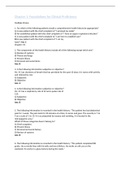
Mental HESI 5.Questions and Answers
Mental HESI 5.Questions and Answers 1. A male client is admitted to the mental health unit because he was feeling depressed about the loss of his wife and job. The client has a history of alcohol dependency and admits that he was drinking alcohol 12 hours ago. His temperature is 100.0 F, pulse is 100, and blood pressure is 142/100. The nurse plans to give the client lorazepam (Ativan) based on which priority nursing diagnosis? a. Risk for injury related to suicidal ideation. b. Risk for injury related to alcohol detoxification. c. Knowledge deficit related to ineffective coping. d. Health seeking behaviors related to personal crisis. The most important nursing diagnosis is related to alcohol detoxification (B) because the client has elevated vital signs, a sign of alcohol detoxification. Maintaining client safety related to suicidal ideation (A) should be addressed after giving the client Ativan for elevated vital signs secondary to alcohol withdrawal. The client's knowledge deficit and health seeking behaviors (C and D) can be addressed when immediate needs for safety are met. 2. A nurse working in the emergency room of a children's hospital admits a child whose injuries could have resulted from abuse. Which statement most accurately describes the nurse's responsibility in cases of suspected child abuse? a. Obtain objective data such as x-rays before reporting suspicions. b. Confirm suspicions of abuse with the physician. c. Report any case of suspected child abuse. d. Document injuries to confirm suspected abuse. It is the nurse's legal responsibility to report all suspected cases of child abuse (C), and notifying the nurse manager or charge nurse starts the legal reporting process. (A, B, and D) delay the first step in reporting the abuse. 3. A child is brought to the emergency room with a broken arm. Because of other injuries, the nurse suspects the child may be a victim of abuse. When the nurse tries to give the child an injection, the child's mother becomes very loud and shouts, "I won't leave my son! Don't you touch him! You'll hurt my child!" What is the best interpretation of the mother's statements? a. She is regressing to an earlier behavior pattern. b. She is sublimating her anger. c. She is projecting her feelings onto the nurse. d. She is suppressing her fear. Projection is attributing one's own thoughts, impulses, or behaviors onto another--it is the mother who is probably harming the child and she is attributing her actions to the nurse (C). The mother may be immature, but regression (A) is not the best description of her behavior. Sublimation (B) is substituting a socially acceptable feeling for an unacceptable one. These are not socially acceptable feelings. The mother may be suppressing her fear (D) by displaying anger, but such an interpretation cannot be concluded from the data presented. 4. A client, who is on a 30-day commitment to a drug rehabilitation unit, asks the nurse if he can go for a walk on the grounds of the treatment center. When he is told that his privileges do not include walking on the grounds, the client becomes verbally abusive. Which approach should the nurse take? a. Ask the staff to escort the client to his room. b. Have the client ask his physician to change his privileges. c. Remind the client of the importance of following the rules. d. Disregard the client's inappropriate verbal outburst. The client is trying to engage the nurse in a dispute. Ignoring the behavior (D) provides no reinforcement for the inappropriate behavior. (A) is not necessary unless the client becomes a physical threat to the nurse. It is inappropriate to delegate the situation to the physician (B) and is not in keeping with good health team management. Consistent limits must be established and enforced. (C) would subject the nurse to more verbal abuse. The client could use any response as an excuse to attack the nurse once again. 5. A client who is known to abuse drugs is admitted to the psychiatric unit. Which medication should the nurse anticipate administering to a client who is exhibiting benzodiazepine withdrawal symptoms? a. Perphenazine (Trilafon). b. Diphenylhydramine (Benadryl). c. Chlordiazepoxide (Librium). d. Isocarboxazid (Marplan). Librium (C), an antianxiety drug, as well as other benzodiazepines, are used for benzodiazepine withdrawal. (A) is an antipsychotic agent. (B) is an antihistamine and antianxiety drug. (D) is an MAO inhibitor. 6. A client is receiving substitution therapy during withdrawal from benzodiazepines. Which expected outcome statement has the highest priority when planning nursing care? a. Client will not demonstrate cross addiction. b. Co-dependent behaviors will be decreased. c. Excessive CNS stimulation will be reduced. d. Client's level of consciousness will increase. Substitution therapy with another CNS depressant is intended to decrease the excessive CNS stimulation that can occur during benzodiazepine withdrawal (C). (A, B, and D) are all appropriate outcome statements for the client described, but do not have the priority of (C). 7. A 45-year-old female client is admitted to the psychiatric unit for evaluation. Her husband states that she has been reluctant to leave home for the last six months. The client has not gone to work for a month and has been terminated from her job. She has not left the house since that time. This client is displaying symptoms of which disorder? a. Claustrophobia. b. Acrophobia. c. Agoraphobia. d. Necrophobia. Agoraphobia (C) is the fear of crowds or being in an open place. Claustrophobia (A) is the fear of being in closed places. Acrophobia (B) is the fear of high places. Necrophobia is an abnormal fear of death or bodies after death (D). A phobia is an unrealistic fear associated with severe anxiety. 8. A 19-year-old female client with a diagnosis of anorexia nervosa wants to help serve dinner trays to other clients on a psychiatric unit. What action should the nurse take? a. Encourage the client's self motivation by asking her to pass trays for the rest of the week. b. Provide an additional challenge by asking the client to help feed the older clients. c. Suggest another way for this client to participate in the unit's activities. d. Tell the client that hospital guidelines allow only staff to pass the trays. Clients with anorexia gain pleasure from providing others with food and watching them eat. Such behaviors reinforce their perception of self-control. These clients should not be allowed to plan or prepare food for unit activities and their desires to do so should be redirected (C). (A and B) are contraindicated for a client with anorexia nervosa. (D) avoids addressing the problem, so it is best to suggest another activity for the client. 9. A female client with depression attends a group and states that she sometimes misses her medication appointments because she feels very anxious about riding the bus. Which statement is the nurse's best response? a. "Can your case manager take you to your appointments?" b. "Take your medication for anxiety before you ride the bus." c. "Let's talk about what happens when you feel very anxious." d. "What are some ways that you can cope with your anxiety?" The best response is to explore ways for the client to cope with anxiety (D). The nurse should encourage problem-solving rather than dependence on the case manager (A) for transportation. Strategies for coping with anxiety should be encouraged before suggesting medication (B). Talking about anxious feelings (C) is therapeutic, but the best response is an open-ended question to explore ways to cope with the anxiety. 10. A woman brings her 48-year-old husband to the outpatient psychiatric unit and describes his behavior to the admitting nurse. She states that he has been sleepwalking, cannot remember who he is, and exhibits multiple personalities. The nurse knows that these behaviors are often associated with which condition? a. Dissociative disorder. b. Obsessive-compulsive disorder. c. Panic disorder. d. Post-traumatic stress syndrome. Sleepwalking, amnesia, and multiple personalities are examples of detaching emotional conflict from one's consciousness (A). (B) is characterized by persistent, recurrent intrusive thoughts or urges (obsessions) that are unwilled and cannot be ignored, and provoke impulsive acts (compulsions) such as handwashing. Panic (C) is an acute attack of anxiety characterized by personality disorganization. (D) is re-experiencing a psychologically terrifying or distressing event that is outside the usual range of human experience, such as war, rape, etc. .......CONTINUED
Written for
Document information
- Uploaded on
- April 10, 2021
- Number of pages
- 24
- Written in
- 2020/2021
- Type
- Exam (elaborations)
- Contains
- Questions & answers
Subjects
-
1 a male client is admitted to the mental health unit because he was feeling depressed about the loss of his wife and job the client has a history of alcohol dependency and admits that he was drinki